Scraper API
Amazon
amazon.sellerAvailable
Amazon seller
The seller's name, rating and feedback figures for the last 30 days, 90 days, 12 months and all time, its own description, and the business name, address and other business details Amazon publishes.
Give it a seller's id and marketplace, or the address of the seller's profile.
1 unit a run, for runs that return data. Runs that fail cost nothing. How units work
- Counted
- 1 unit a run
- Inputs
- 3
- Record
- 16 fields
- A run takes
- up to 5 minutes
- Records kept
- 7 days
- Measured
- its success, on the status page
POST/v1/scrapers/amazon.seller/runs
sent, and answered
a record of the run16 fields
ok1 unit a run
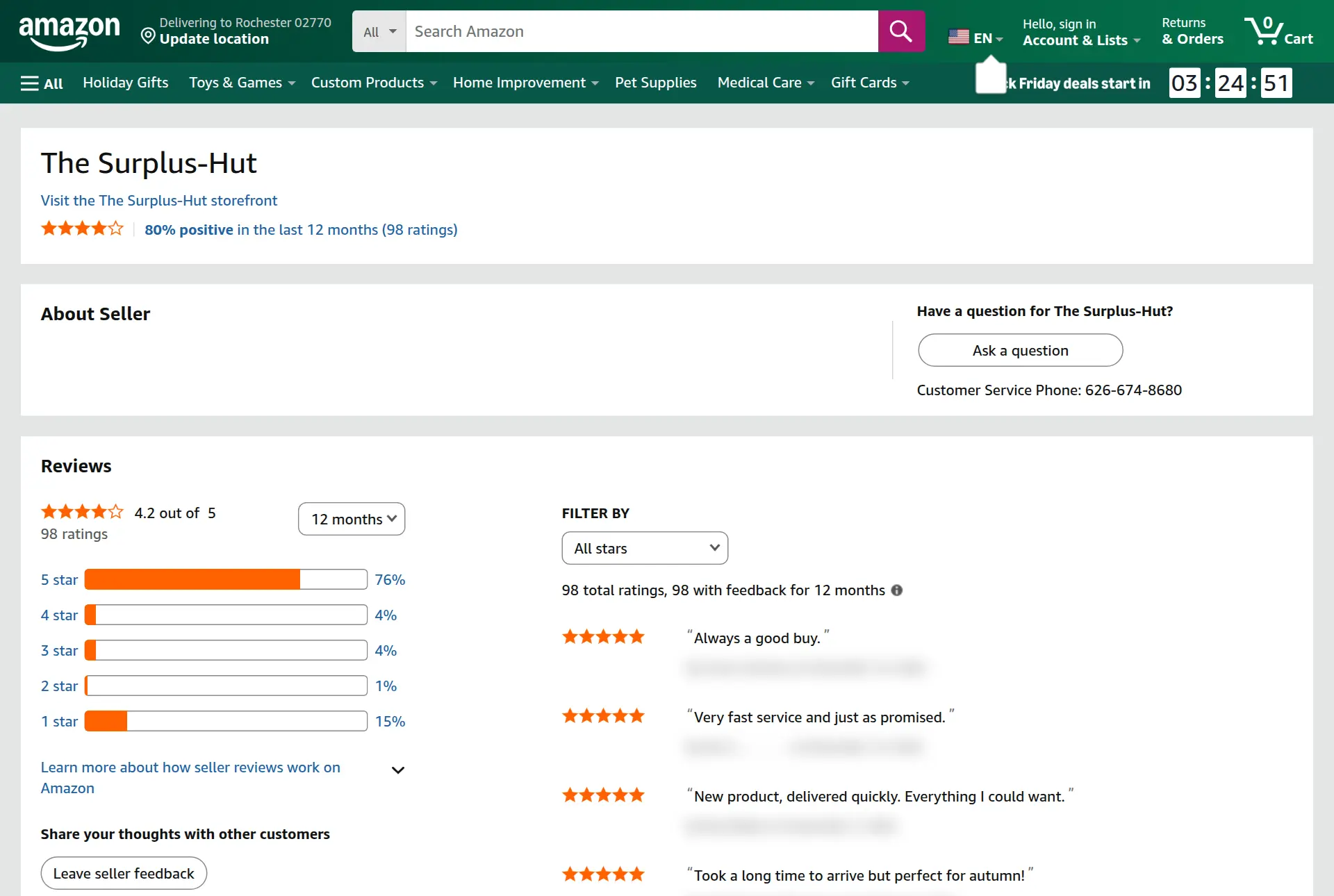
A record this scraper returned for this input. The first 9 of its 16 fields are set down here; the whole record is below.
What it is used for
- Check who a seller is
- A seller's profile: its trading name, business name and address, its rating, the share of positive ratings and how they changed over time.
- Vet a supplier or partner
- Read
rating_count,positive_percentandratings_by_periodbefore you work with a seller or buy from one at volume. - Follow up on your listings
- Take the seller ids from the offers on your products and read each profile, to know which business you are dealing with.
What you send
A seller's id and marketplace, or the address of the seller's profile. These are its 3 inputs, as its schema has them.
seller_idstring One of the two- Amazon's id of the seller: the seller_id of an amazon.product or amazon.offers record.
urlstring One of the two- The address of the seller's profile instead; it names its own marketplace.
marketplacestring Optional- With a seller id: the marketplace's code, such as us, uk, de or jp. us unless you say otherwise.
A request, ready to send
It starts a run with the input shown at the top of this page, waits up to 60 seconds for it, and reads its records. Put your key in the variable it reads.
# Start a run and wait up to 60 seconds for it to finish
curl -X POST "https://api.enrichednow.com/v1/scrapers/amazon.seller/runs?wait=60" \
  -H "Authorization: Bearer $ENRICHEDNOW_API_KEY" \
  -H "Content-Type: application/json" \
  -d '{"input":{"seller_id":"A3M71O3D0PGOID"}}'

# Read its records, with the id the first call answered
curl "https://api.enrichednow.com/v1/runs/$RUN_ID/records?limit=100" \
  -H "Authorization: Bearer $ENRICHEDNOW_API_KEY"
from enrichednow import EnrichedNow
client = EnrichedNow() # reads ENRICHEDNOW_API_KEY
# Start a run, wait for it to end, and get its records
result = client.scrape("amazon.seller", {"seller_id": "A3M71O3D0PGOID"})
print(result.run.id, result.run.status, result.run.record_count)
# Read its records: pages are fetched as you go
for record in result.records:
print(record)Install it with pip install enrichednow, then save as run.py and run python3 run.py
import EnrichedNow from "enrichednow";

const client = new EnrichedNow(); // reads ENRICHEDNOW_API_KEY

// Start a run, wait for it to end, and get its records
const { run, records } = await client.scrape("amazon.seller", { seller_id: "A3M71O3D0PGOID" });
console.log(run.id, run.status, run.record_count);

// Read its records: pages are fetched as you go
for await (const record of records) console.log(record);
Install it with npm install enrichednow, then save as run.mjs and run node run.mjs
package main

import (
	"context"
	"fmt"
	"log"
	"time"

	enrichednow "github.com/enrichednow/enrichednow-go"
)

func main() {
	client, err := enrichednow.NewClient() // reads ENRICHEDNOW_API_KEY
	if err != nil {
		log.Fatal(err)
	}
	ctx, cancel := context.WithTimeout(context.Background(), 10*time.Minute)
	defer cancel()

	// Start a run, wait for it to end, and get its records
	run, records, err := client.Scrape(ctx, "amazon.seller", map[string]any{"seller_id": "A3M71O3D0PGOID"})
	if err != nil {
		log.Fatal(err)
	}
	fmt.Println(run.ID, run.Status, run.RecordCount)

	// Read its records: pages are fetched as you go
	for records.Next() {
		fmt.Println(string(records.Current()))
	}
	if err := records.Err(); err != nil {
		log.Fatal(err)
	}
}
Install it with go get github.com/enrichednow/enrichednow-go@latest, then save as run.go and run go run run.go
import com.enrichednow.EnrichedNowClient;
import com.enrichednow.ScrapeResult;
import java.util.Map;

public class Run {
    public static void main(String[] args) {
        EnrichedNowClient client = EnrichedNowClient.fromEnv(); // reads ENRICHEDNOW_API_KEY

        // Start a run, wait for it to end, and get its records
        ScrapeResult result = client.scrape("amazon.seller", Map.of("seller_id", "A3M71O3D0PGOID"));
        System.out.println(result.run().id() + " " + result.run().status() + " " + result.run().recordCount());

        // Read its records: pages are fetched as you go
        for (Map<String, Object> record : result.records()) {
            System.out.println(record);
        }
    }
}
Add com.enrichednow:enrichednow-java:0.4.0 to your Maven or Gradle build, then save as Run.java
enrichednow run amazon.seller --input seller_id=A3M71O3D0PGOIDInstall it with curl -fsSL https://raw.githubusercontent.com/enrichednow/enrichednow-cli/main/install.sh | sh
What comes back
The seller's name, rating and feedback figures for the last 30 days, 90 days, 12 months and all time, its own description, and the business name, address and other business details Amazon publishes. A record has 16 fields. One we could not read is null, never an empty string or a zero.
{
  "seller_id": "A3M71O3D0PGOID",
  "marketplace": "amazon.com",
  "url": "https://www.amazon.com/sp?seller=A3M71O3D0PGOID",
  "name": "The Surplus-Hut",
  "business_name": "circus link inc",
  "business_address": [
    "2132 S GROVE AVE STE N",
    "ONTARIO",
    "CA"
  ],
  "business_details": [],
  "rating": 4,
  "positive_percent": 80,
  "rating_count": 98,
  "ratings_by_period": [
    {
      "period": "30_days",
      "rating": 5,
      "count": 6
    },
    {
      "period": "90_days",
      "rating": 4.4,
      "count": 24
    }
  ],
  "star_percentages": {
    "1": 5,
    "2": 1,
    "3": 3,
    "4": 8,
    "5": 82
  },
  "about": null,
  "logo": null,
  "storefront_url": "https://www.amazon.com/s?me=A3M71O3D0PGOID",
  "fetched_at": "2026-11-19T18:07:38.370766Z"
}
The scraper returned this record for the input above, reading a saved copy of the page, not the live site.
Values shortened for this page: business_address: 5 items, the first 3 shown; ratings_by_period: 4 items, the first 2 shown.
The fields of a record
seller_idstring- Amazon's id of the seller.
marketplacestring- The marketplace the profile was read on, e.g. amazon.com, amazon.co.uk, amazon.de, amazon.co.jp.
urlstring- The profile's address.
namestring- The seller's name on Amazon.
business_namestring or null- The registered business name the page states.
business_addresslist of strings- The business address the page states, one line per item, in the page's order.
business_detailslist of objects- The other business details the page states, each under its own label: on the European marketplaces a trade register number, a VAT number, a phone number and an email address; none on most others.Each holds
name,value. ratingnumber or null- The seller's rating in stars, 0 to 5 in steps of a half, as the page's summary shows it.
positive_percentinteger or null- The share of positive ratings the summary states, in percent.
rating_countinteger or null- The number of ratings the summary states it is based on.
ratings_by_periodlist of objects- The average rating and the number of ratings of the last 30 days, 90 days, 12 months and of all time.Each holds
period,rating,count. star_percentagesobject- The share of the ratings with each number of stars, in percent, e.g. {"5": 82, "4": 8, "3": 3, "2": 1, "1": 5}.
aboutstring or null- The seller's own description, as text.
logostring or null- The address of the seller's logo, when the page shows one.
storefront_urlstring or null- The address of the seller's products on the marketplace, when the page links to them.
fetched_atdatetime- When the profile was read, in UTC.
Units and limits
- Counted per request
- Billed per request: a run that returns data costs 1 unit, however many records it returns.
- A miss costs nothing
- A run that fails, that meets something not supported yet, or that you cancel costs nothing. You pay for runs that return data.
- What bounds a run
- A run may take up to 5 minutes. Its records are read in pages of up to 1,000 and are kept for 7 days.
What it does not do
- Business details are the ones the marketplace publishes: a name and an address everywhere, and on the European marketplaces a register number, a VAT number, a phone number and an email address.
- Amazon itself has no seller profile: its own id ends as not found.
- amazon.fr is not read.
The bounds its schema sets
marketplace- us, uk, de, in, ca, it, es, nl, jp, au, mx, br, ae, sa, eg, tr, se, pl, be, sg
Questions
What does Amazon seller return?
The seller's name, rating and feedback figures for the last 30 days, 90 days, 12 months and all time, its own description, and the business name, address and other business details Amazon publishes. A record has 16 fields, among them seller_id, marketplace, url, name, business_name and business_address. A value that could not be read is null, never an empty string or a zero.
What do I send?
A seller's id and marketplace, or the address of the seller's profile. Of seller_id and url, send one of the two. Optional: marketplace.
How is it counted?
Billed per request: a run that returns data costs 1 unit, however many records it returns. A run that fails, that meets something not supported yet, or that you cancel costs nothing. The first 1,000 units each month are free.
How much does one run return?
Its schema sets these bounds: marketplace us, uk, de, in, ca, it, es, nl, jp, au, mx, br, ae, sa, eg, tr, se, pl, be, sg. A run may take up to 5 minutes.
What does it not do?
Business details are the ones the marketplace publishes: a name and an address everywhere, and on the European marketplaces a register number, a VAT number, a phone number and an email address. Amazon itself has no seller profile: its own id ends as not found. amazon.fr is not read.
How long are the records kept, and in what format do they come?
Records are kept for 7 days after the run ended, and read in pages of up to 1,000. They come as JSON, as NDJSON with one record a line, or as CSV with a column for each field.
Can an AI assistant call it?
Yes. Through the EnrichedNow MCP server an assistant calls the tool run_scraper with the scraper_id amazon.seller and the same input. It costs what the same API call costs.
Used in this playbook
A playbook runs Amazon seller as one of its steps and hands back the finished list. Its runs of this scraper cost what they cost here, and the playbook adds nothing.
E-commerce
Seller Identity
The legal business behind each marketplace seller of your products, with its address, website, domain record and register entry.
Amazon
Amazon's public pages on twenty-one marketplaces, from the United States, Europe and Japan to Saudi Arabia, Egypt, Turkey, Poland, Sweden, Belgium and Singapore: search results, products, every seller's offer, best seller lists, seller profiles, the reviews a product page shows and the search box's suggestions.
Amazon autocomplete
amazon.autocompleteThe first letters or words of a search, and the marketplace. The searches that marketplace's search box suggests for them, in its order, each with the address of its results.
Amazon search
amazon.searchA search query, and the marketplace to search. The products on a page of Amazon's search results: prices, ratings and review counts, with advertisements marked.
Amazon results page
amazon.results_pageA search query, and the marketplace to search; filters to apply, optionally. What a page of Amazon's search results shows around its products: the corrected query, related searches, the filters with their options, the brands' advertisements and the video advertisements.
Amazon offers
amazon.offersAn Amazon product's ASIN and marketplace, or its address. Every offer in the product's list of sellers: price, delivery cost, condition, the seller's name, id and rating, whether Amazon ships it, and which offer the product page puts forward.
Amazon best sellers
amazon.bestsellersA category and a marketplace, or the address of a Best Sellers or New Releases page. The products Amazon ranks there: rank, title, price, rating, number of ratings and image.
Amazon product reviews
amazon.reviewsAn Amazon product's ASIN and marketplace, or its address. The customer reviews the product's page shows: stars, title, text, language, where and when it was written, the version bought, the verified purchase badge and pictures.
Amazon product
amazon.productAn Amazon product's ASIN and marketplace, or its address. Its price, availability, seller, rating, images, bullet points, category and versions.
- Industry
- Shopping and retail
- Where
- United StatesUnited KingdomGermanyIndiaCanadaFranceItalySpainNetherlandsJapanAustraliaSwedenPolandBelgium21 countries in all
- For
- E-commerce
Run it on an input of your own.
Create an account, make a key, and send the request above with your own input. The first 1,000 units each month are free.