Scraper API
Amazon
amazon.bestsellersAvailable
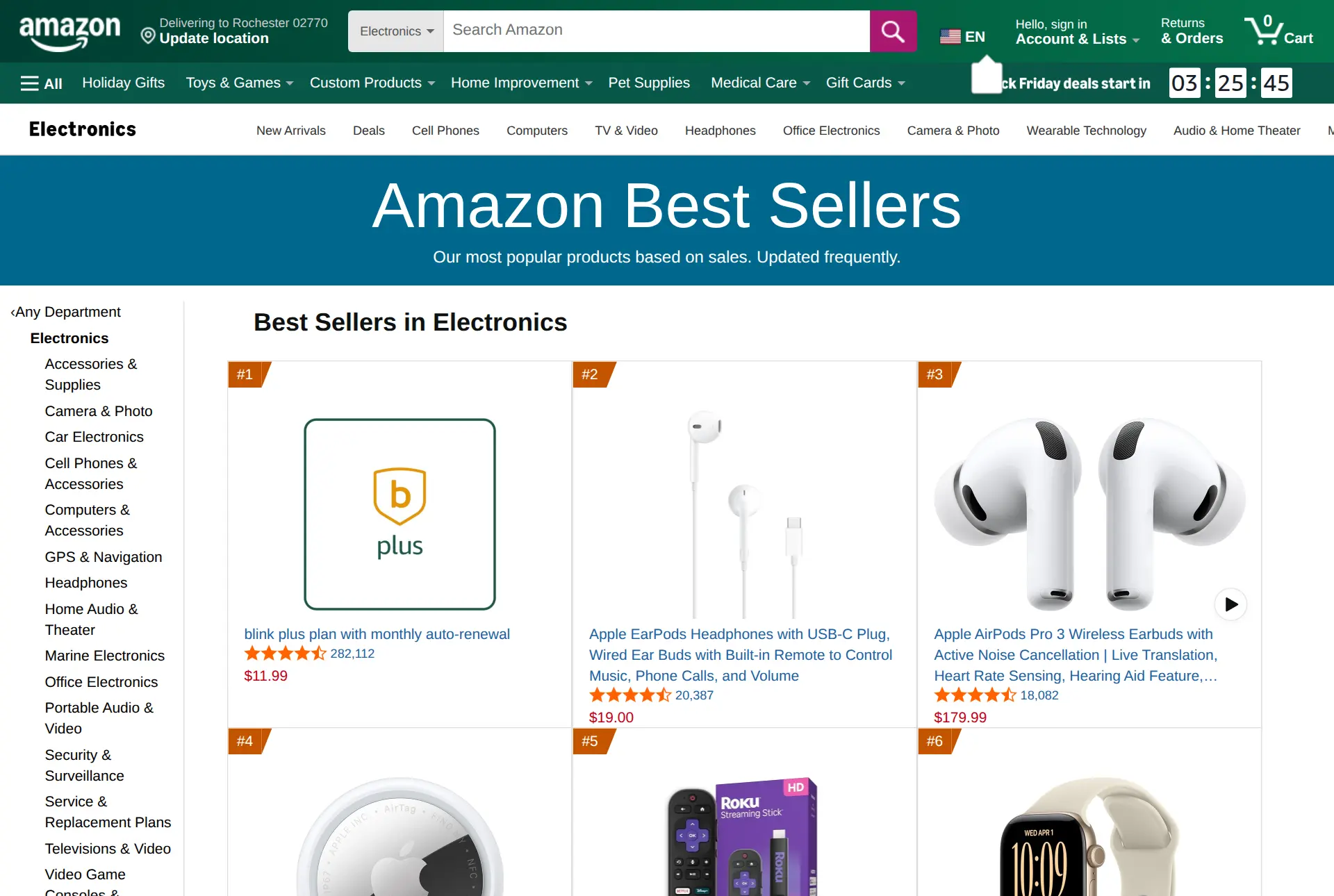
Amazon best sellers
The products Amazon ranks there: rank, title, price, rating, number of ratings and image.
Give it a category and a marketplace, or the address of a Best Sellers or New Releases page.
1 unit a run, for runs that return data. Runs that fail cost nothing. How units work
- Counted
- 1 unit a run
- Inputs
- 6
- Record
- 14 fields
- A run takes
- up to 5 minutes
- Records kept
- 7 days
- Measured
- its success, on the status page
POST/v1/scrapers/amazon.bestsellers/runs
sent, and answered
a record of the run14 fields
ok1 unit a run
A record this scraper returned for this input. The first 9 of its 14 fields are set down here; the whole record is below.
What it is used for
- Follow a category's ranking
- The products on a category's Best Sellers or New Releases list with rank, price, rating and number of ratings.
- Spot a rising product
- Read the list daily and see what climbs. A product that enters at eighty and reaches ten in a week is worth a look.
- Size a market
- Read the lists of the categories you sell in, and see which brands hold the top places and at what prices.
What you send
A category and a marketplace, or the address of a Best Sellers or New Releases page. These are its 6 inputs, as its schema has them.
categorystring Optional- The category as the list's own address names it, such as electronics or electronics/172456. Leave it out for the list of all departments.
rankingstring Optional- best_sellers or new_releases. best_sellers unless you say otherwise.Default
best_sellers marketplacestring Optional- The marketplace's code, such as us, uk, de or jp. us unless you say otherwise.
urlstring Optional- The address of a list page instead of the three above.
pageinteger Optional- 1 for ranks 1 to 50, 2 for ranks 51 to 100.Default
1 max_resultsinteger Optional- Return at most this many products of the page; all of them when not given.
A request, ready to send
It starts a run with the input shown at the top of this page, waits up to 60 seconds for it, and reads its records. Put your key in the variable it reads.
# Start a run and wait up to 60 seconds for it to finish
curl -X POST "https://api.enrichednow.com/v1/scrapers/amazon.bestsellers/runs?wait=60" \
  -H "Authorization: Bearer $ENRICHEDNOW_API_KEY" \
  -H "Content-Type: application/json" \
  -d '{"input":{"category":"electronics"}}'

# Read its records, with the id the first call answered
curl "https://api.enrichednow.com/v1/runs/$RUN_ID/records?limit=100" \
  -H "Authorization: Bearer $ENRICHEDNOW_API_KEY"
from enrichednow import EnrichedNow
client = EnrichedNow() # reads ENRICHEDNOW_API_KEY
# Start a run, wait for it to end, and get its records
result = client.scrape("amazon.bestsellers", {"category": "electronics"})
print(result.run.id, result.run.status, result.run.record_count)
# Read its records: pages are fetched as you go
for record in result.records:
print(record)Install it with pip install enrichednow, then save as run.py and run python3 run.py
import EnrichedNow from "enrichednow";

const client = new EnrichedNow(); // reads ENRICHEDNOW_API_KEY

// Start a run, wait for it to end, and get its records
const { run, records } = await client.scrape("amazon.bestsellers", { category: "electronics" });
console.log(run.id, run.status, run.record_count);

// Read its records: pages are fetched as you go
for await (const record of records) console.log(record);
Install it with npm install enrichednow, then save as run.mjs and run node run.mjs
package main

import (
	"context"
	"fmt"
	"log"
	"time"

	enrichednow "github.com/enrichednow/enrichednow-go"
)

func main() {
	client, err := enrichednow.NewClient() // reads ENRICHEDNOW_API_KEY
	if err != nil {
		log.Fatal(err)
	}
	ctx, cancel := context.WithTimeout(context.Background(), 10*time.Minute)
	defer cancel()

	// Start a run, wait for it to end, and get its records
	run, records, err := client.Scrape(ctx, "amazon.bestsellers", map[string]any{"category": "electronics"})
	if err != nil {
		log.Fatal(err)
	}
	fmt.Println(run.ID, run.Status, run.RecordCount)

	// Read its records: pages are fetched as you go
	for records.Next() {
		fmt.Println(string(records.Current()))
	}
	if err := records.Err(); err != nil {
		log.Fatal(err)
	}
}
Install it with go get github.com/enrichednow/enrichednow-go@latest, then save as run.go and run go run run.go
import com.enrichednow.EnrichedNowClient;
import com.enrichednow.ScrapeResult;
import java.util.Map;

public class Run {
    public static void main(String[] args) {
        EnrichedNowClient client = EnrichedNowClient.fromEnv(); // reads ENRICHEDNOW_API_KEY

        // Start a run, wait for it to end, and get its records
        ScrapeResult result = client.scrape("amazon.bestsellers", Map.of("category", "electronics"));
        System.out.println(result.run().id() + " " + result.run().status() + " " + result.run().recordCount());

        // Read its records: pages are fetched as you go
        for (Map<String, Object> record : result.records()) {
            System.out.println(record);
        }
    }
}
Add com.enrichednow:enrichednow-java:0.4.0 to your Maven or Gradle build, then save as Run.java
enrichednow run amazon.bestsellers --input category=electronicsInstall it with curl -fsSL https://raw.githubusercontent.com/enrichednow/enrichednow-cli/main/install.sh | sh
What comes back
The products Amazon ranks there: rank, title, price, rating, number of ratings and image. A record has 14 fields. One we could not read is null, never an empty string or a zero.
{
  "rank": 2,
  "ranking": "best_sellers",
  "category": "Best Sellers in Electronics",
  "asin": "B0DCH8VDXF",
  "marketplace": "amazon.com",
  "url": "https://www.amazon.com/dp/B0DCH8VDXF",
  "title": "Apple EarPods Headphones with USB-C Plug, Wired Ear Buds with Built-in Remote to Control Music, Phone Calls, and Volume",
  "price": {
    "amount": 19,
    "currency": "USD"
  },
  "rating": 4.5,
  "review_count": 20386,
  "image": "https://images-na.ssl-images-amazon.com/images/I/513OSdW4elL._AC_UL300_SR300,200_.jpg",
  "listed_only": false,
  "page": 1,
  "fetched_at": "2026-11-19T18:07:38.245373Z"
}
The scraper returned this record for the input above, reading a saved copy of the page, not the live site.
The fields of a record
rankinteger- The product's rank in the list, from 1. On the list of all departments: its rank within its department.
rankingstring- Which list: best_sellers or new_releases.
categorystring or null- The list's heading as the page writes it, e.g. "Best Sellers in Electronics"; on the list of all departments, the heading of the product's department.
asinstring- Amazon's product id (ASIN).
marketplacestring- The marketplace the list was read on, e.g. amazon.com, amazon.co.uk, amazon.de, amazon.co.jp.
urlstring- The product's address on that marketplace, without tracking parameters.
titlestring or null- The product's title, as the list shows it; null when listed_only.
priceobject or null- The price shown in the list; null when it shows none.Holds
amount,currency. ratingnumber or null- Average customer rating, 0 to 5.
review_countinteger or null- Number of customer ratings.
imagestring or null- The product's image in the list.
listed_onlyboolean- True for a product the page names with its rank and nothing else: a category's page writes out the first 30 of its 50 products and only names the last 20. Read those with amazon.product.
pageinteger- The page of the list the product was on: 1 (ranks 1 to 50) or 2 (51 to 100).
fetched_atdatetime- When the list was read, in UTC.
Units and limits
- Counted per request
- Billed per request: a run that returns data costs 1 unit, however many records it returns.
- A miss costs nothing
- A run that fails, that meets something not supported yet, or that you cancel costs nothing. You pay for runs that return data.
- What bounds a run
- A run may take up to 5 minutes. Its records are read in pages of up to 1,000 and are kept for 7 days.
What it does not do
- A category's list has 100 products on two pages; one run reads one page.
- The page describes its first 30 products in full and names the last 20 by ASIN and rank only. Those come back marked listed_only; amazon.product reads the rest.
- Without a category, the run returns the first products of each department, ranked within the department.
The bounds its schema sets
ranking- best_sellers, new_releases; best_sellers unless you say otherwise
marketplace- us, uk, de, in, ca, fr, it, es, nl, jp, au, mx, br, ae, sa, eg, tr, se, pl, be, sg
page- 1 to 2; 1 unless you say otherwise
max_results- 1 to 100
Questions
What does Amazon best sellers return?
The products Amazon ranks there: rank, title, price, rating, number of ratings and image. A record has 14 fields, among them rank, ranking, category, asin, marketplace and url. A value that could not be read is null, never an empty string or a zero.
What do I send?
A category and a marketplace, or the address of a Best Sellers or New Releases page. Optional: category, ranking, marketplace, url, page and max_results.
How is it counted?
Billed per request: a run that returns data costs 1 unit, however many records it returns. A run that fails, that meets something not supported yet, or that you cancel costs nothing. The first 1,000 units each month are free.
How much does one run return?
Its schema sets these bounds: ranking best_sellers, new_releases (best_sellers unless you say otherwise); marketplace us, uk, de, in, ca, fr, it, es, nl, jp, au, mx, br, ae, sa, eg, tr, se, pl, be, sg; page 1 to 2 (1 unless you say otherwise); max_results 1 to 100. A run may take up to 5 minutes.
What does it not do?
A category's list has 100 products on two pages; one run reads one page. The page describes its first 30 products in full and names the last 20 by ASIN and rank only. Those come back marked listed_only; amazon.product reads the rest. Without a category, the run returns the first products of each department, ranked within the department.
How long are the records kept, and in what format do they come?
Records are kept for 7 days after the run ended, and read in pages of up to 1,000. They come as JSON, as NDJSON with one record a line, or as CSV with a column for each field.
Can an AI assistant call it?
Yes. Through the EnrichedNow MCP server an assistant calls the tool run_scraper with the scraper_id amazon.bestsellers and the same input. It costs what the same API call costs.
Used in these playbooks
A playbook runs Amazon best sellers as one of its steps and hands back the finished list. Its runs of this scraper cost what they cost here, and the playbook adds nothing.
Finance
E-commerce Panel
A brand's listings on Amazon, Walmart and Target, with price, stock, rating and ratings count, and what changed since the last run.
E-commerce
Out-of-Stock Opportunity
Amazon best sellers that are out of stock on Amazon, and the US retailers that have the same product in stock now.
E-commerce
Storefront Research
What a competing Amazon seller sells in your niche, its prices and Buy Box, the sellers it competes with, and where to source it.
Amazon
Amazon's public pages on twenty-one marketplaces, from the United States, Europe and Japan to Saudi Arabia, Egypt, Turkey, Poland, Sweden, Belgium and Singapore: search results, products, every seller's offer, best seller lists, seller profiles, the reviews a product page shows and the search box's suggestions.
Amazon autocomplete
amazon.autocompleteThe first letters or words of a search, and the marketplace. The searches that marketplace's search box suggests for them, in its order, each with the address of its results.
Amazon search
amazon.searchA search query, and the marketplace to search. The products on a page of Amazon's search results: prices, ratings and review counts, with advertisements marked.
Amazon results page
amazon.results_pageA search query, and the marketplace to search; filters to apply, optionally. What a page of Amazon's search results shows around its products: the corrected query, related searches, the filters with their options, the brands' advertisements and the video advertisements.
Amazon offers
amazon.offersAn Amazon product's ASIN and marketplace, or its address. Every offer in the product's list of sellers: price, delivery cost, condition, the seller's name, id and rating, whether Amazon ships it, and which offer the product page puts forward.
Amazon seller
amazon.sellerA seller's id and marketplace, or the address of the seller's profile. The seller's name, rating and feedback figures for the last 30 days, 90 days, 12 months and all time, its own description, and the business name, address and other business details Amazon publishes.
Amazon product reviews
amazon.reviewsAn Amazon product's ASIN and marketplace, or its address. The customer reviews the product's page shows: stars, title, text, language, where and when it was written, the version bought, the verified purchase badge and pictures.
Amazon product
amazon.productAn Amazon product's ASIN and marketplace, or its address. Its price, availability, seller, rating, images, bullet points, category and versions.
- Industry
- Shopping and retail
- Where
- United StatesUnited KingdomGermanyIndiaCanadaFranceItalySpainNetherlandsJapanAustraliaSwedenPolandBelgium21 countries in all
- For
- E-commerce
Run it on an input of your own.
Create an account, make a key, and send the request above with your own input. The first 1,000 units each month are free.