Scraper API
Amazon
amazon.offersAvailable
Amazon offers
Every offer in the product's list of sellers: price, delivery cost, condition, the seller's name, id and rating, whether Amazon ships it, and which offer the product page puts forward.
Give it an Amazon product's ASIN and marketplace, or its address.
1 unit a run, for runs that return data. Runs that fail cost nothing. How units work
- Counted
- 1 unit a run
- Inputs
- 4
- Record
- 21 fields
- A run takes
- up to 5 minutes
- Records kept
- 7 days
- Measured
- its success, on the status page
POST/v1/scrapers/amazon.offers/runs
sent, and answered
a record of the run21 fields
ok1 unit a run
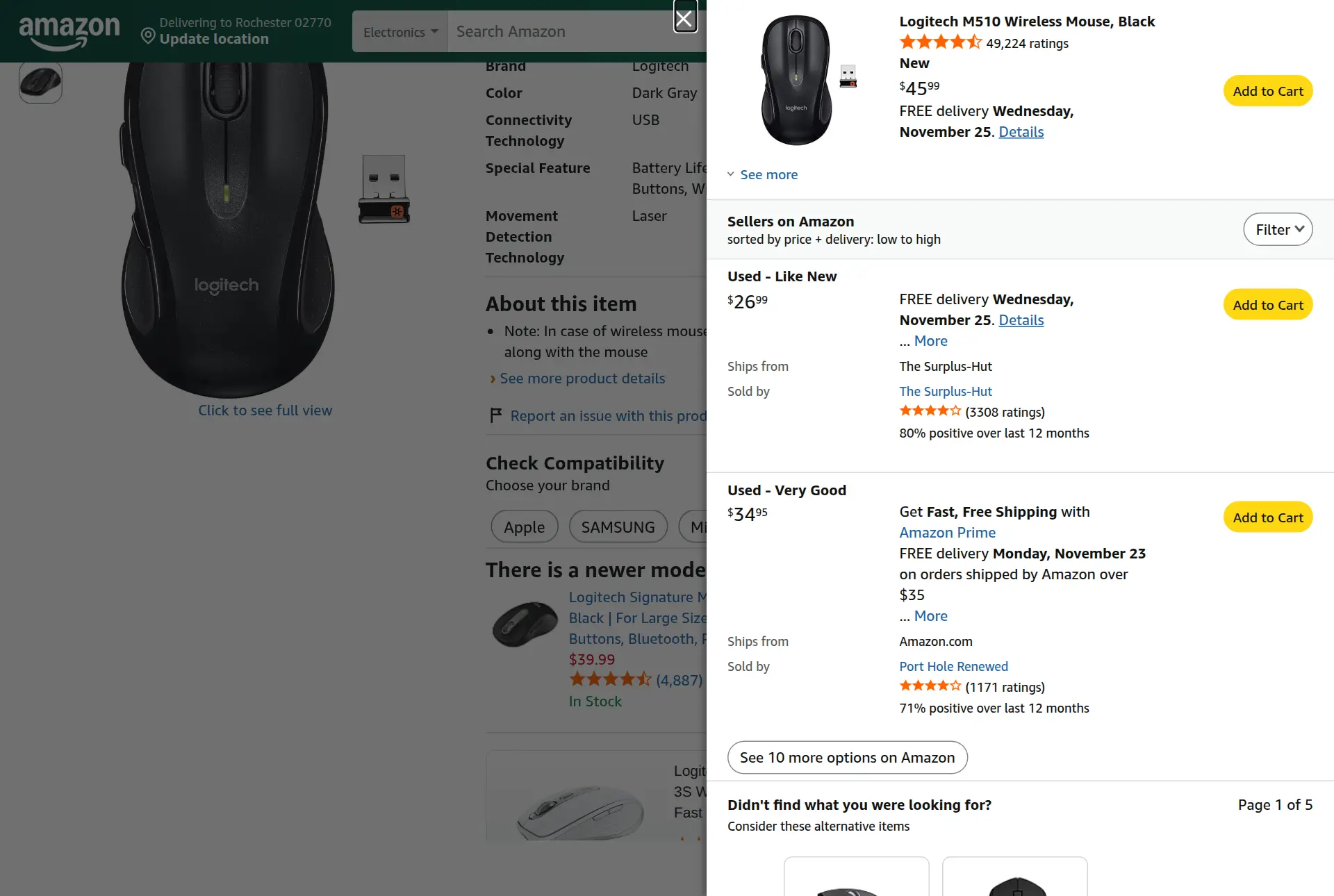
A record this scraper returned for this input. The first 9 of its 21 fields are set down here; the whole record is below.
What it is used for
- See every seller's price
- All the offers for a product: each seller's price, condition, shipping cost and delivery date, and which one holds the buy box.
- Reprice with the facts
- Know the lowest new offer, who fulfils through Amazon and what each seller's rating is before you change your own price.
- Find unauthorised sellers
- List who is selling your product, with each
seller_id, and follow up with the seller scraper for the business behind it.
What you send
An Amazon product's ASIN and marketplace, or its address. These are its 4 inputs, as its schema has them.
asinstring One of the two- Amazon's product id: ten letters and digits. A book's is its ISBN-10.
urlstring One of the two- The product's address instead; it names its own marketplace.
marketplacestring Optional- With an ASIN: the marketplace's code, such as us, uk, de or jp. us unless you say otherwise.
pageinteger Optional- The page of the list, from 1. The first holds the offer the product page puts forward and ten more; each later page the next ten.Default
1
A request, ready to send
It starts a run with the input shown at the top of this page, waits up to 60 seconds for it, and reads its records. Put your key in the variable it reads.
# Start a run and wait up to 60 seconds for it to finish
curl -X POST "https://api.enrichednow.com/v1/scrapers/amazon.offers/runs?wait=60" \
  -H "Authorization: Bearer $ENRICHEDNOW_API_KEY" \
  -H "Content-Type: application/json" \
  -d '{"input":{"asin":"B003NR57BY"}}'

# Read its records, with the id the first call answered
curl "https://api.enrichednow.com/v1/runs/$RUN_ID/records?limit=100" \
  -H "Authorization: Bearer $ENRICHEDNOW_API_KEY"
from enrichednow import EnrichedNow
client = EnrichedNow() # reads ENRICHEDNOW_API_KEY
# Start a run, wait for it to end, and get its records
result = client.scrape("amazon.offers", {"asin": "B003NR57BY"})
print(result.run.id, result.run.status, result.run.record_count)
# Read its records: pages are fetched as you go
for record in result.records:
print(record)Install it with pip install enrichednow, then save as run.py and run python3 run.py
import EnrichedNow from "enrichednow";

const client = new EnrichedNow(); // reads ENRICHEDNOW_API_KEY

// Start a run, wait for it to end, and get its records
const { run, records } = await client.scrape("amazon.offers", { asin: "B003NR57BY" });
console.log(run.id, run.status, run.record_count);

// Read its records: pages are fetched as you go
for await (const record of records) console.log(record);
Install it with npm install enrichednow, then save as run.mjs and run node run.mjs
package main

import (
	"context"
	"fmt"
	"log"
	"time"

	enrichednow "github.com/enrichednow/enrichednow-go"
)

func main() {
	client, err := enrichednow.NewClient() // reads ENRICHEDNOW_API_KEY
	if err != nil {
		log.Fatal(err)
	}
	ctx, cancel := context.WithTimeout(context.Background(), 10*time.Minute)
	defer cancel()

	// Start a run, wait for it to end, and get its records
	run, records, err := client.Scrape(ctx, "amazon.offers", map[string]any{"asin": "B003NR57BY"})
	if err != nil {
		log.Fatal(err)
	}
	fmt.Println(run.ID, run.Status, run.RecordCount)

	// Read its records: pages are fetched as you go
	for records.Next() {
		fmt.Println(string(records.Current()))
	}
	if err := records.Err(); err != nil {
		log.Fatal(err)
	}
}
Install it with go get github.com/enrichednow/enrichednow-go@latest, then save as run.go and run go run run.go
import com.enrichednow.EnrichedNowClient;
import com.enrichednow.ScrapeResult;
import java.util.Map;

public class Run {
    public static void main(String[] args) {
        EnrichedNowClient client = EnrichedNowClient.fromEnv(); // reads ENRICHEDNOW_API_KEY

        // Start a run, wait for it to end, and get its records
        ScrapeResult result = client.scrape("amazon.offers", Map.of("asin", "B003NR57BY"));
        System.out.println(result.run().id() + " " + result.run().status() + " " + result.run().recordCount());

        // Read its records: pages are fetched as you go
        for (Map<String, Object> record : result.records()) {
            System.out.println(record);
        }
    }
}
Add com.enrichednow:enrichednow-java:0.4.0 to your Maven or Gradle build, then save as Run.java
enrichednow run amazon.offers --input asin=B003NR57BYInstall it with curl -fsSL https://raw.githubusercontent.com/enrichednow/enrichednow-cli/main/install.sh | sh
What comes back
Every offer in the product's list of sellers: price, delivery cost, condition, the seller's name, id and rating, whether Amazon ships it, and which offer the product page puts forward. A record has 21 fields. One we could not read is null, never an empty string or a zero.
{
  "position": 2,
  "page": 1,
  "asin": "B003NR57BY",
  "marketplace": "amazon.com",
  "url": "https://www.amazon.com/dp/B003NR57BY",
  "buy_box": false,
  "condition": "Used - Like New",
  "price": {
    "amount": 26.99,
    "currency": "USD"
  },
  "list_price": null,
  "shipping": "FREE",
  "shipping_price": null,
  "delivery": "FREE delivery November 23 - 25.",
  "delivery_date": "November 23 - 25",
  "seller_name": "The Surplus-Hut",
  "seller_id": "A3M71O3D0PGOID",
  "fulfilled_by_amazon": false,
  "ships_from": "The Surplus-Hut",
  "seller_rating": 4,
  "seller_rating_count": 3308,
  "seller_positive_percent": 80,
  "fetched_at": "2026-11-19T18:07:38.304592Z"
}
The scraper returned this record for the input above, reading a saved copy of the page, not the live site.
The fields of a record
positioninteger- The offer's place among the returned offers of this page, from 1.
pageinteger- The page of the offer list the offer was on, from 1.
asinstring- The ASIN of the product the offer is for.
marketplacestring- The marketplace the list was read on, e.g. amazon.com, amazon.co.uk, amazon.de, amazon.co.jp.
urlstring- The product's address on that marketplace.
buy_boxboolean- True for the offer the product page itself puts forward (the list shows it first, apart from the others); false for every other offer. A list that sets none apart has none.
conditionstring or null- The condition, in the page's own words and language, e.g. "New", "Used - Very Good", "Neu".
priceobject or null- The offer's price, without delivery.Holds
amount,currency. list_priceobject or null- The struck-through list price shown with the offer, when there is one.Holds
amount,currency. shippingstring or null- What delivery costs, as the page states it: an amount ("$3.99") or its word for free ("FREE", "GRATIS").
shipping_priceobject or null- The delivery cost as a number, when the page states an amount; null when it states free delivery or nothing.
deliverystring or null- The delivery line, in the page's own words and language, e.g. "FREE delivery November 23 - 25."
delivery_datestring or null- The date or range of dates of that line, as written, e.g. "November 23 - 25".
seller_namestring or null- Who sells the offer.
seller_idstring or null- Amazon's id of the seller; null when the seller is Amazon itself, which has no seller profile.
fulfilled_by_amazonboolean or null- True when Amazon ships the order (its own offers, and sellers who use its warehouses), false when the seller ships it, null when the page does not say.
ships_fromstring or null- Who ships the order, as the page names it.
seller_ratingnumber or null- The seller's rating in stars, 0 to 5 in steps of a half, as the list shows it; null for Amazon itself and for a seller with no ratings yet.
seller_rating_countinteger or null- How many ratings the seller has.
seller_positive_percentinteger or null- The share of the seller's ratings of the last 12 months that are positive, in percent.
fetched_atdatetime- When the offer list was read, in UTC.
Units and limits
- Counted per request
- Billed per request: a run that returns data costs 1 unit, however many records it returns.
- A miss costs nothing
- A run that fails, that meets something not supported yet, or that you cancel costs nothing. You pay for runs that return data.
- What bounds a run
- A run may take up to 5 minutes. Its records are read in pages of up to 1,000 and are kept for 7 days.
What it does not do
- One run reads one page of the list. A product with many sellers takes several runs.
- Delivery costs and dates are the ones Amazon shows without a delivery address.
- Amazon itself has no seller id and no seller rating.
The bounds its schema sets
marketplace- us, uk, de, in, ca, fr, it, es, nl, jp, au, mx, br, ae, sa, eg, tr, se, pl, be, sg
page- 1 to 50; 1 unless you say otherwise
Questions
What does Amazon offers return?
Every offer in the product's list of sellers: price, delivery cost, condition, the seller's name, id and rating, whether Amazon ships it, and which offer the product page puts forward. A record has 21 fields, among them position, page, asin, marketplace, url and buy_box. A value that could not be read is null, never an empty string or a zero.
What do I send?
An Amazon product's ASIN and marketplace, or its address. Of asin and url, send one of the two. Optional: marketplace and page.
How is it counted?
Billed per request: a run that returns data costs 1 unit, however many records it returns. A run that fails, that meets something not supported yet, or that you cancel costs nothing. The first 1,000 units each month are free.
How much does one run return?
Its schema sets these bounds: marketplace us, uk, de, in, ca, fr, it, es, nl, jp, au, mx, br, ae, sa, eg, tr, se, pl, be, sg; page 1 to 50 (1 unless you say otherwise). A run may take up to 5 minutes.
What does it not do?
One run reads one page of the list. A product with many sellers takes several runs. Delivery costs and dates are the ones Amazon shows without a delivery address. Amazon itself has no seller id and no seller rating.
How long are the records kept, and in what format do they come?
Records are kept for 7 days after the run ended, and read in pages of up to 1,000. They come as JSON, as NDJSON with one record a line, or as CSV with a column for each field.
Can an AI assistant call it?
Yes. Through the EnrichedNow MCP server an assistant calls the tool run_scraper with the scraper_id amazon.offers and the same input. It costs what the same API call costs.
Used in these playbooks
A playbook runs Amazon offers as one of its steps and hands back the finished list. Its runs of this scraper cost what they cost here, and the playbook adds nothing.
E-commerce
Price and Seller Watch
Who sells each of your products on Amazon, Best Buy, Target and Newegg, at what price, what changed, and who is under your minimum.
E-commerce
Seller Identity
The legal business behind each marketplace seller of your products, with its address, website, domain record and register entry.
E-commerce
Storefront Research
What a competing Amazon seller sells in your niche, its prices and Buy Box, the sellers it competes with, and where to source it.
Amazon
Amazon's public pages on twenty-one marketplaces, from the United States, Europe and Japan to Saudi Arabia, Egypt, Turkey, Poland, Sweden, Belgium and Singapore: search results, products, every seller's offer, best seller lists, seller profiles, the reviews a product page shows and the search box's suggestions.
Amazon autocomplete
amazon.autocompleteThe first letters or words of a search, and the marketplace. The searches that marketplace's search box suggests for them, in its order, each with the address of its results.
Amazon search
amazon.searchA search query, and the marketplace to search. The products on a page of Amazon's search results: prices, ratings and review counts, with advertisements marked.
Amazon results page
amazon.results_pageA search query, and the marketplace to search; filters to apply, optionally. What a page of Amazon's search results shows around its products: the corrected query, related searches, the filters with their options, the brands' advertisements and the video advertisements.
Amazon best sellers
amazon.bestsellersA category and a marketplace, or the address of a Best Sellers or New Releases page. The products Amazon ranks there: rank, title, price, rating, number of ratings and image.
Amazon seller
amazon.sellerA seller's id and marketplace, or the address of the seller's profile. The seller's name, rating and feedback figures for the last 30 days, 90 days, 12 months and all time, its own description, and the business name, address and other business details Amazon publishes.
Amazon product reviews
amazon.reviewsAn Amazon product's ASIN and marketplace, or its address. The customer reviews the product's page shows: stars, title, text, language, where and when it was written, the version bought, the verified purchase badge and pictures.
Amazon product
amazon.productAn Amazon product's ASIN and marketplace, or its address. Its price, availability, seller, rating, images, bullet points, category and versions.
- Industry
- Shopping and retail
- Where
- United StatesUnited KingdomGermanyIndiaCanadaFranceItalySpainNetherlandsJapanAustraliaSwedenPolandBelgium21 countries in all
- For
- E-commerce
Run it on an input of your own.
Create an account, make a key, and send the request above with your own input. The first 1,000 units each month are free.