Scraper API
TCGplayer
tcgplayer.productAvailable
TCGplayer product
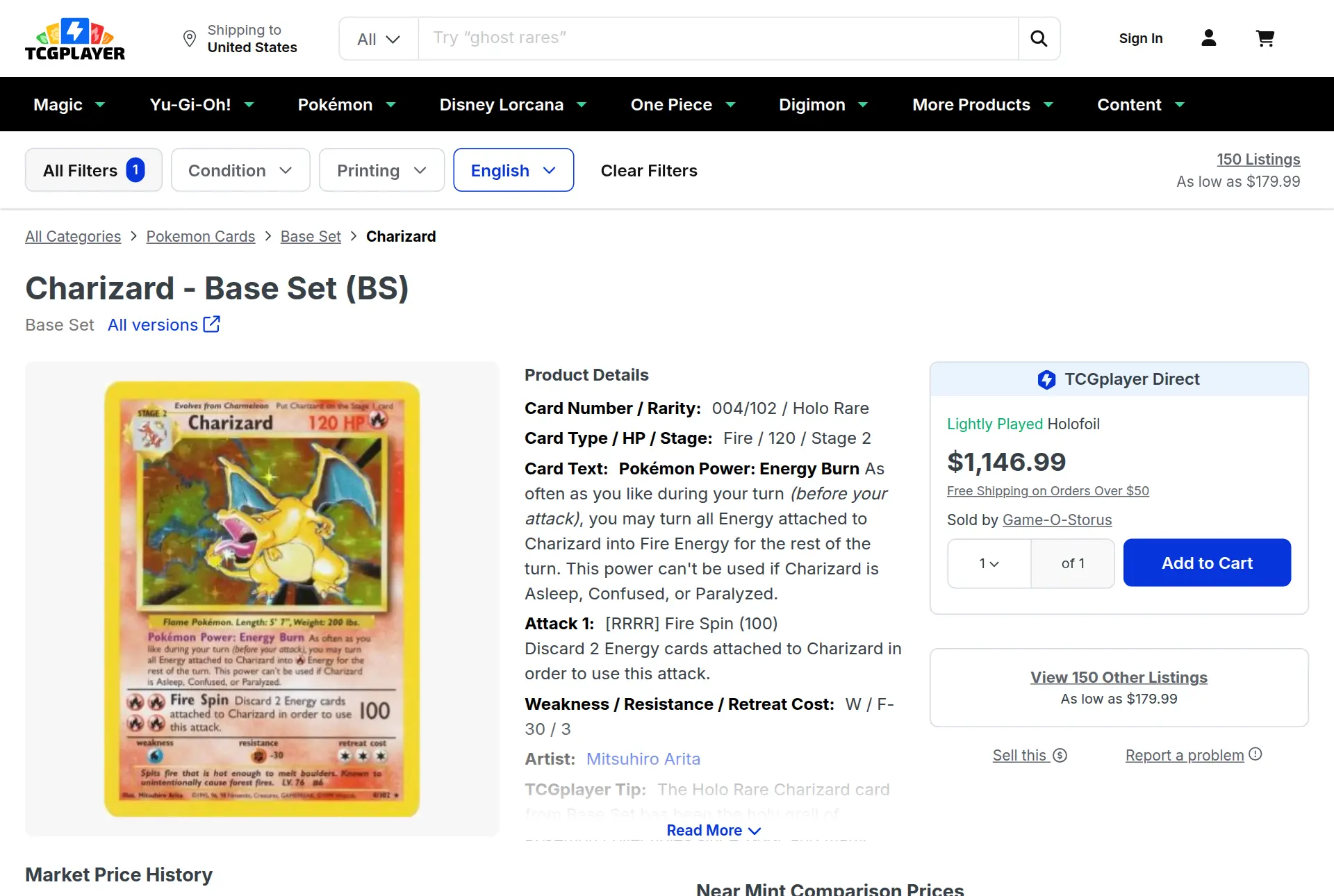
The product: game, set, rarity, card number, market price, lowest and median listed price, the number of listings and sellers, the card's text and details, and the versions it is sold in.
Give it a product's id on TCGplayer, or the address of its page.
1 unit a run, for runs that return data. Runs that fail cost nothing. How units work
- Counted
- 1 unit a run
- Inputs
- 1, 1 required
- Record
- 22 fields
- A run takes
- up to 5 minutes
- Records kept
- 7 days
- Measured
- its success, on the status page
POST/v1/scrapers/tcgplayer.product/runs
sent, and answered
a record of the run22 fields
ok1 unit a run
A record this scraper returned for this input. The first 9 of its 22 fields are set down here; the whole record is below.
What it is used for
- Value a collection
- Read each card's
market_price,lowest_priceandmedian_priceby its id, and total a collection's worth in US dollars. - Keep a catalogue of cards
- Store a card's game, set, rarity, number, text and
attributesas TCGplayer lists them. - Watch a card's market
- Read a product on a schedule and see its
listings,sellersand prices move.
What you send
A product's id on TCGplayer, or the address of its page. It is the one input.
productstring Required- The product: its id on TCGplayer, the number in its page's address (
42382), or that address (https://www.tcgplayer.com/product/42382/pokemon-base-set-charizard).tcgplayer.searchreturns it asproduct_id.
A request, ready to send
It starts a run with the input shown at the top of this page, waits up to 60 seconds for it, and reads its records. Put your key in the variable it reads.
# Start a run and wait up to 60 seconds for it to finish
curl -X POST "https://api.enrichednow.com/v1/scrapers/tcgplayer.product/runs?wait=60" \
  -H "Authorization: Bearer $ENRICHEDNOW_API_KEY" \
  -H "Content-Type: application/json" \
  -d '{"input":{"product":"42382"}}'

# Read its records, with the id the first call answered
curl "https://api.enrichednow.com/v1/runs/$RUN_ID/records?limit=100" \
  -H "Authorization: Bearer $ENRICHEDNOW_API_KEY"
from enrichednow import EnrichedNow
client = EnrichedNow() # reads ENRICHEDNOW_API_KEY
# Start a run, wait for it to end, and get its records
result = client.scrape("tcgplayer.product", {"product": "42382"})
print(result.run.id, result.run.status, result.run.record_count)
# Read its records: pages are fetched as you go
for record in result.records:
print(record)Install it with pip install enrichednow, then save as run.py and run python3 run.py
import EnrichedNow from "enrichednow";

const client = new EnrichedNow(); // reads ENRICHEDNOW_API_KEY

// Start a run, wait for it to end, and get its records
const { run, records } = await client.scrape("tcgplayer.product", { product: "42382" });
console.log(run.id, run.status, run.record_count);

// Read its records: pages are fetched as you go
for await (const record of records) console.log(record);
Install it with npm install enrichednow, then save as run.mjs and run node run.mjs
package main

import (
	"context"
	"fmt"
	"log"
	"time"

	enrichednow "github.com/enrichednow/enrichednow-go"
)

func main() {
	client, err := enrichednow.NewClient() // reads ENRICHEDNOW_API_KEY
	if err != nil {
		log.Fatal(err)
	}
	ctx, cancel := context.WithTimeout(context.Background(), 10*time.Minute)
	defer cancel()

	// Start a run, wait for it to end, and get its records
	run, records, err := client.Scrape(ctx, "tcgplayer.product", map[string]any{"product": "42382"})
	if err != nil {
		log.Fatal(err)
	}
	fmt.Println(run.ID, run.Status, run.RecordCount)

	// Read its records: pages are fetched as you go
	for records.Next() {
		fmt.Println(string(records.Current()))
	}
	if err := records.Err(); err != nil {
		log.Fatal(err)
	}
}
Install it with go get github.com/enrichednow/enrichednow-go@latest, then save as run.go and run go run run.go
import com.enrichednow.EnrichedNowClient;
import com.enrichednow.ScrapeResult;
import java.util.Map;

public class Run {
    public static void main(String[] args) {
        EnrichedNowClient client = EnrichedNowClient.fromEnv(); // reads ENRICHEDNOW_API_KEY

        // Start a run, wait for it to end, and get its records
        ScrapeResult result = client.scrape("tcgplayer.product", Map.of("product", "42382"));
        System.out.println(result.run().id() + " " + result.run().status() + " " + result.run().recordCount());

        // Read its records: pages are fetched as you go
        for (Map<String, Object> record : result.records()) {
            System.out.println(record);
        }
    }
}
Add com.enrichednow:enrichednow-java:0.4.0 to your Maven or Gradle build, then save as Run.java
enrichednow run tcgplayer.product --input-json '{"product":"42382"}'Install it with curl -fsSL https://raw.githubusercontent.com/enrichednow/enrichednow-cli/main/install.sh | sh
What comes back
The product: game, set, rarity, card number, market price, lowest and median listed price, the number of listings and sellers, the card's text and details, and the versions it is sold in. A record has 22 fields. One we could not read is null, never an empty string or a zero.
{
  "position": null,
  "product_id": 42382,
  "name": "Charizard",
  "url": "https://www.tcgplayer.com/product/42382",
  "game": "Pokemon",
  "set_name": "Base Set",
  "set_code": "BS",
  "product_type": "Cards",
  "rarity": "Holo Rare",
  "number": "004/102",
  "sealed": false,
  "market_price": 1001.05,
  "lowest_price": 179.99,
  "lowest_price_with_shipping": 189,
  "median_price": null,
  "listings": 145,
  "sellers": 76,
  "release_date": "1999-01-09",
  "description": "Pokémon Power: Energy Burn As often as you like during your turn (before your attack), you may turn all Energy attached to Charizard into Fire Energy for the rest of the turn. This power can't be used if Charizard is Asleep, Confused, or … [truncated]",
  "attributes": [
    {
      "name": "Card Number / Rarity",
      "value": "004/102 / Holo Rare"
    },
    {
      "name": "Card Type / HP / Stage",
      "value": "Fire / 120 / Stage 2"
    },
    {
      "name": "Card Text",
      "value": "Pokémon Power: Energy Burn As often as you like during your turn (before your attack), you may turn all Energy attached to Charizard into Fire Energy for the rest of the turn. This power can't be used if Charizard is Asleep, Confused, or … [truncated]"
    }
  ],
  "skus": [
    {
      "sku_id": 2999652,
      "condition": "Near Mint",
      "printing": "Holofoil",
      "language": "English"
    },
    {
      "sku_id": 2999653,
      "condition": "Lightly Played",
      "printing": "Holofoil",
      "language": "English"
    }
  ],
  "fetched_at": "2026-11-19T18:07:41.385594Z"
}
The scraper returned this record for the input above, reading a saved copy of the page, not the live site.
Values shortened for this page: description: 248 characters, the first 237 shown; attributes: 7 items, the first 3 shown; attributes[2].value: 248 characters, the first 237 shown; skus: 5 items, the first 2 shown.
The fields of a record
positioninteger or null- The product's place in the search results, from 1, counted across pages. Null for a single product.
product_idinteger- TCGplayer's id of the product: the number in its page's address.
tcgplayer.productandtcgplayer.price_historytake it. namestring- The product's name, e.g.
Charizardor151 Booster Bundle. urlstring- The product's page on tcgplayer.com.
gamestring or null- The game or product line, e.g.
Pokemon,Magic: The Gathering,YuGiOh. set_namestring or null- The set the product belongs to, e.g.
Base Set. set_codestring or null- The set's short code, e.g.
BS. product_typestring or nullCardsfor a single card,Sealed Productsfor a box or a pack. Null in search results.raritystring or null- The card's rarity, e.g.
Holo Rare. Null for a sealed product. numberstring or null- The card's number in its set, as printed, e.g.
004/102. sealedboolean or null- True for a sealed product.
market_pricenumber or null- TCGplayer's market price: what the product has recently sold for, in US dollars. Null when there were too few sales.
lowest_pricenumber or null- The lowest price it is listed at now, without shipping, in US dollars.
lowest_price_with_shippingnumber or null- The lowest listed price with shipping included, in US dollars.
median_pricenumber or null- The median of the listed prices, in US dollars, when TCGplayer states it.
listingsinteger or null- How many listings the product has now.
sellersinteger or null- How many sellers list it now. Null in search results.
release_datedate or null- The day the product was released.
descriptionstring or null- The card's text or the product's description, as plain text.
attributeslist of objects- The details the product page lists under their own headings, in the page's order. Empty in search results.Each holds
name,value. skuslist of objects- The versions the product is sold in, by condition, printing and language. Empty in search results.Each holds
sku_id,condition,printing,language. fetched_atdatetime- When TCGplayer was asked, in UTC.
Units and limits
- Counted per request
- Billed per request: a run that returns data costs 1 unit, however many records it returns.
- A miss costs nothing
- A run that fails, that meets something not supported yet, or that you cancel costs nothing. You pay for runs that return data.
- What bounds a run
- A run may take up to 5 minutes. Its records are read in pages of up to 1,000 and are kept for 7 days.
What it does not do
- One run reads one product. Sellers' individual listings are not returned.
- Prices are in US dollars.
Questions
What does TCGplayer product return?
The product: game, set, rarity, card number, market price, lowest and median listed price, the number of listings and sellers, the card's text and details, and the versions it is sold in. A record has 22 fields, among them position, product_id, name, url, game and set_name. A value that could not be read is null, never an empty string or a zero.
What do I send?
A product's id on TCGplayer, or the address of its page. The input product is required.
How is it counted?
Billed per request: a run that returns data costs 1 unit, however many records it returns. A run that fails, that meets something not supported yet, or that you cancel costs nothing. The first 1,000 units each month are free.
What does it not do?
One run reads one product. Sellers' individual listings are not returned. Prices are in US dollars.
How long are the records kept, and in what format do they come?
Records are kept for 7 days after the run ended, and read in pages of up to 1,000. They come as JSON, as NDJSON with one record a line, or as CSV with a column for each field.
Can an AI assistant call it?
Yes. Through the EnrichedNow MCP server an assistant calls the tool run_scraper with the scraper_id tcgplayer.product and the same input. It costs what the same API call costs.
TCGplayer
Trading-card products on TCGplayer: search results, a product's prices and details, and its sales history.
TCGplayer search
tcgplayer.searchWhat to search for, and optionally a game and a page. The products on a page of TCGplayer's results, 24 a page: name, game, set, rarity, card number, market price, lowest listed price and the number of listings.
TCGplayer price history
tcgplayer.price_historyA product's id on TCGplayer, or the address of its page, and how far back to look. One record for each version sold, by condition, printing and language: copies sold over the range, and for each period the market price, copies sold, number of sales and the lowest and highest sale price.
- Industry
- Shopping and retail
- Where
- United States
- For
- E-commerce
Run it on an input of your own.
Create an account, make a key, and send the request above with your own input. The first 1,000 units each month are free.