Scraper API
TCGplayer
tcgplayer.price_historyAvailable
TCGplayer price history
One record for each version sold, by condition, printing and language: copies sold over the range, and for each period the market price, copies sold, number of sales and the lowest and highest sale price.
Give it a product's id on TCGplayer, or the address of its page, and how far back to look.
1 unit a run, for runs that return data. Runs that fail cost nothing. How units work
- Counted
- 1 unit a run
- Inputs
- 2, 1 required
- Record
- 12 fields
- A run takes
- up to 5 minutes
- Records kept
- 7 days
- Measured
- its success, on the status page
POST/v1/scrapers/tcgplayer.price_history/runs
sent, and answered
a record of the run12 fields
ok1 unit a run
A record this scraper returned for this input. The first 9 of its 12 fields are set down here; the whole record is below.
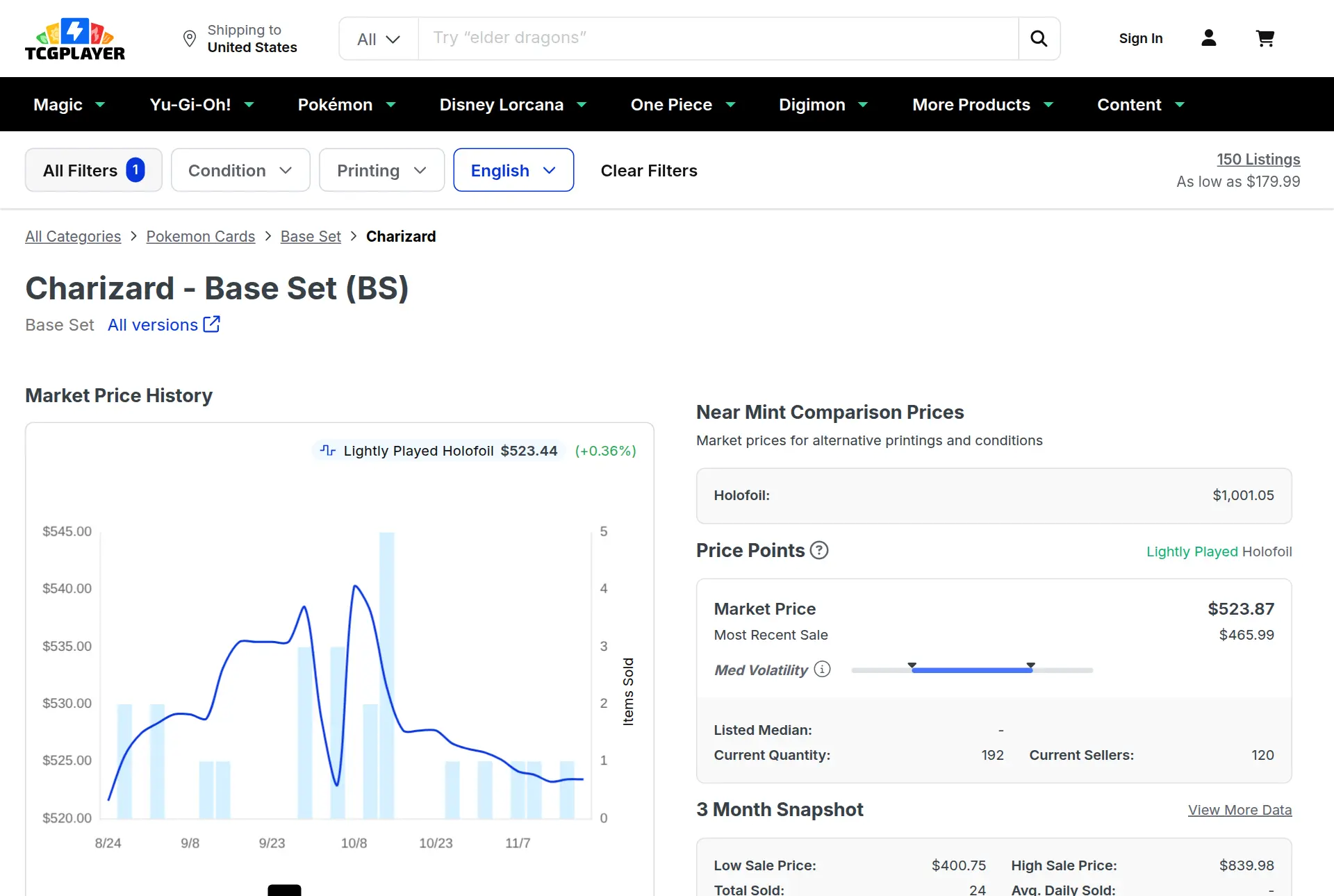
What it is used for
- Chart what a card sold for
- Each version's
pointsgive the market price, copies sold and the lowest and highest sale price for each period of the range. - Compare conditions and printings
- One record for each
condition,printingandlanguageshows how much each version sells for and how often. - Measure how fast a card sells
total_quantity_soldandaverage_daily_quantity_soldsay how many copies changed hands over the range.
What you send
A product's id on TCGplayer, or the address of its page, and how far back to look. These are its 2 inputs, as its schema has them.
productstring Required- The product: its id on TCGplayer, the number in its page's address (
42382), or that address (https://www.tcgplayer.com/product/42382/pokemon-base-set-charizard).tcgplayer.searchreturns it asproduct_id. rangestring Optional- How far back:
month(a point a day),quarter(a point every three days),semi_annualorannual(a point a week).Defaultquarter
A request, ready to send
It starts a run with the input shown at the top of this page, waits up to 60 seconds for it, and reads its records. Put your key in the variable it reads.
# Start a run and wait up to 60 seconds for it to finish
curl -X POST "https://api.enrichednow.com/v1/scrapers/tcgplayer.price_history/runs?wait=60" \
  -H "Authorization: Bearer $ENRICHEDNOW_API_KEY" \
  -H "Content-Type: application/json" \
  -d '{"input":{"product":"42382","range":"quarter"}}'

# Read its records, with the id the first call answered
curl "https://api.enrichednow.com/v1/runs/$RUN_ID/records?limit=100" \
  -H "Authorization: Bearer $ENRICHEDNOW_API_KEY"
from enrichednow import EnrichedNow
client = EnrichedNow() # reads ENRICHEDNOW_API_KEY
# Start a run, wait for it to end, and get its records
result = client.scrape("tcgplayer.price_history", {
"product": "42382",
"range": "quarter",
})
print(result.run.id, result.run.status, result.run.record_count)
# Read its records: pages are fetched as you go
for record in result.records:
print(record)Install it with pip install enrichednow, then save as run.py and run python3 run.py
import EnrichedNow from "enrichednow";

const client = new EnrichedNow(); // reads ENRICHEDNOW_API_KEY

// Start a run, wait for it to end, and get its records
const { run, records } = await client.scrape("tcgplayer.price_history", {
  product: "42382",
  range: "quarter",
});
console.log(run.id, run.status, run.record_count);

// Read its records: pages are fetched as you go
for await (const record of records) console.log(record);
Install it with npm install enrichednow, then save as run.mjs and run node run.mjs
package main

import (
	"context"
	"fmt"
	"log"
	"time"

	enrichednow "github.com/enrichednow/enrichednow-go"
)

func main() {
	client, err := enrichednow.NewClient() // reads ENRICHEDNOW_API_KEY
	if err != nil {
		log.Fatal(err)
	}
	ctx, cancel := context.WithTimeout(context.Background(), 10*time.Minute)
	defer cancel()

	// Start a run, wait for it to end, and get its records
	run, records, err := client.Scrape(ctx, "tcgplayer.price_history", map[string]any{"product": "42382", "range": "quarter"})
	if err != nil {
		log.Fatal(err)
	}
	fmt.Println(run.ID, run.Status, run.RecordCount)

	// Read its records: pages are fetched as you go
	for records.Next() {
		fmt.Println(string(records.Current()))
	}
	if err := records.Err(); err != nil {
		log.Fatal(err)
	}
}
Install it with go get github.com/enrichednow/enrichednow-go@latest, then save as run.go and run go run run.go
import com.enrichednow.EnrichedNowClient;
import com.enrichednow.ScrapeResult;
import java.util.Map;

public class Run {
    public static void main(String[] args) {
        EnrichedNowClient client = EnrichedNowClient.fromEnv(); // reads ENRICHEDNOW_API_KEY

        // Start a run, wait for it to end, and get its records
        ScrapeResult result = client.scrape("tcgplayer.price_history", Map.of("product", "42382", "range", "quarter"));
        System.out.println(result.run().id() + " " + result.run().status() + " " + result.run().recordCount());

        // Read its records: pages are fetched as you go
        for (Map<String, Object> record : result.records()) {
            System.out.println(record);
        }
    }
}
Add com.enrichednow:enrichednow-java:0.4.0 to your Maven or Gradle build, then save as Run.java
enrichednow run tcgplayer.price_history --input-json '{"product":"42382","range":"quarter"}'Install it with curl -fsSL https://raw.githubusercontent.com/enrichednow/enrichednow-cli/main/install.sh | sh
What comes back
One record for each version sold, by condition, printing and language: copies sold over the range, and for each period the market price, copies sold, number of sales and the lowest and highest sale price. A record has 12 fields. One we could not read is null, never an empty string or a zero.
{
  "product_id": 42382,
  "url": "https://www.tcgplayer.com/product/42382",
  "sku_id": 2999652,
  "condition": "Near Mint",
  "printing": "Holofoil",
  "language": "English",
  "range": "quarter",
  "total_quantity_sold": 6,
  "total_transactions": 6,
  "average_daily_quantity_sold": 0,
  "points": [
    {
      "period_start": "2026-11-17",
      "market_price": 991.77,
      "quantity_sold": 0,
      "transactions": 0,
      "low_sale_price": null,
      "high_sale_price": null
    },
    {
      "period_start": "2026-11-14",
      "market_price": 991.77,
      "quantity_sold": 1,
      "transactions": 1,
      "low_sale_price": 1195.98,
      "high_sale_price": 1195.98
    }
  ],
  "fetched_at": "2026-11-19T18:07:41.380751Z"
}
The scraper returned this record for the input above, reading a saved copy of the page, not the live site.
Values shortened for this page: points: 6 items, the first 2 shown.
The fields of a record
product_idinteger- TCGplayer's id of the product.
urlstring- The product's page on tcgplayer.com.
sku_idinteger or null- TCGplayer's id of this version of the product.
conditionstring or null- The condition, e.g.
Near Mint. printingstring or null- The printing, e.g.
Normal,Foil,Holofoil. languagestring or null- The language of the card.
rangestring- The range asked for:
month,quarter,semi_annualorannual. total_quantity_soldinteger or null- How many copies of this version sold over the range.
total_transactionsinteger or null- How many sales those were.
average_daily_quantity_soldinteger or null- The average number of copies sold a day over the range, as TCGplayer rounds it.
pointslist of objects- The periods of the range, newest first: a day each for
month, three days forquarter, a week for the longer ranges.Each holdsperiod_start,market_price,quantity_sold,transactions,low_sale_price,high_sale_price. fetched_atdatetime- When TCGplayer was asked, in UTC.
Units and limits
- Counted per request
- Billed per request: a run that returns data costs 1 unit, however many records it returns.
- A miss costs nothing
- A run that fails, that meets something not supported yet, or that you cancel costs nothing. You pay for runs that return data.
- What bounds a run
- A run may take up to 5 minutes. Its records are read in pages of up to 1,000 and are kept for 7 days.
What it does not do
- The range goes back a year at most, in periods of a day, three days or a week.
- A product with no recorded sales returns no records.
The bounds its schema sets
range- month, quarter, semi_annual, annual; quarter unless you say otherwise
Questions
What does TCGplayer price history return?
One record for each version sold, by condition, printing and language: copies sold over the range, and for each period the market price, copies sold, number of sales and the lowest and highest sale price. A record has 12 fields, among them product_id, url, sku_id, condition, printing and language. A value that could not be read is null, never an empty string or a zero.
What do I send?
A product's id on TCGplayer, or the address of its page, and how far back to look. The input product is required. Optional: range.
How is it counted?
Billed per request: a run that returns data costs 1 unit, however many records it returns. A run that fails, that meets something not supported yet, or that you cancel costs nothing. The first 1,000 units each month are free.
How much does one run return?
Its schema sets these bounds: range month, quarter, semi_annual, annual (quarter unless you say otherwise). A run may take up to 5 minutes.
What does it not do?
The range goes back a year at most, in periods of a day, three days or a week. A product with no recorded sales returns no records.
How long are the records kept, and in what format do they come?
Records are kept for 7 days after the run ended, and read in pages of up to 1,000. They come as JSON, as NDJSON with one record a line, or as CSV with a column for each field.
Can an AI assistant call it?
Yes. Through the EnrichedNow MCP server an assistant calls the tool run_scraper with the scraper_id tcgplayer.price_history and the same input. It costs what the same API call costs.
TCGplayer
Trading-card products on TCGplayer: search results, a product's prices and details, and its sales history.
TCGplayer search
tcgplayer.searchWhat to search for, and optionally a game and a page. The products on a page of TCGplayer's results, 24 a page: name, game, set, rarity, card number, market price, lowest listed price and the number of listings.
TCGplayer product
tcgplayer.productA product's id on TCGplayer, or the address of its page. The product: game, set, rarity, card number, market price, lowest and median listed price, the number of listings and sellers, the card's text and details, and the versions it is sold in.
- Industry
- Shopping and retail
- Where
- United States
- For
- E-commerce
Run it on an input of your own.
Create an account, make a key, and send the request above with your own input. The first 1,000 units each month are free.