Scraper API
App storesgoogle_play.reviewsAvailable
Google Play reviews
The reviews under its listing, newest, most relevant or highest rated first: stars, text, date, helpful count, app version and the developer's reply.
Give it an app's package name on Google Play, a country and a language.
1 unit a record, for runs that return data. Runs that fail cost nothing. How units work
- Counted
- 1 unit a record
- Inputs
- 6, 1 required
- Record
- 13 fields
- A run takes
- up to 5 minutes
- Records kept
- 7 days
- Measured
- its success, on the status page
POST/v1/scrapers/google_play.reviews/runs
sent, and answered
a record of the run13 fields
ok1 unit a record
A record this scraper returned for this input. The first 9 of its 13 fields are set down here; the whole record is below.
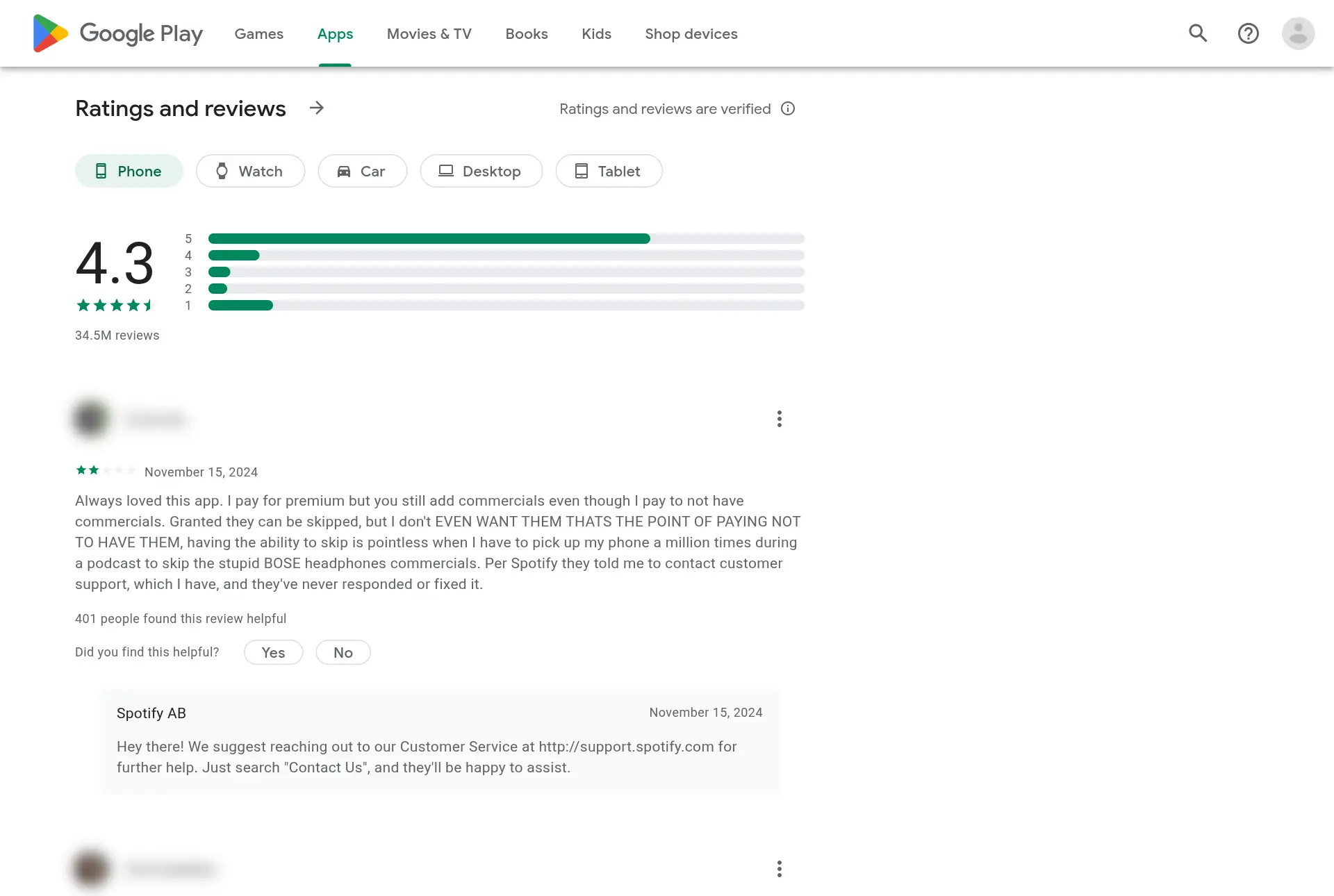
What it is used for
- Read what users say
- An app's reviews with rating, text, date, the app version it was written about and the developer's reply.
- Tie complaints to a release
- Group the low ratings by
app_versionand see which release brought them. - Answer faster
- List the reviews without
reply_textand send them to the people who answer.
What you send
An app's package name on Google Play, a country and a language. These are its 6 inputs, as its schema has them.
app_idstring Required- The app's package name, e.g. com.whatsapp.
countrystring Optional- Two-letter country code: the store's
glparameter.Defaultus languagestring Optional- Language code: the store's
hlparameter, e.g. en, de, pt-BR. Google Play returns the reviews written in it.Defaulten sortstring Optional- The order: "newest" first, "relevant" (Google Play's default ranking), or "rating" (highest stars first).Default
newest starsinteger Optional- Only reviews with this many stars; every review when not given.
max_resultsinteger Optional- The most reviews to return. They load 100 at a time, so a larger number takes longer.Default
100
A request, ready to send
It starts a run with the input shown at the top of this page, waits up to 60 seconds for it, and reads its records. Put your key in the variable it reads.
# Start a run and wait up to 60 seconds for it to finish
curl -X POST "https://api.enrichednow.com/v1/scrapers/google_play.reviews/runs?wait=60" \
  -H "Authorization: Bearer $ENRICHEDNOW_API_KEY" \
  -H "Content-Type: application/json" \
  -d '{"input":{"app_id":"com.spotify.music","sort":"relevant","max_results":3}}'

# Read its records, with the id the first call answered
curl "https://api.enrichednow.com/v1/runs/$RUN_ID/records?limit=100" \
  -H "Authorization: Bearer $ENRICHEDNOW_API_KEY"
from enrichednow import EnrichedNow
client = EnrichedNow() # reads ENRICHEDNOW_API_KEY
# Start a run, wait for it to end, and get its records
result = client.scrape("google_play.reviews", {
"app_id": "com.spotify.music",
"sort": "relevant",
"max_results": 3,
})
print(result.run.id, result.run.status, result.run.record_count)
# Read its records: pages are fetched as you go
for record in result.records:
print(record)Install it with pip install enrichednow, then save as run.py and run python3 run.py
import EnrichedNow from "enrichednow";

const client = new EnrichedNow(); // reads ENRICHEDNOW_API_KEY

// Start a run, wait for it to end, and get its records
const { run, records } = await client.scrape("google_play.reviews", {
  app_id: "com.spotify.music",
  sort: "relevant",
  max_results: 3,
});
console.log(run.id, run.status, run.record_count);

// Read its records: pages are fetched as you go
for await (const record of records) console.log(record);
Install it with npm install enrichednow, then save as run.mjs and run node run.mjs
package main

import (
	"context"
	"fmt"
	"log"
	"time"

	enrichednow "github.com/enrichednow/enrichednow-go"
)

func main() {
	client, err := enrichednow.NewClient() // reads ENRICHEDNOW_API_KEY
	if err != nil {
		log.Fatal(err)
	}
	ctx, cancel := context.WithTimeout(context.Background(), 10*time.Minute)
	defer cancel()

	// Start a run, wait for it to end, and get its records
	run, records, err := client.Scrape(ctx, "google_play.reviews", map[string]any{"app_id": "com.spotify.music", "sort": "relevant", "max_results": 3})
	if err != nil {
		log.Fatal(err)
	}
	fmt.Println(run.ID, run.Status, run.RecordCount)

	// Read its records: pages are fetched as you go
	for records.Next() {
		fmt.Println(string(records.Current()))
	}
	if err := records.Err(); err != nil {
		log.Fatal(err)
	}
}
Install it with go get github.com/enrichednow/enrichednow-go@latest, then save as run.go and run go run run.go
import com.enrichednow.EnrichedNowClient;
import com.enrichednow.ScrapeResult;
import java.util.Map;

public class Run {
    public static void main(String[] args) {
        EnrichedNowClient client = EnrichedNowClient.fromEnv(); // reads ENRICHEDNOW_API_KEY

        // Start a run, wait for it to end, and get its records
        ScrapeResult result = client.scrape("google_play.reviews", Map.of("app_id", "com.spotify.music", "sort", "relevant", "max_results", 3));
        System.out.println(result.run().id() + " " + result.run().status() + " " + result.run().recordCount());

        // Read its records: pages are fetched as you go
        for (Map<String, Object> record : result.records()) {
            System.out.println(record);
        }
    }
}
Add com.enrichednow:enrichednow-java:0.4.0 to your Maven or Gradle build, then save as Run.java
enrichednow run google_play.reviews --input app_id=com.spotify.music --input sort=relevant --input max_results=3Install it with curl -fsSL https://raw.githubusercontent.com/enrichednow/enrichednow-cli/main/install.sh | sh
What comes back
The reviews under its listing, newest, most relevant or highest rated first: stars, text, date, helpful count, app version and the developer's reply. A record has 13 fields. One we could not read is null, never an empty string or a zero.
{
  "position": 1,
  "id": "b55b5b30-774b-4813-8ece-871fce152df1",
  "app_id": "com.spotify.music",
  "rating": 2,
  "text": "Always loved this app. I pay for premium but you still add commercials even though I pay to not have commercials. Granted they can be skipped, but I don't EVEN WANT THEM THATS THE POINT OF PAYING NOT TO HAVE THEM, having the ability to skip … [truncated]",
  "posted_at": "2024-11-15T15:53:46Z",
  "helpful_count": 400,
  "app_version": "8.9.92.408",
  "author_name": "Reviewer 1",
  "reply_text": "Hey there! We suggest reaching out to our Customer Service at http://support.spotify.com for further help. Just search \"Contact Us\", and they'll be happy to assist.",
  "replied_at": "2024-11-15T15:42:35Z",
  "country": "us",
  "language": "en"
}
The scraper returned this record for the input above, reading a saved copy of the page, not the live site.
Values shortened for this page: text: 475 characters, the first 240 shown.
The fields of a record
positioninteger- Its place among the returned reviews, from 1, in the order asked for.
idstring- Google Play's id of the review.
app_idstring- The package name of the app reviewed.
ratinginteger or null- The stars given, 1 to 5.
textstring or null- The review's text.
posted_atdatetime or null- When the review was written or last edited.
helpful_countinteger or null- How many people found the review helpful.
app_versionstring or null- The version of the app the review was written about, when shown.
author_namestring or null- The name shown as the review's byline, exactly as published.
reply_textstring or null- The developer's reply, when there is one.
replied_atdatetime or null- When the developer replied.
countrystring- The country asked for.
languagestring- The language asked for; Google Play shows reviews written in it.
Units and limits
- Counted per record
- Billed per record: a run that returns data costs 1 unit for each record it returns.
- A miss costs nothing
- A run that fails, that meets something not supported yet, or that you cancel costs nothing. You pay for runs that return data.
- What bounds a run
- A run may take up to 5 minutes. Its records are read in pages of up to 1,000 and are kept for 7 days.
What it does not do
- Up to 1,000 reviews a run, loaded 100 at a time.
- Google Play returns the reviews written in the language you ask for.
- The name shown with a review is returned as shown. Nothing else about its author is read.
The bounds its schema sets
sort- newest, relevant, rating; newest unless you say otherwise
stars- 1 to 5
max_results- 1 to 1,000; 100 unless you say otherwise
Questions
What does Google Play reviews return?
The reviews under its listing, newest, most relevant or highest rated first: stars, text, date, helpful count, app version and the developer's reply. A record has 13 fields, among them position, id, app_id, rating, text and posted_at. A value that could not be read is null, never an empty string or a zero.
What do I send?
An app's package name on Google Play, a country and a language. The input app_id is required. Optional: country, language, sort, stars and max_results.
How is it counted?
Billed per record: a run that returns data costs 1 unit for each record it returns. A run that fails, that meets something not supported yet, or that you cancel costs nothing. The first 1,000 units each month are free.
How much does one run return?
Its schema sets these bounds: sort newest, relevant, rating (newest unless you say otherwise); stars 1 to 5; max_results 1 to 1,000 (100 unless you say otherwise). A run may take up to 5 minutes.
What does it not do?
Up to 1,000 reviews a run, loaded 100 at a time. Google Play returns the reviews written in the language you ask for. The name shown with a review is returned as shown. Nothing else about its author is read.
How long are the records kept, and in what format do they come?
Records are kept for 7 days after the run ended, and read in pages of up to 1,000. They come as JSON, as NDJSON with one record a line, or as CSV with a column for each field.
Can an AI assistant call it?
Yes. Through the EnrichedNow MCP server an assistant calls the tool run_scraper with the scraper_id google_play.reviews and the same input. It costs what the same API call costs.
Used in this playbook
A playbook runs Google Play reviews as one of its steps and hands back the finished list. Its runs of this scraper cost what they cost here, and the playbook adds nothing.
Other
App Intelligence
Ratings, versions, release notes and chart ranks of apps on the App Store and Google Play, with what changed since last run.
App stores
Apple's App Store and Google Play as a visitor who is not signed in sees them: an app's listing, its reviews, search results, top charts and a developer's apps.
App Store app
app_store.appAn app's id or address on Apple's App Store, and a country. Its listing there: developer, category, rating, price, description, version and images.
Google Play app
google_play.appAn app's package name on Google Play. Its listing there: developer, category, rating, installs, price, description, last update and images.
App Store search
app_store.searchA search term and a country. The apps Apple's App Store search returns, in its order: developer, category, rating, price, version, description and images.
App Store reviews
app_store.reviewsAn app's id or address on Apple's App Store, and a country. The customer reviews published for it there, newest or most helpful first: stars, headline, text, app version and date.
App Store top charts
app_store.top_chartsA country, a chart (free, paid or grossing) and, if you like, a category and a device. The chart in order: rank, app, developer, category, price and release date.
App Store developer apps
app_store.developer_appsA developer's id or address on Apple's App Store, and a country. The apps that developer publishes there: category, rating, price, version, description and images of each.
Google Play search
google_play.searchA search term, a country and a language. The apps on Google Play's search results page: developer, category, rating, price, installs and description.
Google Play top charts
google_play.top_chartsA chart (free, paid or grossing), a category and a country. The chart in order: app, developer, category, rating, price and installs.
Google Play developer apps
google_play.developer_appsA developer's id or name, as the address of their Google Play page gives it. The apps that page shows: category, rating, price, installs and description of each.
- Industry
- Reviews and apps
- Where
- Worldwide
Run it on an input of your own.
Create an account, make a key, and send the request above with your own input. The first 1,000 units each month are free.