Scraper API
Google Patents
google.patents_searchAvailable
Google Patents search
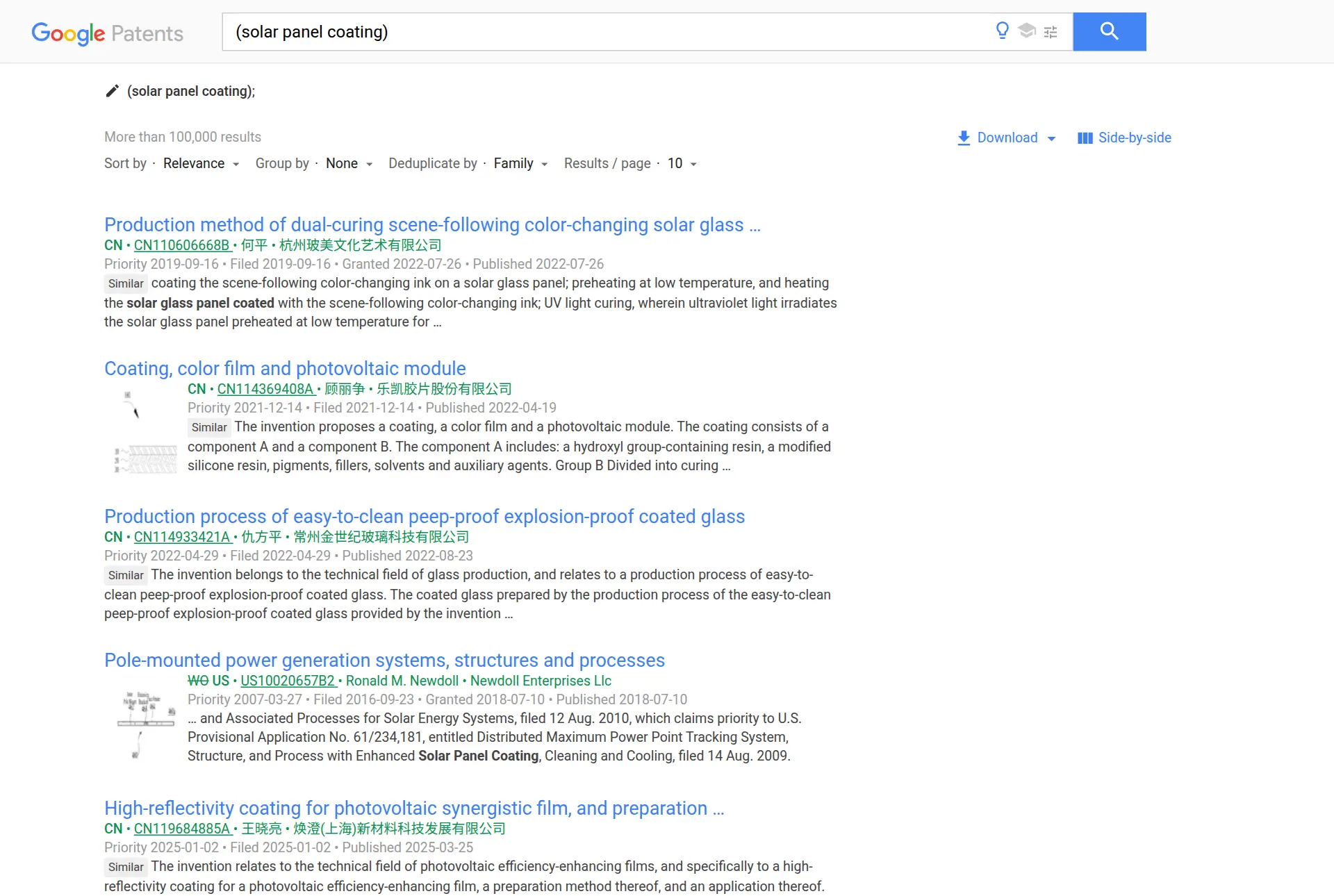
One page of results, in order: publication number, title, the passage that matched, priority, filing, publication and grant dates, the first inventor, the assignee, the language, the PDF and the legal state.
Give it Words to search for, or an inventor or an assignee, with Google Patents' own filters: patent office, granted or not, a range of priority dates, the order and the page.
1 unit a run, for runs that return data. Runs that fail cost nothing. How units work
- Counted
- 1 unit a run
- Inputs
- 10
- Record
- 16 fields
- A run takes
- up to 5 minutes
- Records kept
- 7 days
- Measured
- its success, on the status page
POST/v1/scrapers/google.patents_search/runs
sent, and answered
a record of the run16 fields
ok1 unit a run
A record this scraper returned for this input. The first 9 of its 16 fields are set down here; the whole record is below.
What it is used for
- Survey a field
- Search a technology and collect the patents in it, with their assignees, dates and legal state, page by page.
- Watch a competitor's filings
- Search by
assigneesorted newest first and read what a company has filed lately. - Check prior art
- Search a claim's words with
priority_beforeset to a day, and read the passages that matched.
What you send
Words to search for, or an inventor or an assignee, with Google Patents' own filters: patent office, granted or not, a range of priority dates, the order and the page. These are its 10 inputs, as its schema has them.
querystring At least one of the three- What to search for, as typed into Google Patents: words, a quoted phrase, or its own operators.
inventorstring At least one of the three- Only patents naming this inventor.
assigneestring At least one of the three- Only patents assigned to this company.
countrystring Optional- Only patents of this patent office, as two letters: US, EP, WO, CN or JP, for example.
statusstring Optional- grant for granted patents only, application for applications only.
priority_afterstring Optional- Only patents with a priority date on or after this day, written 2020-01-31.
priority_beforestring Optional- Only patents with a priority date before this day, written 2020-01-31.
sortstring Optional- relevance, newest or oldest: by relevance, or by priority date. relevance unless you say otherwise.Default
relevance pageinteger Optional- The results page, from 1.Default
1 numinteger Optional- Results a page: 10, 25, 50 or 100. 10 unless you say otherwise.Default
10
A request, ready to send
It starts a run with the input shown at the top of this page, waits up to 60 seconds for it, and reads its records. Put your key in the variable it reads.
# Start a run and wait up to 60 seconds for it to finish
curl -X POST "https://api.enrichednow.com/v1/scrapers/google.patents_search/runs?wait=60" \
  -H "Authorization: Bearer $ENRICHEDNOW_API_KEY" \
  -H "Content-Type: application/json" \
  -d '{"input":{"query":"solar panel coating"}}'

# Read its records, with the id the first call answered
curl "https://api.enrichednow.com/v1/runs/$RUN_ID/records?limit=100" \
  -H "Authorization: Bearer $ENRICHEDNOW_API_KEY"
from enrichednow import EnrichedNow
client = EnrichedNow() # reads ENRICHEDNOW_API_KEY
# Start a run, wait for it to end, and get its records
result = client.scrape("google.patents_search", {"query": "solar panel coating"})
print(result.run.id, result.run.status, result.run.record_count)
# Read its records: pages are fetched as you go
for record in result.records:
print(record)Install it with pip install enrichednow, then save as run.py and run python3 run.py
import EnrichedNow from "enrichednow";

const client = new EnrichedNow(); // reads ENRICHEDNOW_API_KEY

// Start a run, wait for it to end, and get its records
const { run, records } = await client.scrape("google.patents_search", { query: "solar panel coating" });
console.log(run.id, run.status, run.record_count);

// Read its records: pages are fetched as you go
for await (const record of records) console.log(record);
Install it with npm install enrichednow, then save as run.mjs and run node run.mjs
package main

import (
	"context"
	"fmt"
	"log"
	"time"

	enrichednow "github.com/enrichednow/enrichednow-go"
)

func main() {
	client, err := enrichednow.NewClient() // reads ENRICHEDNOW_API_KEY
	if err != nil {
		log.Fatal(err)
	}
	ctx, cancel := context.WithTimeout(context.Background(), 10*time.Minute)
	defer cancel()

	// Start a run, wait for it to end, and get its records
	run, records, err := client.Scrape(ctx, "google.patents_search", map[string]any{"query": "solar panel coating"})
	if err != nil {
		log.Fatal(err)
	}
	fmt.Println(run.ID, run.Status, run.RecordCount)

	// Read its records: pages are fetched as you go
	for records.Next() {
		fmt.Println(string(records.Current()))
	}
	if err := records.Err(); err != nil {
		log.Fatal(err)
	}
}
Install it with go get github.com/enrichednow/enrichednow-go@latest, then save as run.go and run go run run.go
import com.enrichednow.EnrichedNowClient;
import com.enrichednow.ScrapeResult;
import java.util.Map;

public class Run {
    public static void main(String[] args) {
        EnrichedNowClient client = EnrichedNowClient.fromEnv(); // reads ENRICHEDNOW_API_KEY

        // Start a run, wait for it to end, and get its records
        ScrapeResult result = client.scrape("google.patents_search", Map.of("query", "solar panel coating"));
        System.out.println(result.run().id() + " " + result.run().status() + " " + result.run().recordCount());

        // Read its records: pages are fetched as you go
        for (Map<String, Object> record : result.records()) {
            System.out.println(record);
        }
    }
}
Add com.enrichednow:enrichednow-java:0.4.0 to your Maven or Gradle build, then save as Run.java
enrichednow run google.patents_search --input 'query=solar panel coating'Install it with curl -fsSL https://raw.githubusercontent.com/enrichednow/enrichednow-cli/main/install.sh | sh
What comes back
One page of results, in order: publication number, title, the passage that matched, priority, filing, publication and grant dates, the first inventor, the assignee, the language, the PDF and the legal state. A record has 16 fields. One we could not read is null, never an empty string or a zero.
{
  "position": 1,
  "page": 1,
  "publication_number": "CN110606668B",
  "url": "https://patents.google.com/patent/CN110606668B/en",
  "title": "Production method of dual-curing scene-following color-changing solar glass",
  "snippet": "coating the scene-following color-changing ink on a solar glass panel; preheating at low temperature, and heating the solar glass panel coated with the scene-following color-changing ink; UV light curing, wherein ultraviolet light … [truncated]",
  "priority_date": "2019-09-16",
  "filing_date": "2019-09-16",
  "publication_date": "2022-07-26",
  "grant_date": "2022-07-26",
  "inventor": "何平",
  "assignee": "杭州玻美文化艺术有限公司",
  "language": "en",
  "pdf_url": "https://patentimages.storage.googleapis.com/83/68/04/c51f7cfeaaa3dd/CN110606668B.pdf",
  "family_status": {
    "CN": "ACTIVE"
  },
  "fetched_at": "2026-11-19T18:07:40.662319Z"
}
The scraper returned this record for the input above, reading a saved copy of the page, not the live site.
Values shortened for this page: snippet: 296 characters, the first 230 shown.
The fields of a record
positioninteger- The rank in the results, from 1, counted across pages.
pageinteger- The results page the patent was on.
publication_numberstring- The publication number with country and kind codes, e.g.
US7654321B2. urlstring- The patent's page on Google Patents.
titlestring or null- The title as the results show it; a long one is cut there.
snippetstring or null- The passage of the patent that matches the search, as the results show it.
priority_datestring or null- The priority date,
YYYY-MM-DD. filing_datestring or null- The filing date,
YYYY-MM-DD. publication_datestring or null- The date of this publication,
YYYY-MM-DD. grant_datestring or null- The grant date,
YYYY-MM-DD; null for an application. inventorstring or null- The inventor the results name: the first one listed on the patent.
assigneestring or null- The assignee the results name.
languagestring- The language of the text Google Patents holds, e.g.
en. pdf_urlstring or null- The address of the patent's PDF, when Google Patents has one.
family_statusobject- The legal state of the patent family per patent office, as Google Patents states it, e.g.
{"US": "ACTIVE"}. fetched_atdatetime- When the results were read, in UTC.
Units and limits
- Counted per request
- Billed per request: a run that returns data costs 1 unit, however many records it returns.
- A miss costs nothing
- A run that fails, that meets something not supported yet, or that you cancel costs nothing. You pay for runs that return data.
- What bounds a run
- A run may take up to 5 minutes. Its records are read in pages of up to 1,000 and are kept for 7 days.
What it does not do
- Google Patents shows the first 1,000 results of a search: page times num cannot go past them.
- A search that matches nothing, or a page past the last, is ok with no records.
- Each result names its first inventor and its first assignee; read the patent for all of them.
The bounds its schema sets
status- grant, application
sort- relevance, newest, oldest; relevance unless you say otherwise
page- 1 to 100; 1 unless you say otherwise
num- 10, 25, 50, 100; 10 unless you say otherwise
Questions
What does Google Patents search return?
One page of results, in order: publication number, title, the passage that matched, priority, filing, publication and grant dates, the first inventor, the assignee, the language, the PDF and the legal state. A record has 16 fields, among them position, page, publication_number, url, title and snippet. A value that could not be read is null, never an empty string or a zero.
What do I send?
Words to search for, or an inventor or an assignee, with Google Patents' own filters: patent office, granted or not, a range of priority dates, the order and the page. Of query, inventor and assignee, send at least one of the three. Optional: country, status, priority_after, priority_before, sort, page and num.
How is it counted?
Billed per request: a run that returns data costs 1 unit, however many records it returns. A run that fails, that meets something not supported yet, or that you cancel costs nothing. The first 1,000 units each month are free.
How much does one run return?
Its schema sets these bounds: status grant, application; sort relevance, newest, oldest (relevance unless you say otherwise); page 1 to 100 (1 unless you say otherwise); num 10, 25, 50, 100 (10 unless you say otherwise). A run may take up to 5 minutes.
What does it not do?
Google Patents shows the first 1,000 results of a search: page times num cannot go past them. A search that matches nothing, or a page past the last, is ok with no records. Each result names its first inventor and its first assignee; read the patent for all of them.
How long are the records kept, and in what format do they come?
Records are kept for 7 days after the run ended, and read in pages of up to 1,000. They come as JSON, as NDJSON with one record a line, or as CSV with a column for each field.
Can an AI assistant call it?
Yes. Through the EnrichedNow MCP server an assistant calls the tool run_scraper with the scraper_id google.patents_search and the same input. It costs what the same API call costs.
Google Patents
Searches and patents on Google Patents, from its own public pages.
Google Patents patent
google.patentA patent's publication number with its country code, such as US7654321B2, or the address of its page on Google Patents. The patent as Google Patents shows it: numbers and dates, inventors, current and original assignees, legal status, classifications, the abstract, the claims, the description, the drawings, the PDF, and how many patents it cites and is cited by.
- Industry
- Code and research
- Where
- Worldwide
Run it on an input of your own.
Create an account, make a key, and send the request above with your own input. The first 1,000 units each month are free.