Scraper API
Google Search
google.newsAvailable
Google News results
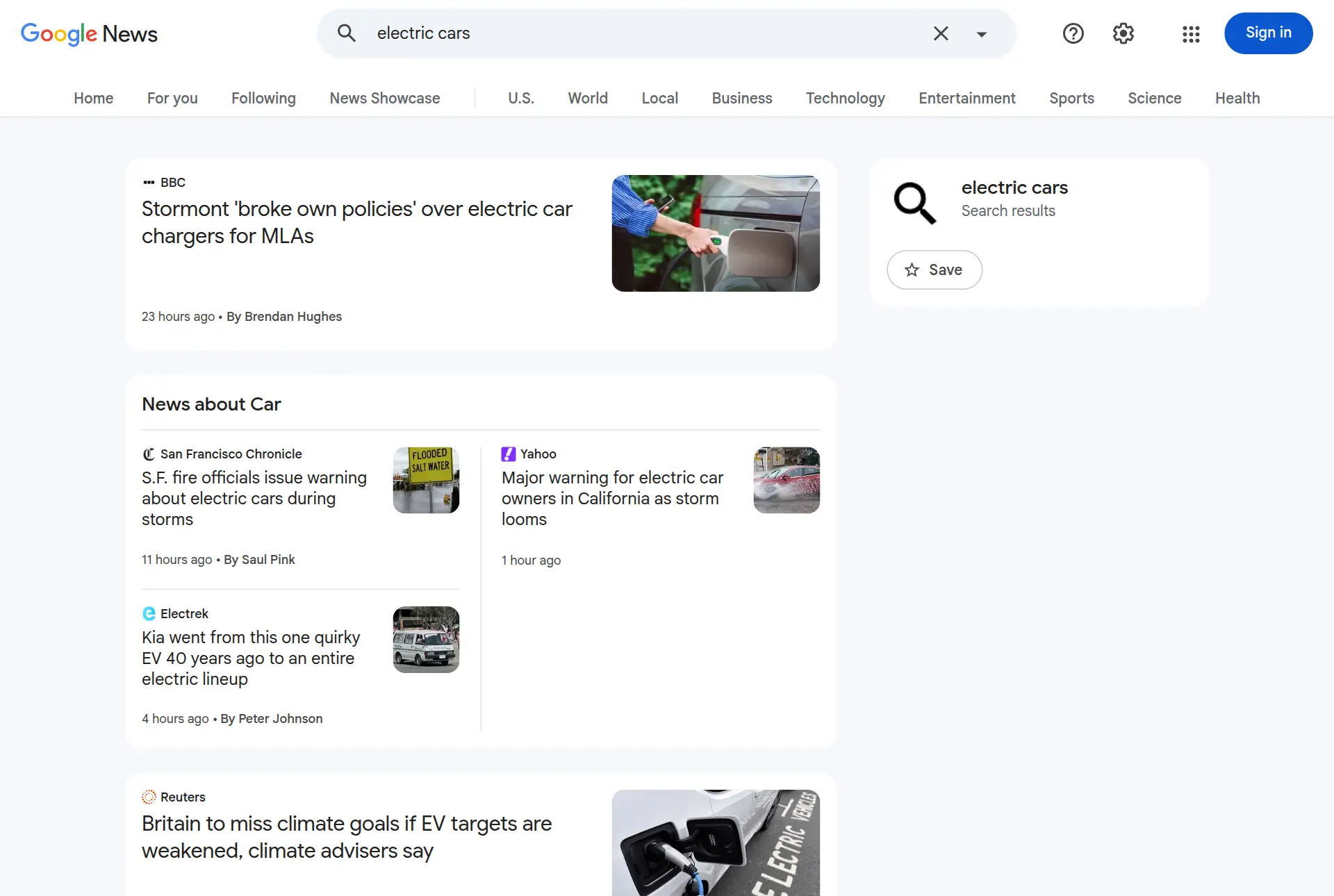
The stories Google News lists for the query, in order: headline, publisher, address, and how long ago each was published.
Give it a search query, and the country and language to rank the stories for.
1 unit a run, for runs that return data. Runs that fail cost nothing. How units work
- Counted
- 1 unit a run
- Inputs
- 5, 1 required
- Record
- 8 fields
- A run takes
- up to 5 minutes
- Records kept
- 7 days
- Measured
- its success, on the status page
POST/v1/scrapers/google.news/runs
sent, and answered
a record of the run8 fields
ok1 unit a run
A record this scraper returned for this input. The first 8 of its 8 fields are set down here; the whole record is below.
What it is used for
- Follow a subject in the news
- The articles Google News lists for a query: headline, publication, address and when each was published.
- Watch for mentions
- Search a company or product name on a schedule and pass on the headlines you have not seen.
- Build a reading list
- Collect a week's coverage of a subject by publication, then read each article with the Markdown scraper.
What you send
A search query, and the country and language to rank the stories for. These are its 5 inputs, as its schema has them.
querystring Required- What to search the news for, in plain words.
countrystring Optional- The country the stories are ranked for, as a two-letter code such as us, gb or de. us unless you say otherwise.Default
us languagestring Optional- The language of the page, as a code such as en, de or pt-BR. en unless you say otherwise.Default
en pageinteger Optional- The results page, from 1. Ten stories a page.Default
1 numinteger Optional- Return at most this many stories of the page.Default
10
A request, ready to send
It starts a run with the input shown at the top of this page, waits up to 60 seconds for it, and reads its records. Put your key in the variable it reads.
# Start a run and wait up to 60 seconds for it to finish
curl -X POST "https://api.enrichednow.com/v1/scrapers/google.news/runs?wait=60" \
  -H "Authorization: Bearer $ENRICHEDNOW_API_KEY" \
  -H "Content-Type: application/json" \
  -d '{"input":{"query":"electric cars"}}'

# Read its records, with the id the first call answered
curl "https://api.enrichednow.com/v1/runs/$RUN_ID/records?limit=100" \
  -H "Authorization: Bearer $ENRICHEDNOW_API_KEY"
from enrichednow import EnrichedNow
client = EnrichedNow() # reads ENRICHEDNOW_API_KEY
# Start a run, wait for it to end, and get its records
result = client.scrape("google.news", {"query": "electric cars"})
print(result.run.id, result.run.status, result.run.record_count)
# Read its records: pages are fetched as you go
for record in result.records:
print(record)Install it with pip install enrichednow, then save as run.py and run python3 run.py
import EnrichedNow from "enrichednow";

const client = new EnrichedNow(); // reads ENRICHEDNOW_API_KEY

// Start a run, wait for it to end, and get its records
const { run, records } = await client.scrape("google.news", { query: "electric cars" });
console.log(run.id, run.status, run.record_count);

// Read its records: pages are fetched as you go
for await (const record of records) console.log(record);
Install it with npm install enrichednow, then save as run.mjs and run node run.mjs
package main

import (
	"context"
	"fmt"
	"log"
	"time"

	enrichednow "github.com/enrichednow/enrichednow-go"
)

func main() {
	client, err := enrichednow.NewClient() // reads ENRICHEDNOW_API_KEY
	if err != nil {
		log.Fatal(err)
	}
	ctx, cancel := context.WithTimeout(context.Background(), 10*time.Minute)
	defer cancel()

	// Start a run, wait for it to end, and get its records
	run, records, err := client.Scrape(ctx, "google.news", map[string]any{"query": "electric cars"})
	if err != nil {
		log.Fatal(err)
	}
	fmt.Println(run.ID, run.Status, run.RecordCount)

	// Read its records: pages are fetched as you go
	for records.Next() {
		fmt.Println(string(records.Current()))
	}
	if err := records.Err(); err != nil {
		log.Fatal(err)
	}
}
Install it with go get github.com/enrichednow/enrichednow-go@latest, then save as run.go and run go run run.go
import com.enrichednow.EnrichedNowClient;
import com.enrichednow.ScrapeResult;
import java.util.Map;

public class Run {
    public static void main(String[] args) {
        EnrichedNowClient client = EnrichedNowClient.fromEnv(); // reads ENRICHEDNOW_API_KEY

        // Start a run, wait for it to end, and get its records
        ScrapeResult result = client.scrape("google.news", Map.of("query", "electric cars"));
        System.out.println(result.run().id() + " " + result.run().status() + " " + result.run().recordCount());

        // Read its records: pages are fetched as you go
        for (Map<String, Object> record : result.records()) {
            System.out.println(record);
        }
    }
}
Add com.enrichednow:enrichednow-java:0.4.0 to your Maven or Gradle build, then save as Run.java
enrichednow run google.news --input 'query=electric cars'Install it with curl -fsSL https://raw.githubusercontent.com/enrichednow/enrichednow-cli/main/install.sh | sh
What comes back
The stories Google News lists for the query, in order: headline, publisher, address, and how long ago each was published. A record has 8 fields. One we could not read is null, never an empty string or a zero.
{
  "query": "electric cars",
  "position": 1,
  "page": 1,
  "title": "Stormont 'broke own policies' over electric car chargers for MLAs",
  "source": "BBC",
  "url": "https://www.bbc.com/news/articles/cw8r7jz40x66o",
  "published": "22 hours ago",
  "fetched_at": "2026-11-19T18:07:40.631619Z"
}
The scraper returned this record for the input above, reading a saved copy of the page, not the live site.
The fields of a record
querystring- The query that was asked.
positioninteger- The rank among the stories, from 1, counted across pages.
pageinteger- The results page the story was on.
titlestring- The story's headline, as the results page shows it.
sourcestring or null- The publisher, as Google names it, e.g.
BBC. urlstring or null- The story's page on the publisher's site. Null only when the address could not be read for this story; the run is then
partial. publishedstring or null- When the story was published, as Google words it:
3 hours ago,2 days ago, or a date. fetched_atdatetime- When the results were read, in UTC.
Units and limits
- Counted per request
- Billed per request: a run that returns data costs 1 unit, however many records it returns.
- A miss costs nothing
- A run that fails, that meets something not supported yet, or that you cancel costs nothing. You pay for runs that return data.
- What bounds a run
- A run may take up to 5 minutes. Its records are read in pages of up to 1,000 and are kept for 7 days.
What it does not do
- Ten stories a run; ask for the next ten with page.
- A query with an operator such as site:, or a phrase in quotation marks, is refused by the news tab: the run ends as failed, and costs nothing. Use plain words.
- published is the age as the page words it, such as "3 hours ago", or a date for older stories. It is not a timestamp.
- A story's summary and picture are not returned: the page's cards do not carry them.
- A run takes about half a minute. The first run after a quiet spell takes longer, sometimes over a minute: wait up to 300 seconds for it, or poll the run.
The bounds its schema sets
page- 1 to 30; 1 unless you say otherwise
num- 1 to 10; 10 unless you say otherwise
Questions
What does Google News results return?
The stories Google News lists for the query, in order: headline, publisher, address, and how long ago each was published. A record has 8 fields, among them query, position, page, title, source and url. A value that could not be read is null, never an empty string or a zero.
What do I send?
A search query, and the country and language to rank the stories for. The input query is required. Optional: country, language, page and num.
How is it counted?
Billed per request: a run that returns data costs 1 unit, however many records it returns. A run that fails, that meets something not supported yet, or that you cancel costs nothing. The first 1,000 units each month are free.
How much does one run return?
Its schema sets these bounds: page 1 to 30 (1 unless you say otherwise); num 1 to 10 (10 unless you say otherwise). A run may take up to 5 minutes.
What does it not do?
Ten stories a run; ask for the next ten with page. A query with an operator such as site:, or a phrase in quotation marks, is refused by the news tab: the run ends as failed, and costs nothing. Use plain words. published is the age as the page words it, such as "3 hours ago", or a date for older stories. It is not a timestamp. A story's summary and picture are not returned: the page's cards do not carry them. A run takes about half a minute. The first run after a quiet spell takes longer, sometimes over a minute: wait up to 300 seconds for it, or poll the run.
How long are the records kept, and in what format do they come?
Records are kept for 7 days after the run ended, and read in pages of up to 1,000. They come as JSON, as NDJSON with one record a line, or as CSV with a column for each field.
Can an AI assistant call it?
Yes. Through the EnrichedNow MCP server an assistant calls the tool run_scraper with the scraper_id google.news and the same input. It costs what the same API call costs.
Used in these playbooks
A playbook runs Google News results as one of its steps and hands back the finished list. Its runs of this scraper cost what they cost here, and the playbook adds nothing.
Sales
Funding and Announcement Trigger
Companies that just announced funding, an expansion, a launch or a senior hire, with who to contact and the fact.
Marketing
Unlinked Mentions
Pages that name your brand but do not link to your site, each read to be sure, with the email the site publishes.
Google Search
Results pages of Google Search and of its news tab, as a visitor who is not signed in sees them.
Google Search results
google.searchA search query, and the country and language to rank the results for. One page of Google Search: the organic results in order with title, address and snippet, and the other blocks the page shows, each as records of its own type: related questions, related searches, top stories, local places, the knowledge panel, the AI Overview, recipes, sports games and the corrected query.
Google Search short videos
google.short_videosA search query, and the country to rank the videos for. The short videos Google Search lists for the query, in order: title, the site it is on, the account that posted it, its length and its address.
- Industry
- Search and the open web
- Where
- Worldwide
Run it on an input of your own.
Create an account, make a key, and send the request above with your own input. The first 1,000 units each month are free.