Scraper API
Companies House
companies_house.searchAvailable
Companies House search
The companies the Companies House register lists for it, 20 a page: company number, name, status, date of incorporation or dissolution, registered office address, and the earlier names that matched.
Give it a UK company's name, part of it, or its company number.
1 unit a run, for runs that return data. Runs that fail cost nothing. How units work
- Counted
- 1 unit a run
- Inputs
- 2, 1 required
- Record
- 11 fields
- A run takes
- up to 5 minutes
- Records kept
- 7 days
- Measured
- its success, on the status page
POST/v1/scrapers/companies_house.search/runs
sent, and answered
a record of the run11 fields
ok1 unit a run
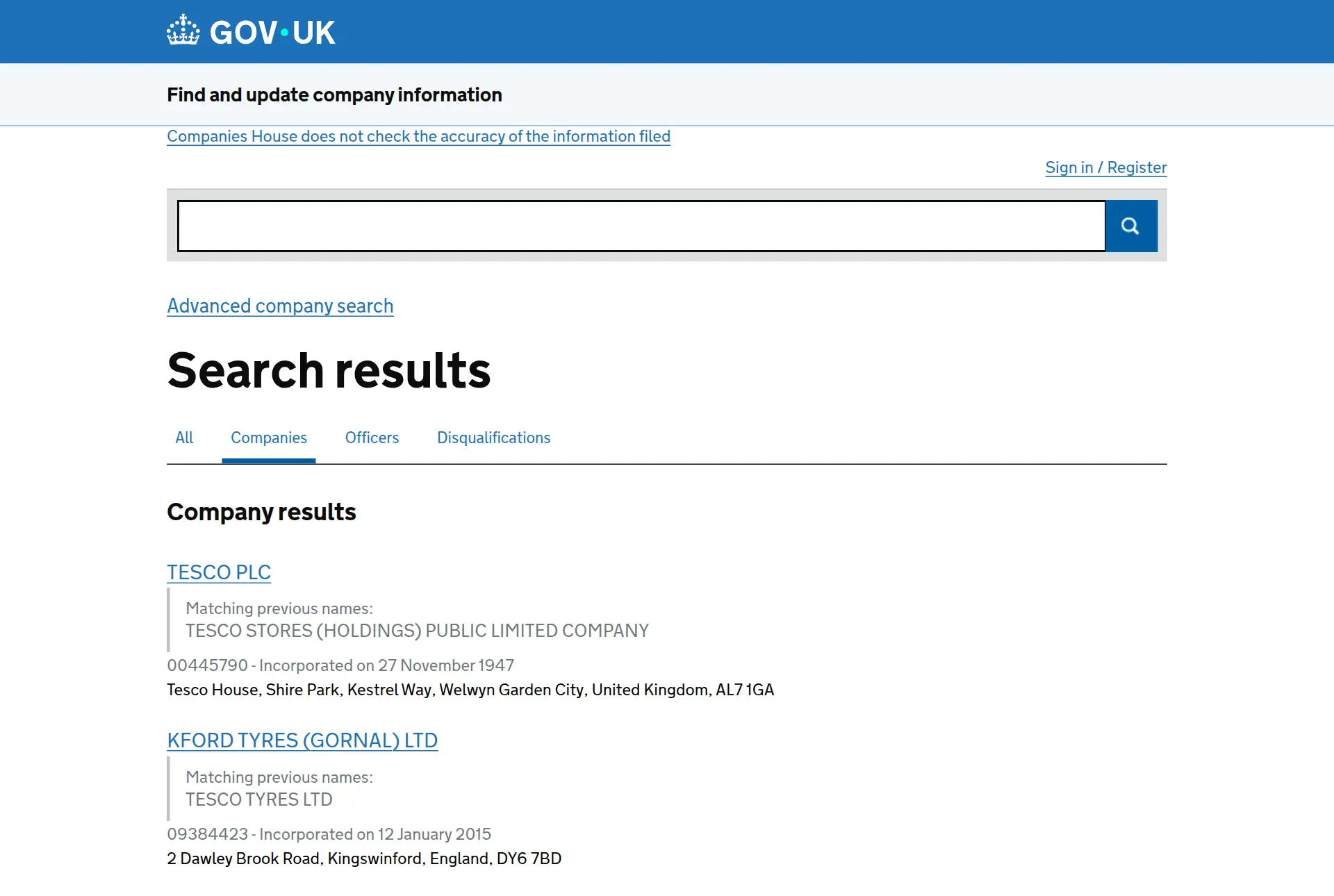
A record this scraper returned for this input. The first 9 of its 11 fields are set down here; the whole record is below.
What it is used for
- Find a company's number
- Search the register by name and get each match's
company_number, status and registered office, ready to read in full with the company scraper. - Match names to the register
- Clean a list of UK company names by finding each on the register, including by an earlier name, which
matched_previous_namesshows. - See who already uses a name
- Before you settle on a trading name, search it and read the companies registered under it, with their status and the date each was incorporated.
What you send
A UK company's name, part of it, or its company number. These are its 2 inputs, as its schema has them.
querystring Required- A company's name, part of it, or its number, as you would type it into the register's own search.
pageinteger Optional- The page of results, from 1; 20 companies a page.Default
1
A request, ready to send
It starts a run with the input shown at the top of this page, waits up to 60 seconds for it, and reads its records. Put your key in the variable it reads.
# Start a run and wait up to 60 seconds for it to finish
curl -X POST "https://api.enrichednow.com/v1/scrapers/companies_house.search/runs?wait=60" \
  -H "Authorization: Bearer $ENRICHEDNOW_API_KEY" \
  -H "Content-Type: application/json" \
  -d '{"input":{"query":"tesco"}}'

# Read its records, with the id the first call answered
curl "https://api.enrichednow.com/v1/runs/$RUN_ID/records?limit=100" \
  -H "Authorization: Bearer $ENRICHEDNOW_API_KEY"
from enrichednow import EnrichedNow
client = EnrichedNow() # reads ENRICHEDNOW_API_KEY
# Start a run, wait for it to end, and get its records
result = client.scrape("companies_house.search", {"query": "tesco"})
print(result.run.id, result.run.status, result.run.record_count)
# Read its records: pages are fetched as you go
for record in result.records:
print(record)Install it with pip install enrichednow, then save as run.py and run python3 run.py
import EnrichedNow from "enrichednow";

const client = new EnrichedNow(); // reads ENRICHEDNOW_API_KEY

// Start a run, wait for it to end, and get its records
const { run, records } = await client.scrape("companies_house.search", { query: "tesco" });
console.log(run.id, run.status, run.record_count);

// Read its records: pages are fetched as you go
for await (const record of records) console.log(record);
Install it with npm install enrichednow, then save as run.mjs and run node run.mjs
package main

import (
	"context"
	"fmt"
	"log"
	"time"

	enrichednow "github.com/enrichednow/enrichednow-go"
)

func main() {
	client, err := enrichednow.NewClient() // reads ENRICHEDNOW_API_KEY
	if err != nil {
		log.Fatal(err)
	}
	ctx, cancel := context.WithTimeout(context.Background(), 10*time.Minute)
	defer cancel()

	// Start a run, wait for it to end, and get its records
	run, records, err := client.Scrape(ctx, "companies_house.search", map[string]any{"query": "tesco"})
	if err != nil {
		log.Fatal(err)
	}
	fmt.Println(run.ID, run.Status, run.RecordCount)

	// Read its records: pages are fetched as you go
	for records.Next() {
		fmt.Println(string(records.Current()))
	}
	if err := records.Err(); err != nil {
		log.Fatal(err)
	}
}
Install it with go get github.com/enrichednow/enrichednow-go@latest, then save as run.go and run go run run.go
import com.enrichednow.EnrichedNowClient;
import com.enrichednow.ScrapeResult;
import java.util.Map;

public class Run {
    public static void main(String[] args) {
        EnrichedNowClient client = EnrichedNowClient.fromEnv(); // reads ENRICHEDNOW_API_KEY

        // Start a run, wait for it to end, and get its records
        ScrapeResult result = client.scrape("companies_house.search", Map.of("query", "tesco"));
        System.out.println(result.run().id() + " " + result.run().status() + " " + result.run().recordCount());

        // Read its records: pages are fetched as you go
        for (Map<String, Object> record : result.records()) {
            System.out.println(record);
        }
    }
}
Add com.enrichednow:enrichednow-java:0.4.0 to your Maven or Gradle build, then save as Run.java
enrichednow run companies_house.search --input query=tescoInstall it with curl -fsSL https://raw.githubusercontent.com/enrichednow/enrichednow-cli/main/install.sh | sh
What comes back
The companies the Companies House register lists for it, 20 a page: company number, name, status, date of incorporation or dissolution, registered office address, and the earlier names that matched. A record has 11 fields. One we could not read is null, never an empty string or a zero.
{
  "company_number": "00445790",
  "name": "TESCO PLC",
  "url": "https://find-and-update.company-information.service.gov.uk/company/00445790",
  "status": null,
  "incorporated_on": "1947-11-27",
  "dissolved_on": null,
  "description": "00445790 - Incorporated on 27 November 1947",
  "address": "Tesco House, Shire Park, Kestrel Way, Welwyn Garden City, United Kingdom, AL7 1GA",
  "matched_previous_names": [
    "TESCO STORES (HOLDINGS) PUBLIC LIMITED COMPANY"
  ],
  "position": 1,
  "fetched_at": "2026-11-19T18:07:39.688615Z"
}
The scraper returned this record for the input above, reading a saved copy of the page, not the live site.
The fields of a record
company_numberstring- The company's number on the register, eight characters, e.g.
00445790,SC123456,OC300001. namestring- The company's registered name.
urlstring- The company's page on the register.
statusstring or null- The status the result states after the date, e.g.
Dissolved,Liquidation,Closed. Null for an active company: the result prints nothing for it. incorporated_ondate or null- The date the result states the company was incorporated or registered on, or a UK establishment opened on.
dissolved_ondate or null- The date the company was dissolved, for a dissolved company.
descriptionstring- The line under the name, as printed: the number, the date of incorporation and any status.
addressstring or null- The registered office address, on one line.
matched_previous_nameslist of strings- The company's earlier names that matched the search, when it was found by one of them.
positioninteger- The result's place in the whole list, from 1.
fetched_atdatetime- When the register was read, in UTC.
Units and limits
- Counted per request
- Billed per request: a run that returns data costs 1 unit, however many records it returns.
- A miss costs nothing
- A run that fails, that meets something not supported yet, or that you cancel costs nothing. You pay for runs that return data.
- What bounds a run
- A run may take up to 5 minutes. Its records are read in pages of up to 1,000 and are kept for 7 days.
What it does not do
- One run reads one page of 20 results. The register shows the first 1,000 results of a search: 50 pages.
- Companies only. People are not searched: there is no search for officers or for anyone by name.
- status is what the result prints after the date, such as Dissolved or Liquidation; it is empty for an active company, which the page prints nothing for.
The bounds its schema sets
page- 1 to 50; 1 unless you say otherwise
Questions
What does Companies House search return?
The companies the Companies House register lists for it, 20 a page: company number, name, status, date of incorporation or dissolution, registered office address, and the earlier names that matched. A record has 11 fields, among them company_number, name, url, status, incorporated_on and dissolved_on. A value that could not be read is null, never an empty string or a zero.
What do I send?
A UK company's name, part of it, or its company number. The input query is required. Optional: page.
How is it counted?
Billed per request: a run that returns data costs 1 unit, however many records it returns. A run that fails, that meets something not supported yet, or that you cancel costs nothing. The first 1,000 units each month are free.
How much does one run return?
Its schema sets these bounds: page 1 to 50 (1 unless you say otherwise). A run may take up to 5 minutes.
What does it not do?
One run reads one page of 20 results. The register shows the first 1,000 results of a search: 50 pages. Companies only. People are not searched: there is no search for officers or for anyone by name. status is what the result prints after the date, such as Dissolved or Liquidation; it is empty for an active company, which the page prints nothing for.
How long are the records kept, and in what format do they come?
Records are kept for 7 days after the run ended, and read in pages of up to 1,000. They come as JSON, as NDJSON with one record a line, or as CSV with a column for each field.
Can an AI assistant call it?
Yes. Through the EnrichedNow MCP server an assistant calls the tool run_scraper with the scraper_id companies_house.search and the same input. It costs what the same API call costs.
Used in these playbooks
A playbook runs Companies House search as one of its steps and hands back the finished list. Its runs of this scraper cost what they cost here, and the playbook adds nothing.
Finance
Company Diligence
Each company you name checked on its register, in adverse news, reviews and complaints, and its website, with red flags.
E-commerce
Seller Identity
The legal business behind each marketplace seller of your products, with its address, website, domain record and register entry.
Companies House
UK companies as the public Companies House register shows them: a search by name or number, and one company's page.
Companies House company
companies_house.companyA UK company's number on the Companies House register, or the address of its page there. What the register's page states: name, status, type, registered office, date of incorporation, the dates of its accounts and confirmation statement and whether either is overdue, SIC codes, previous names, whether it has charges or insolvency history, and its officers.
Companies House on the line-up
- Industry
- Companies and B2B
- Where
- United Kingdom
- Data
- Company profiles
Run it on an input of your own.
Create an account, make a key, and send the request above with your own input. The first 1,000 units each month are free.