Scraper API
Companies House
companies_house.companyAvailable
Companies House company
What the register's page states: name, status, type, registered office, date of incorporation, the dates of its accounts and confirmation statement and whether either is overdue, SIC codes, previous names, whether it has charges or insolvency history, and its officers.
Give it a UK company's number on the Companies House register, or the address of its page there.
1 unit a run, for runs that return data. Runs that fail cost nothing. How units work
- Counted
- 1 unit a run
- Inputs
- 2, 1 required
- Record
- 24 fields
- A run takes
- up to 5 minutes
- Records kept
- 7 days
- Measured
- its success, on the status page
POST/v1/scrapers/companies_house.company/runs
sent, and answered
a record of the run24 fields
ok1 unit a run
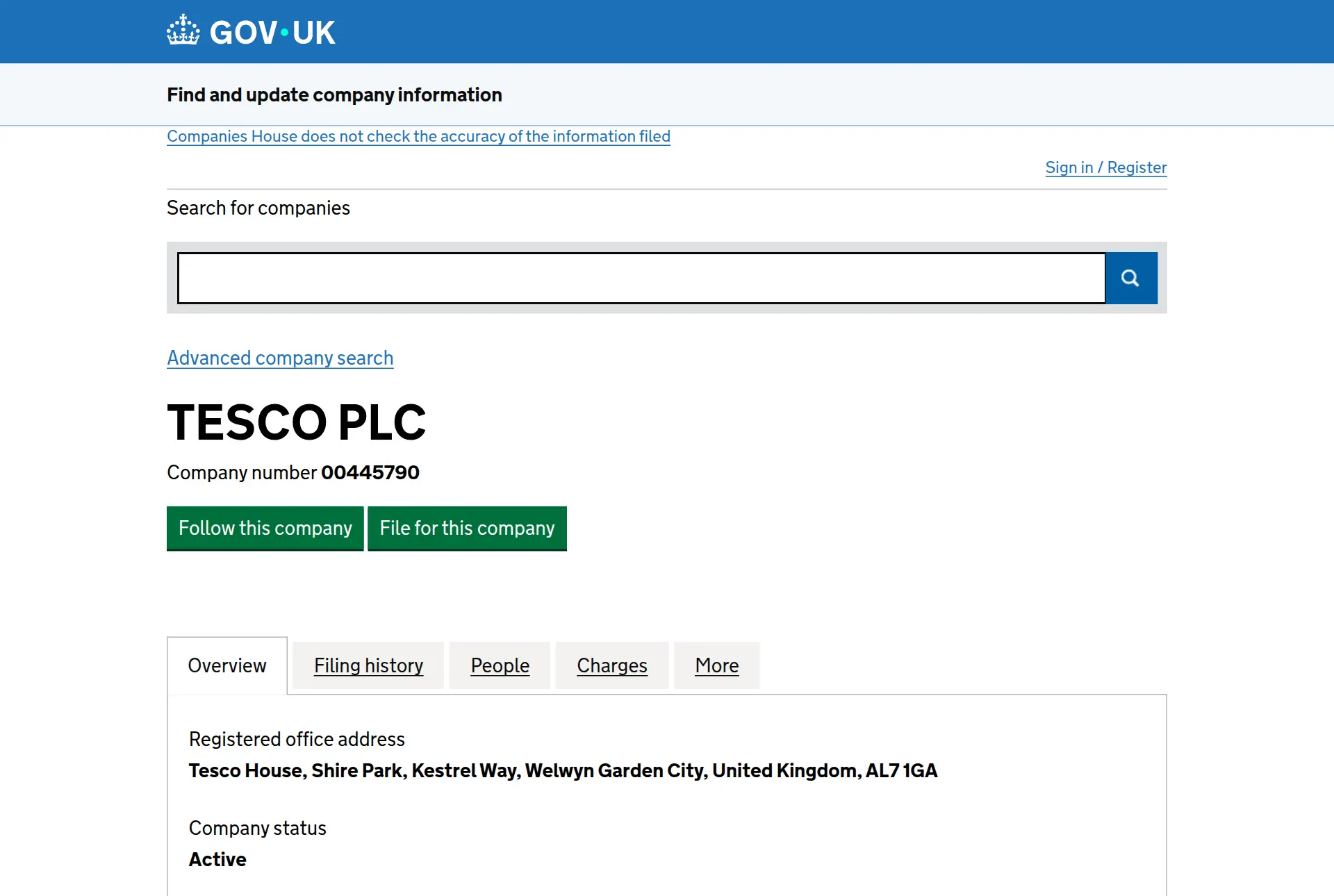
A record this scraper returned for this input. The first 9 of its 24 fields are set down here; the whole record is below.
What it is used for
- Vet a UK company
- Status, company type, registered office, incorporation date and SIC codes, with whether the register holds charges or insolvency history, from its own page.
- Watch filing deadlines
- Read a company on your schedule and follow
next_accounts_due_by,next_statement_due_byand the overdue flags, to see when a filing falls late. - Complete a company record
- Add the registered name, previous names, registered office and officers to the UK companies you hold, keyed by
company_number.
What you send
A UK company's number on the Companies House register, or the address of its page there. These are its 2 inputs, as its schema has them.
companystring Required- The company number, such as 00445790, SC123456 or OC300001, or the address of the company's page on the register. companies_house.search finds the number by name.
officersboolean Optional- true, the default, reads the company's officers as well: up to 105, current ones first. false reads the company's own page only.Default
true
A request, ready to send
It starts a run with the input shown at the top of this page, waits up to 60 seconds for it, and reads its records. Put your key in the variable it reads.
# Start a run and wait up to 60 seconds for it to finish
curl -X POST "https://api.enrichednow.com/v1/scrapers/companies_house.company/runs?wait=60" \
  -H "Authorization: Bearer $ENRICHEDNOW_API_KEY" \
  -H "Content-Type: application/json" \
  -d '{"input":{"company":"00445790","officers":false}}'

# Read its records, with the id the first call answered
curl "https://api.enrichednow.com/v1/runs/$RUN_ID/records?limit=100" \
  -H "Authorization: Bearer $ENRICHEDNOW_API_KEY"
from enrichednow import EnrichedNow
client = EnrichedNow() # reads ENRICHEDNOW_API_KEY
# Start a run, wait for it to end, and get its records
result = client.scrape("companies_house.company", {
"company": "00445790",
"officers": False,
})
print(result.run.id, result.run.status, result.run.record_count)
# Read its records: pages are fetched as you go
for record in result.records:
print(record)Install it with pip install enrichednow, then save as run.py and run python3 run.py
import EnrichedNow from "enrichednow";

const client = new EnrichedNow(); // reads ENRICHEDNOW_API_KEY

// Start a run, wait for it to end, and get its records
const { run, records } = await client.scrape("companies_house.company", {
  company: "00445790",
  officers: false,
});
console.log(run.id, run.status, run.record_count);

// Read its records: pages are fetched as you go
for await (const record of records) console.log(record);
Install it with npm install enrichednow, then save as run.mjs and run node run.mjs
package main

import (
	"context"
	"fmt"
	"log"
	"time"

	enrichednow "github.com/enrichednow/enrichednow-go"
)

func main() {
	client, err := enrichednow.NewClient() // reads ENRICHEDNOW_API_KEY
	if err != nil {
		log.Fatal(err)
	}
	ctx, cancel := context.WithTimeout(context.Background(), 10*time.Minute)
	defer cancel()

	// Start a run, wait for it to end, and get its records
	run, records, err := client.Scrape(ctx, "companies_house.company", map[string]any{"company": "00445790", "officers": false})
	if err != nil {
		log.Fatal(err)
	}
	fmt.Println(run.ID, run.Status, run.RecordCount)

	// Read its records: pages are fetched as you go
	for records.Next() {
		fmt.Println(string(records.Current()))
	}
	if err := records.Err(); err != nil {
		log.Fatal(err)
	}
}
Install it with go get github.com/enrichednow/enrichednow-go@latest, then save as run.go and run go run run.go
import com.enrichednow.EnrichedNowClient;
import com.enrichednow.ScrapeResult;
import java.util.Map;

public class Run {
    public static void main(String[] args) {
        EnrichedNowClient client = EnrichedNowClient.fromEnv(); // reads ENRICHEDNOW_API_KEY

        // Start a run, wait for it to end, and get its records
        ScrapeResult result = client.scrape("companies_house.company", Map.of("company", "00445790", "officers", false));
        System.out.println(result.run().id() + " " + result.run().status() + " " + result.run().recordCount());

        // Read its records: pages are fetched as you go
        for (Map<String, Object> record : result.records()) {
            System.out.println(record);
        }
    }
}
Add com.enrichednow:enrichednow-java:0.4.0 to your Maven or Gradle build, then save as Run.java
enrichednow run companies_house.company --input-json '{"company":"00445790","officers":false}'Install it with curl -fsSL https://raw.githubusercontent.com/enrichednow/enrichednow-cli/main/install.sh | sh
What comes back
What the register's page states: name, status, type, registered office, date of incorporation, the dates of its accounts and confirmation statement and whether either is overdue, SIC codes, previous names, whether it has charges or insolvency history, and its officers. A record has 24 fields. One we could not read is null, never an empty string or a zero.
{
  "company_number": "00445790",
  "name": "TESCO PLC",
  "url": "https://find-and-update.company-information.service.gov.uk/company/00445790",
  "status": "Active",
  "company_type": "Public limited Company",
  "registered_office_address": "Tesco House, Shire Park, Kestrel Way, Welwyn Garden City, United Kingdom, AL7 1GA",
  "incorporated_on": "1947-11-27",
  "dissolved_on": null,
  "next_accounts_made_up_to": "2027-02-26",
  "next_accounts_due_by": "2027-08-26",
  "last_accounts_made_up_to": "2026-02-28",
  "accounts_overdue": false,
  "next_statement_date": "2027-06-18",
  "next_statement_due_by": "2027-07-02",
  "last_statement_date": "2026-06-18",
  "confirmation_statement_overdue": false,
  "sic_codes": [
    {
      "code": "47110",
      "description": "Retail sale in non-specialised stores with food, beverages or tobacco predominating"
    }
  ],
  "previous_names": [
    {
      "name": "TESCO STORES (HOLDINGS) PUBLIC LIMITED COMPANY",
      "from_date": "1981-12-14",
      "to_date": "1983-08-25"
    },
    {
      "name": "TESCO STORES (HOLDINGS) LIMITED",
      "from_date": "1947-11-27",
      "to_date": "1981-12-14"
    }
  ],
  "has_charges": true,
  "has_insolvency_history": false,
  "officer_count": null,
  "resigned_officer_count": null,
  "officers": [],
  "fetched_at": "2026-11-19T18:07:39.673450Z"
}
The scraper returned this record for the input above, reading a saved copy of the page, not the live site.
The fields of a record
company_numberstring- The company's number on the register, e.g.
00445790. namestring- The company's registered name.
urlstring- The company's page on the register.
statusstring or null- The company's status, e.g.
Active,Dissolved,Liquidation,Closed. company_typestring or null- The kind of company, as the register words it, e.g.
Private limited Company,Public limited Company,Limited liability partnership. registered_office_addressstring or null- The registered office address, on one line. For a UK establishment of an overseas company, the establishment's office.
incorporated_ondate or null- The day the company was incorporated (or registered, or a UK establishment opened).
dissolved_ondate or null- The day the company was dissolved, for a dissolved company.
next_accounts_made_up_todate or null- The end of the period the next accounts cover.
next_accounts_due_bydate or null- The day the next accounts are due.
last_accounts_made_up_todate or null- The end of the period the last filed accounts cover.
accounts_overdueboolean- True when the page warns that the accounts are overdue.
next_statement_datedate or null- The date of the next confirmation statement.
next_statement_due_bydate or null- The day the next confirmation statement is due.
last_statement_datedate or null- The date of the last confirmation statement filed.
confirmation_statement_overdueboolean- True when the page warns that the confirmation statement is overdue.
sic_codeslist of objects- The nature of the business, as the SIC codes the company filed.
previous_nameslist of objects- The names the company had before, latest first.
has_chargesboolean- True when the register holds charges (mortgages and the like) for the company: its page then has a Charges tab.
has_insolvency_historyboolean- True when the register holds insolvency cases for the company: its page then has an Insolvency tab.
officer_countinteger or null- How many appointments the register lists for the company, past ones included. Null when the officers were not read.
resigned_officer_countinteger or null- How many of those appointments have ended.
officerslist of objects- The officers, in the register's order: current appointments first. See
officer_countfor how many there are in all.Each holdsname,role,status,appointed_on,resigned_on,date_of_birth,nationality,country_of_residence. fetched_atdatetime- When the register was read, in UTC.
Units and limits
- Counted per request
- Billed per request: a run that returns data costs 1 unit, however many records it returns.
- A miss costs nothing
- A run that fails, that meets something not supported yet, or that you cancel costs nothing. You pay for runs that return data.
- What bounds a run
- A run may take up to 5 minutes. Its records are read in pages of up to 1,000 and are kept for 7 days.
What it does not do
- One run reads one company. Up to 105 officers are returned, current ones first; officer_count says how many the register lists.
- An officer is returned as the register prints the appointment: name, role, dates, nationality, country of residence and month and year of birth. Correspondence addresses are not returned, and a person cannot be looked up: the input is always a company.
- Filing history, charges, insolvency cases and persons with significant control are not read: has_charges and has_insolvency_history say whether the register holds any.
Questions
What does Companies House company return?
What the register's page states: name, status, type, registered office, date of incorporation, the dates of its accounts and confirmation statement and whether either is overdue, SIC codes, previous names, whether it has charges or insolvency history, and its officers. A record has 24 fields, among them company_number, name, url, status, company_type and registered_office_address. A value that could not be read is null, never an empty string or a zero.
What do I send?
A UK company's number on the Companies House register, or the address of its page there. The input company is required. Optional: officers.
How is it counted?
Billed per request: a run that returns data costs 1 unit, however many records it returns. A run that fails, that meets something not supported yet, or that you cancel costs nothing. The first 1,000 units each month are free.
What does it not do?
One run reads one company. Up to 105 officers are returned, current ones first; officer_count says how many the register lists. An officer is returned as the register prints the appointment: name, role, dates, nationality, country of residence and month and year of birth. Correspondence addresses are not returned, and a person cannot be looked up: the input is always a company. Filing history, charges, insolvency cases and persons with significant control are not read: has_charges and has_insolvency_history say whether the register holds any.
How long are the records kept, and in what format do they come?
Records are kept for 7 days after the run ended, and read in pages of up to 1,000. They come as JSON, as NDJSON with one record a line, or as CSV with a column for each field.
Can an AI assistant call it?
Yes. Through the EnrichedNow MCP server an assistant calls the tool run_scraper with the scraper_id companies_house.company and the same input. It costs what the same API call costs.
Used in this playbook
A playbook runs Companies House company as one of its steps and hands back the finished list. Its runs of this scraper cost what they cost here, and the playbook adds nothing.
Finance
Company Diligence
Each company you name checked on its register, in adverse news, reviews and complaints, and its website, with red flags.
Companies House
UK companies as the public Companies House register shows them: a search by name or number, and one company's page.
Companies House search
companies_house.searchA UK company's name, part of it, or its company number. The companies the Companies House register lists for it, 20 a page: company number, name, status, date of incorporation or dissolution, registered office address, and the earlier names that matched.
Companies House on the line-up
- Industry
- Companies and B2B
- Where
- United Kingdom
- Data
- Company profiles
Run it on an input of your own.
Create an account, make a key, and send the request above with your own input. The first 1,000 units each month are free.