Scraper API
Yahoo Search
yahoo.videosAvailable
Yahoo video search
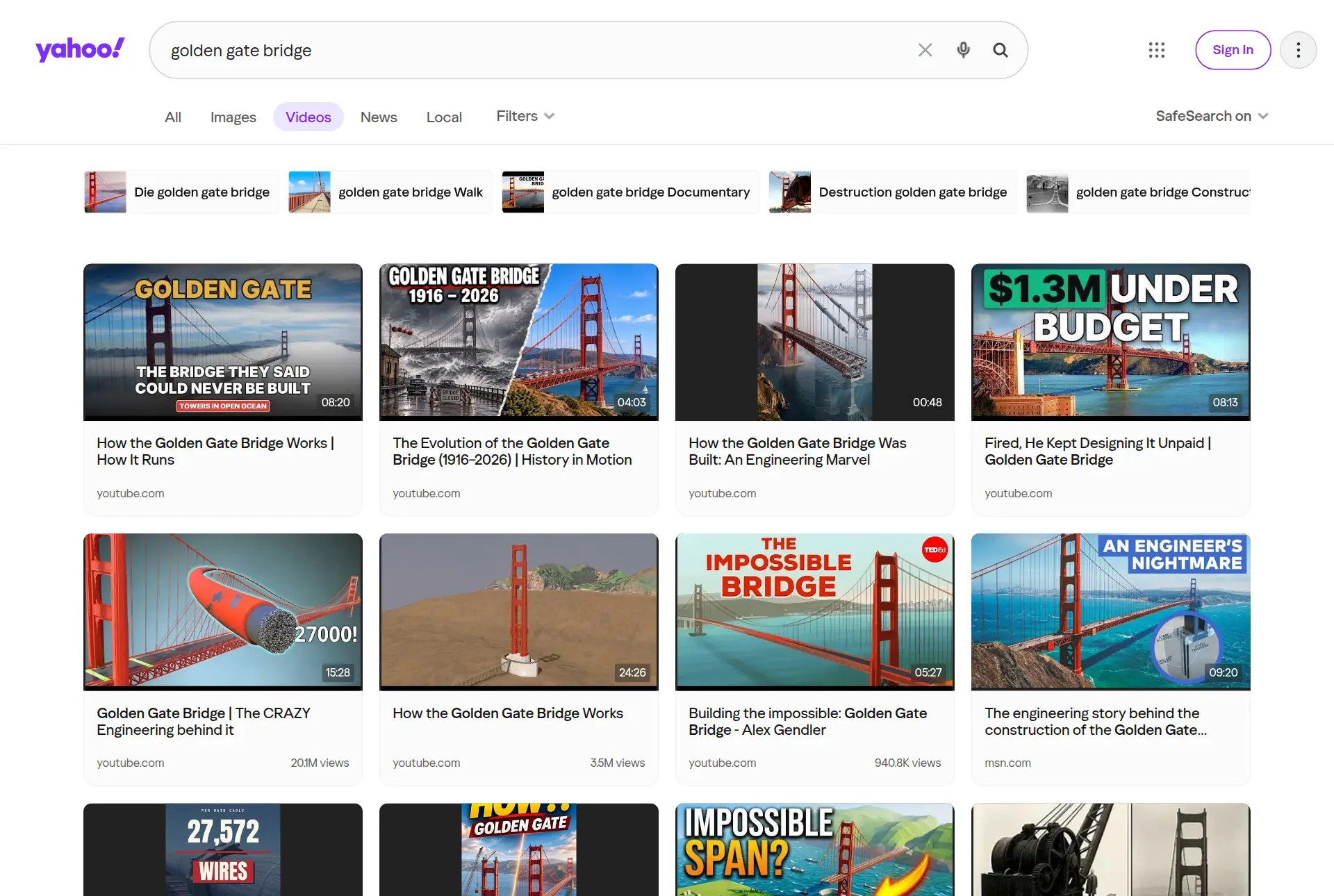
The videos on the first screen of Yahoo's video results: title, the address of the video's page, length, the site that hosts it and the start of its description.
Give it Words to search for.
1 unit a run, for runs that return data. Runs that fail cost nothing. How units work
- Counted
- 1 unit a run
- Inputs
- 2, 1 required
- Record
- 9 fields
- A run takes
- up to 5 minutes
- Records kept
- 7 days
- Measured
- its success, on the status page
POST/v1/scrapers/yahoo.videos/runs
sent, and answered
a record of the run9 fields
ok1 unit a run
A record this scraper returned for this input. The first 9 of its 9 fields are set down here; the whole record is below.
What it is used for
- Find videos on a subject
- The videos Yahoo finds for a query, from the sites that host them, each with its title, duration, source and page address.
- See which platforms rank
- Count the results by
source_domainto see which video sites Yahoo puts first for the terms your audience searches. - Watch a brand in video
- Search a name on a schedule and list the videos you have not seen, with the site that hosts each and its description.
What you send
Words to search for. These are its 2 inputs, as its schema has them.
querystring Required- What to search for, e.g.
golden gate bridge. max_resultsinteger Optional- Return at most this many results; all of the first screen (about 60) when not given.
A request, ready to send
It starts a run with the input shown at the top of this page, waits up to 60 seconds for it, and reads its records. Put your key in the variable it reads.
# Start a run and wait up to 60 seconds for it to finish
curl -X POST "https://api.enrichednow.com/v1/scrapers/yahoo.videos/runs?wait=60" \
  -H "Authorization: Bearer $ENRICHEDNOW_API_KEY" \
  -H "Content-Type: application/json" \
  -d '{"input":{"query":"golden gate bridge"}}'

# Read its records, with the id the first call answered
curl "https://api.enrichednow.com/v1/runs/$RUN_ID/records?limit=100" \
  -H "Authorization: Bearer $ENRICHEDNOW_API_KEY"
from enrichednow import EnrichedNow
client = EnrichedNow() # reads ENRICHEDNOW_API_KEY
# Start a run, wait for it to end, and get its records
result = client.scrape("yahoo.videos", {"query": "golden gate bridge"})
print(result.run.id, result.run.status, result.run.record_count)
# Read its records: pages are fetched as you go
for record in result.records:
print(record)Install it with pip install enrichednow, then save as run.py and run python3 run.py
import EnrichedNow from "enrichednow";

const client = new EnrichedNow(); // reads ENRICHEDNOW_API_KEY

// Start a run, wait for it to end, and get its records
const { run, records } = await client.scrape("yahoo.videos", { query: "golden gate bridge" });
console.log(run.id, run.status, run.record_count);

// Read its records: pages are fetched as you go
for await (const record of records) console.log(record);
Install it with npm install enrichednow, then save as run.mjs and run node run.mjs
package main

import (
	"context"
	"fmt"
	"log"
	"time"

	enrichednow "github.com/enrichednow/enrichednow-go"
)

func main() {
	client, err := enrichednow.NewClient() // reads ENRICHEDNOW_API_KEY
	if err != nil {
		log.Fatal(err)
	}
	ctx, cancel := context.WithTimeout(context.Background(), 10*time.Minute)
	defer cancel()

	// Start a run, wait for it to end, and get its records
	run, records, err := client.Scrape(ctx, "yahoo.videos", map[string]any{"query": "golden gate bridge"})
	if err != nil {
		log.Fatal(err)
	}
	fmt.Println(run.ID, run.Status, run.RecordCount)

	// Read its records: pages are fetched as you go
	for records.Next() {
		fmt.Println(string(records.Current()))
	}
	if err := records.Err(); err != nil {
		log.Fatal(err)
	}
}
Install it with go get github.com/enrichednow/enrichednow-go@latest, then save as run.go and run go run run.go
import com.enrichednow.EnrichedNowClient;
import com.enrichednow.ScrapeResult;
import java.util.Map;

public class Run {
    public static void main(String[] args) {
        EnrichedNowClient client = EnrichedNowClient.fromEnv(); // reads ENRICHEDNOW_API_KEY

        // Start a run, wait for it to end, and get its records
        ScrapeResult result = client.scrape("yahoo.videos", Map.of("query", "golden gate bridge"));
        System.out.println(result.run().id() + " " + result.run().status() + " " + result.run().recordCount());

        // Read its records: pages are fetched as you go
        for (Map<String, Object> record : result.records()) {
            System.out.println(record);
        }
    }
}
Add com.enrichednow:enrichednow-java:0.4.0 to your Maven or Gradle build, then save as Run.java
enrichednow run yahoo.videos --input 'query=golden gate bridge'Install it with curl -fsSL https://raw.githubusercontent.com/enrichednow/enrichednow-cli/main/install.sh | sh
What comes back
The videos on the first screen of Yahoo's video results: title, the address of the video's page, length, the site that hosts it and the start of its description. A record has 9 fields. One we could not read is null, never an empty string or a zero.
{
  "position": 1,
  "title": "How the Golden Gate Bridge Works | How It Runs",
  "url": "https://www.youtube.com/watch?v=pHnU-BScXoc",
  "duration": "08:20",
  "source": "YouTube",
  "source_domain": "youtube.com",
  "description": "In the 1920s, many experts said a bridge across the Golden Gate was impossible: the water was too deep, the tides too strong, the winds too wild, and the ground shook with earthquakes. It was built anyway, in just over four years, and it is … [truncated]",
  "thumbnail": "https://up.yimg.com/ib/th/id/OVF.ntafWXBdcpB7TkUeuKkqfg?pid=Api&h=360&w=480&c=7&rs=1&qlt=95",
  "fetched_at": "2026-11-19T18:07:42.713978Z"
}
The scraper returned this record for the input above, reading a saved copy of the page, not the live site.
Values shortened for this page: description: 349 characters, the first 240 shown.
The fields of a record
positioninteger- The video's place among the results, from 1.
titlestring- The video's title.
urlstring- The address of the video's page on the site that hosts it.
durationstring or null- The video's length as shown on the tile, e.g.
08:20or1:02:45. sourcestring or null- The name of the site that hosts the video, e.g.
YouTube. source_domainstring or null- That site's domain, e.g.
youtube.com. descriptionstring or null- The start of the video's description, where the tile carries one.
thumbnailstring or null- The address of the preview picture shown in the results.
fetched_atdatetime- When the results were read, in UTC.
Units and limits
- Counted per request
- Billed per request: a run that returns data costs 1 unit, however many records it returns.
- A miss costs nothing
- A run that fails, that meets something not supported yet, or that you cancel costs nothing. You pay for runs that return data.
- What bounds a run
- A run may take up to 5 minutes. Its records are read in pages of up to 1,000 and are kept for 7 days.
What it does not do
- One run reads the first screen of results, about 60 videos. The ones Yahoo loads on scrolling are not read.
- The record gives the address of the video's page. No video file is downloaded.
The bounds its schema sets
max_results- 1 to 100
Questions
What does Yahoo video search return?
The videos on the first screen of Yahoo's video results: title, the address of the video's page, length, the site that hosts it and the start of its description. A record has 9 fields, among them position, title, url, duration, source and source_domain. A value that could not be read is null, never an empty string or a zero.
What do I send?
Words to search for. The input query is required. Optional: max_results.
How is it counted?
Billed per request: a run that returns data costs 1 unit, however many records it returns. A run that fails, that meets something not supported yet, or that you cancel costs nothing. The first 1,000 units each month are free.
How much does one run return?
Its schema sets these bounds: max_results 1 to 100. A run may take up to 5 minutes.
What does it not do?
One run reads the first screen of results, about 60 videos. The ones Yahoo loads on scrolling are not read. The record gives the address of the video's page. No video file is downloaded.
How long are the records kept, and in what format do they come?
Records are kept for 7 days after the run ended, and read in pages of up to 1,000. They come as JSON, as NDJSON with one record a line, or as CSV with a column for each field.
Can an AI assistant call it?
Yes. Through the EnrichedNow MCP server an assistant calls the tool run_scraper with the scraper_id yahoo.videos and the same input. It costs what the same API call costs.
Yahoo Search
Yahoo's image and video search results, as a visitor who is not signed in sees them.
Yahoo image search
yahoo.imagesWords to search for. The images on the first screen of Yahoo's image results: each image's address and size, its title, and the page it is on.
- Industry
- Search and the open web
- Where
- Worldwide
Run it on an input of your own.
Create an account, make a key, and send the request above with your own input. The first 1,000 units each month are free.