Scraper API
WordPress plugins
wordpress.pluginAvailable
WordPress plugin
The plugin: author, version, rating with the count of each star, active installations, downloads, support threads, the WordPress and PHP versions it needs, tags, when it was added and last updated, and its description.
Give it a plugin's slug, or the address of its page on wordpress.org.
1 unit a run, for runs that return data. Runs that fail cost nothing. How units work
- Counted
- 1 unit a run
- Inputs
- 1, 1 required
- Record
- 29 fields
- A run takes
- up to 5 minutes
- Records kept
- 7 days
- Measured
- its success, on the status page
POST/v1/scrapers/wordpress.plugin/runs
sent, and answered
a record of the run29 fields
ok1 unit a run
A record this scraper returned for this input. The first 9 of its 29 fields are set down here; the whole record is below.
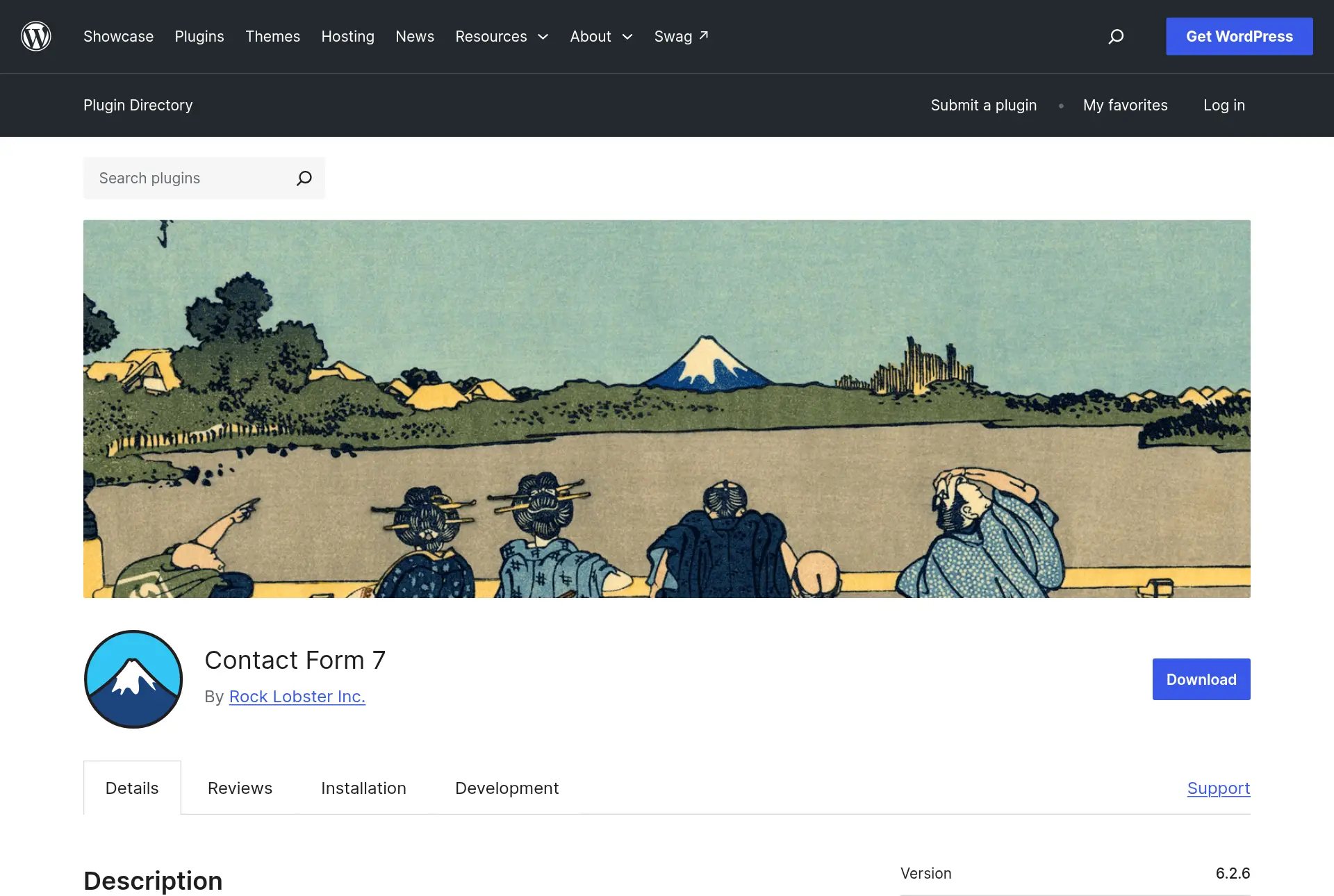
What it is used for
- Track a plugin's reach
- Read a plugin on a schedule and follow its
active_installations,ratinganddownloads. - Vet before you install
- Check
tested_up_to,requires_php,last_updatedandsupport_threads_resolvedfirst. - Find commercial plugins
- Read
business_modelandcommercial_support_urlto see who sells upgrades or support.
What you send
A plugin's slug, or the address of its page on wordpress.org. It is the one input.
pluginstring Required- The plugin's slug (the name in its address, e.g. contact-form-7) or its address.
A request, ready to send
It starts a run with the input shown at the top of this page, waits up to 60 seconds for it, and reads its records. Put your key in the variable it reads.
# Start a run and wait up to 60 seconds for it to finish
curl -X POST "https://api.enrichednow.com/v1/scrapers/wordpress.plugin/runs?wait=60" \
  -H "Authorization: Bearer $ENRICHEDNOW_API_KEY" \
  -H "Content-Type: application/json" \
  -d '{"input":{"plugin":"contact-form-7"}}'

# Read its records, with the id the first call answered
curl "https://api.enrichednow.com/v1/runs/$RUN_ID/records?limit=100" \
  -H "Authorization: Bearer $ENRICHEDNOW_API_KEY"
from enrichednow import EnrichedNow
client = EnrichedNow() # reads ENRICHEDNOW_API_KEY
# Start a run, wait for it to end, and get its records
result = client.scrape("wordpress.plugin", {"plugin": "contact-form-7"})
print(result.run.id, result.run.status, result.run.record_count)
# Read its records: pages are fetched as you go
for record in result.records:
print(record)Install it with pip install enrichednow, then save as run.py and run python3 run.py
import EnrichedNow from "enrichednow";

const client = new EnrichedNow(); // reads ENRICHEDNOW_API_KEY

// Start a run, wait for it to end, and get its records
const { run, records } = await client.scrape("wordpress.plugin", { plugin: "contact-form-7" });
console.log(run.id, run.status, run.record_count);

// Read its records: pages are fetched as you go
for await (const record of records) console.log(record);
Install it with npm install enrichednow, then save as run.mjs and run node run.mjs
package main

import (
	"context"
	"fmt"
	"log"
	"time"

	enrichednow "github.com/enrichednow/enrichednow-go"
)

func main() {
	client, err := enrichednow.NewClient() // reads ENRICHEDNOW_API_KEY
	if err != nil {
		log.Fatal(err)
	}
	ctx, cancel := context.WithTimeout(context.Background(), 10*time.Minute)
	defer cancel()

	// Start a run, wait for it to end, and get its records
	run, records, err := client.Scrape(ctx, "wordpress.plugin", map[string]any{"plugin": "contact-form-7"})
	if err != nil {
		log.Fatal(err)
	}
	fmt.Println(run.ID, run.Status, run.RecordCount)

	// Read its records: pages are fetched as you go
	for records.Next() {
		fmt.Println(string(records.Current()))
	}
	if err := records.Err(); err != nil {
		log.Fatal(err)
	}
}
Install it with go get github.com/enrichednow/enrichednow-go@latest, then save as run.go and run go run run.go
import com.enrichednow.EnrichedNowClient;
import com.enrichednow.ScrapeResult;
import java.util.Map;

public class Run {
    public static void main(String[] args) {
        EnrichedNowClient client = EnrichedNowClient.fromEnv(); // reads ENRICHEDNOW_API_KEY

        // Start a run, wait for it to end, and get its records
        ScrapeResult result = client.scrape("wordpress.plugin", Map.of("plugin", "contact-form-7"));
        System.out.println(result.run().id() + " " + result.run().status() + " " + result.run().recordCount());

        // Read its records: pages are fetched as you go
        for (Map<String, Object> record : result.records()) {
            System.out.println(record);
        }
    }
}
Add com.enrichednow:enrichednow-java:0.4.0 to your Maven or Gradle build, then save as Run.java
enrichednow run wordpress.plugin --input plugin=contact-form-7Install it with curl -fsSL https://raw.githubusercontent.com/enrichednow/enrichednow-cli/main/install.sh | sh
What comes back
The plugin: author, version, rating with the count of each star, active installations, downloads, support threads, the WordPress and PHP versions it needs, tags, when it was added and last updated, and its description. A record has 29 fields. One we could not read is null, never an empty string or a zero.
{
  "slug": "contact-form-7",
  "url": "https://wordpress.org/plugins/contact-form-7/",
  "name": "Contact Form 7",
  "version": "6.2.6",
  "author": "Rock Lobster Inc.",
  "short_description": "Just another contact form plugin. Simple but flexible.",
  "description": "Contact Form 7 is a plugin designed to be a practical tool for all WordPress users who embrace the philosophy of free and open source software. It employs sophisticatedly modularized architecture and its original Schema-Woven Validation … [truncated]",
  "tags": [
    "contact form",
    "schema-woven validation"
  ],
  "rating": 4,
  "rating_count": 2189,
  "ratings_by_stars": {
    "1": 409,
    "2": 68,
    "3": 79,
    "4": 156,
    "5": 1477
  },
  "active_installations": 10000000,
  "downloads": 436008221,
  "support_threads": 89,
  "support_threads_resolved": 31,
  "requires_wordpress": "7.1",
  "tested_up_to": "7.2",
  "requires_php": "8.3",
  "last_updated": "2026-11-23T02:28:00Z",
  "added": "2007-08-02",
  "business_model": null,
  "homepage": "https://contactform7.com/",
  "commercial_support_url": null,
  "version_count": 213,
  "icon": "https://ps.w.org/contact-form-7/assets/icon.svg?rev=2339255",
  "closed": false,
  "closed_date": null,
  "closed_reason": null,
  "fetched_at": "2026-11-24T20:16:20.089368Z"
}
The scraper returned this record for the input above, reading a saved copy of the page, not the live site.
Values shortened for this page: description: 991 characters, the first 236 shown.
The fields of a record
slugstring- The plugin's slug, the name in its address.
wordpress.plugintakes it. urlstring- The plugin's page on wordpress.org.
namestring- The plugin's name.
versionstring or null- The latest version.
authorstring or null- The plugin's author, by the name the directory shows.
short_descriptionstring or null- The plugin's one-line description.
descriptionstring or null- The plugin's description, as text.
tagslist of strings- The plugin's tags.
ratingnumber or null- The average rating, from 1 to 5; null for a plugin nobody has rated.
rating_countinteger or null- How many people rated it.
ratings_by_starsobject- How many ratings of each number of stars, e.g. {"5": 1477, "1": 409}.
active_installationsinteger or null- The sites it is active on, as the directory rounds them (10000000 is "10+ million").
downloadsinteger or null- How many times it was downloaded, all versions.
support_threadsinteger or null- Threads in its support forum in the last two months.
support_threads_resolvedinteger or null- How many of those are marked resolved.
requires_wordpressstring or null- The oldest version of WordPress it needs.
tested_up_tostring or null- The newest version of WordPress it was tested with.
requires_phpstring or null- The oldest version of PHP it needs.
last_updateddatetime or null- When it was last updated, in UTC.
addedstring or null- The day it was added to the directory, as YYYY-MM-DD.
business_modelstring or nullcommercialfor a plugin with paid upgrades or services,communityfor one a community supports; null when it states neither.homepagestring or null- The plugin's website.
commercial_support_urlstring or null- Where paid support is offered, for a commercial plugin.
version_countinteger or null- How many versions it has published.
iconstring or null- The plugin's icon.
closedboolean- True when the directory has closed the plugin: it is no longer offered for download, and the record holds only what the closure notice states.
closed_datestring or null- The day the directory closed it, as YYYY-MM-DD.
closed_reasonstring or null- Why, as the directory states it:
security-issue,author-request,guideline-violation, ... fetched_atdatetime- When the directory answered, in UTC.
Units and limits
- Counted per request
- Billed per request: a run that returns data costs 1 unit, however many records it returns.
- A miss costs nothing
- A run that fails, that meets something not supported yet, or that you cancel costs nothing. You pay for runs that return data.
- What bounds a run
- A run may take up to 5 minutes. Its records are read in pages of up to 1,000 and are kept for 7 days.
What it does not do
- Active installations is the directory's rounded figure.
- A slug the directory has no plugin for ends as failed with the reason not_found, and costs nothing.
Questions
What does WordPress plugin return?
The plugin: author, version, rating with the count of each star, active installations, downloads, support threads, the WordPress and PHP versions it needs, tags, when it was added and last updated, and its description. A record has 29 fields, among them slug, url, name, version, author and short_description. A value that could not be read is null, never an empty string or a zero.
What do I send?
A plugin's slug, or the address of its page on wordpress.org. The input plugin is required.
How is it counted?
Billed per request: a run that returns data costs 1 unit, however many records it returns. A run that fails, that meets something not supported yet, or that you cancel costs nothing. The first 1,000 units each month are free.
What does it not do?
Active installations is the directory's rounded figure. A slug the directory has no plugin for ends as failed with the reason not_found, and costs nothing.
How long are the records kept, and in what format do they come?
Records are kept for 7 days after the run ended, and read in pages of up to 1,000. They come as JSON, as NDJSON with one record a line, or as CSV with a column for each field.
Can an AI assistant call it?
Yes. Through the EnrichedNow MCP server an assistant calls the tool run_scraper with the scraper_id wordpress.plugin and the same input. It costs what the same API call costs.
WordPress plugins
Plugins of the WordPress.org directory: author, rating, active installations, downloads, the versions they need and when they were updated.
WordPress plugins
wordpress.pluginsA section of the plugin directory (popular, featured, blocks or beta) or a tag, and a page. A page of 20 plugins: name, author, rating and count of ratings, active installations, the WordPress version tested with, categories and one-line description.
WordPress plugins on the line-up
- Industry
- Reviews and apps
- Where
- Worldwide
Run it on an input of your own.
Create an account, make a key, and send the request above with your own input. The first 1,000 units each month are free.