Scraper API
Wikipedia
wikipedia.pageAvailable
Wikipedia article
The article: its text as a whole and by section, its one-line description, categories, lead image, coordinates, Wikidata id and when it was last edited.
Give it an article's title and a language, or the article's address.
1 unit a run, for runs that return data. Runs that fail cost nothing. How units work
- Counted
- 1 unit a run
- Inputs
- 3
- Record
- 21 fields
- A run takes
- up to 5 minutes
- Records kept
- 7 days
- Measured
- its success, on the status page
POST/v1/scrapers/wikipedia.page/runs
sent, and answered
a record of the run21 fields
ok1 unit a run
A record this scraper returned for this input. The first 9 of its 21 fields are set down here; the whole record is below.
What it is used for
- Ground a model in an article
- An article as plain text, whole and cut at its headings in
sections, with itssummary, ready to give a language model or a search index. - Link entities to Wikidata
wikidata_id,descriptionand the coordinates for a place connect a name in your data to one entity, in any of Wikipedia's languages.- Notice when an article changes
- Read an article on a schedule and compare
revision_idandlast_edited_atto know when it was edited, then read what it says now.
What you send
An article's title and a language, or the article's address. These are its 3 inputs, as its schema has them.
titlestring Optional- The article's title, e.g.
Ada Lovelace. A title Wikipedia redirects is followed. urlstring Optional- The article's address instead, e.g.
https://en.wikipedia.org/wiki/Ada_Lovelace. Its language is the address's own. languagestring Optional- The language edition, as Wikipedia's code for it:
en(the default),de,ja,simple. Withurlit may only repeat the address's own.
A request, ready to send
It starts a run with the input shown at the top of this page, waits up to 60 seconds for it, and reads its records. Put your key in the variable it reads.
# Start a run and wait up to 60 seconds for it to finish
curl -X POST "https://api.enrichednow.com/v1/scrapers/wikipedia.page/runs?wait=60" \
  -H "Authorization: Bearer $ENRICHEDNOW_API_KEY" \
  -H "Content-Type: application/json" \
  -d '{"input":{"title":"Ada Lovelace"}}'

# Read its records, with the id the first call answered
curl "https://api.enrichednow.com/v1/runs/$RUN_ID/records?limit=100" \
  -H "Authorization: Bearer $ENRICHEDNOW_API_KEY"
from enrichednow import EnrichedNow
client = EnrichedNow() # reads ENRICHEDNOW_API_KEY
# Start a run, wait for it to end, and get its records
result = client.scrape("wikipedia.page", {"title": "Ada Lovelace"})
print(result.run.id, result.run.status, result.run.record_count)
# Read its records: pages are fetched as you go
for record in result.records:
print(record)Install it with pip install enrichednow, then save as run.py and run python3 run.py
import EnrichedNow from "enrichednow";

const client = new EnrichedNow(); // reads ENRICHEDNOW_API_KEY

// Start a run, wait for it to end, and get its records
const { run, records } = await client.scrape("wikipedia.page", { title: "Ada Lovelace" });
console.log(run.id, run.status, run.record_count);

// Read its records: pages are fetched as you go
for await (const record of records) console.log(record);
Install it with npm install enrichednow, then save as run.mjs and run node run.mjs
package main

import (
	"context"
	"fmt"
	"log"
	"time"

	enrichednow "github.com/enrichednow/enrichednow-go"
)

func main() {
	client, err := enrichednow.NewClient() // reads ENRICHEDNOW_API_KEY
	if err != nil {
		log.Fatal(err)
	}
	ctx, cancel := context.WithTimeout(context.Background(), 10*time.Minute)
	defer cancel()

	// Start a run, wait for it to end, and get its records
	run, records, err := client.Scrape(ctx, "wikipedia.page", map[string]any{"title": "Ada Lovelace"})
	if err != nil {
		log.Fatal(err)
	}
	fmt.Println(run.ID, run.Status, run.RecordCount)

	// Read its records: pages are fetched as you go
	for records.Next() {
		fmt.Println(string(records.Current()))
	}
	if err := records.Err(); err != nil {
		log.Fatal(err)
	}
}
Install it with go get github.com/enrichednow/enrichednow-go@latest, then save as run.go and run go run run.go
import com.enrichednow.EnrichedNowClient;
import com.enrichednow.ScrapeResult;
import java.util.Map;

public class Run {
    public static void main(String[] args) {
        EnrichedNowClient client = EnrichedNowClient.fromEnv(); // reads ENRICHEDNOW_API_KEY

        // Start a run, wait for it to end, and get its records
        ScrapeResult result = client.scrape("wikipedia.page", Map.of("title", "Ada Lovelace"));
        System.out.println(result.run().id() + " " + result.run().status() + " " + result.run().recordCount());

        // Read its records: pages are fetched as you go
        for (Map<String, Object> record : result.records()) {
            System.out.println(record);
        }
    }
}
Add com.enrichednow:enrichednow-java:0.4.0 to your Maven or Gradle build, then save as Run.java
enrichednow run wikipedia.page --input 'title=Ada Lovelace'Install it with curl -fsSL https://raw.githubusercontent.com/enrichednow/enrichednow-cli/main/install.sh | sh
What comes back
The article: its text as a whole and by section, its one-line description, categories, lead image, coordinates, Wikidata id and when it was last edited. A record has 21 fields. One we could not read is null, never an empty string or a zero.
{
  "page_id": 974,
  "title": "Ada Lovelace",
  "url": "https://en.wikipedia.org/wiki/Ada_Lovelace",
  "language": "en",
  "description": "English mathematician (1815–1852)",
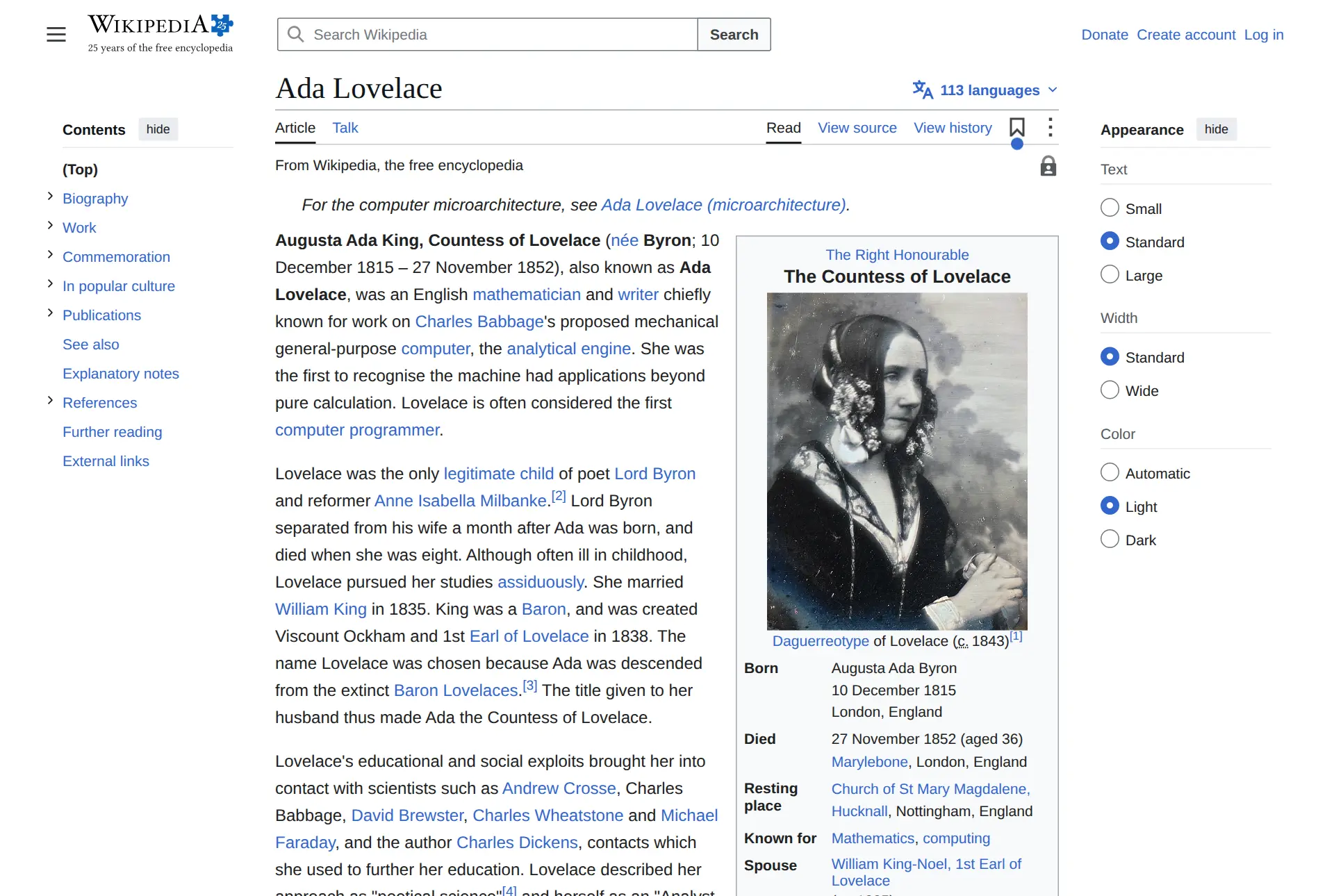
  "summary": "Augusta Ada King, Countess of Lovelace (née Byron; 10 December 1815 – 27 November 1852), also known as Ada Lovelace, was an English mathematician and writer chiefly known for work on Charles Babbage's proposed mechanical general-purpose … [truncated]",
  "text": "Augusta Ada King, Countess of Lovelace (née Byron; 10 December 1815 – 27 November 1852), also known as Ada Lovelace, was an English mathematician and writer chiefly known for work on Charles Babbage's proposed mechanical general-purpose … [truncated]",
  "sections": [
    {
      "title": "Biography",
      "level": 2,
      "text": ""
    },
    {
      "title": "Childhood",
      "level": 3,
      "text": "Lord Byron expected his child to be a \"glorious boy\" and was disappointed when Lady Byron gave birth to a girl. The child was named after Byron's half-sister, Augusta Leigh, and was called \"Ada\" by Byron himself. On 16 January 1816, at Lord … [truncated]"
    }
  ],
  "categories": [
    "1815 births",
    "1852 deaths",
    "19th-century British women mathematicians"
  ],
  "image": "https://upload.wikimedia.org/wikipedia/commons/4/4c/Ada_Lovelace_daguerreotype_by_Antoine_Claudet_1843_-_cropped.png",
  "image_width": 957,
  "image_height": 1239,
  "latitude": null,
  "longitude": null,
  "wikidata_id": "Q7259",
  "is_disambiguation": false,
  "redirected_from": null,
  "last_edited_at": "2026-11-18T12:08:56Z",
  "revision_id": 1386418140,
  "length_bytes": 98431,
  "fetched_at": "2026-11-19T18:07:42.674158Z"
}
The scraper returned this record for the input above, reading a saved copy of the page, not the live site.
Values shortened for this page: summary: 3,186 characters, the first 236 shown; text: 40,824 characters, the first 236 shown; sections: 29 items, the first 2 shown; sections[1].text: 3,981 characters, the first 240 shown; categories: 30 items, the first 3 shown.
The fields of a record
page_idinteger- Wikipedia's id of the article in this language edition.
titlestring- The article's title.
urlstring- The article's address.
languagestring- The language edition the article is from, e.g.
en. descriptionstring or null- The one-line description Wikipedia shows under the title, e.g.
English mathematician (1815–1852). Null where the article has none. summarystring or null- The article's introduction: its text before the first section heading.
textstring or null- The whole article as plain text, section headings written as
== Heading ==. Tables, infoboxes and reference lists are not part of it. sectionslist of objects- The article's sections in order, each with its own text. The introduction is
summary, not a section.Each holdstitle,level,text. categorieslist of strings- The categories the article is in, without Wikipedia's maintenance categories.
imagestring or null- The address of the article's lead image at full size. Null where the article has none.
image_widthinteger or null- The width of that image in pixels.
image_heightinteger or null- The height of that image in pixels.
latitudenumber or null- The latitude of the place the article is about, in decimal degrees. Null for an article that is not about a place.
longitudenumber or null- The longitude of that place.
wikidata_idstring or null- The id of the article's subject in Wikidata, e.g.
Q7259. is_disambiguationboolean- True when the page lists the articles a name can mean instead of being an article itself.
redirected_fromstring or null- The title that was asked for, when Wikipedia led from it to this article (
UKleads toUnited Kingdom). Null otherwise. last_edited_atdatetime or null- When the article was last edited, in UTC.
revision_idinteger or null- The id of the article's current revision.
length_bytesinteger or null- The size of the article's source in bytes.
fetched_atdatetime- When the article was read, in UTC.
Units and limits
- Counted per request
- Billed per request: a run that returns data costs 1 unit, however many records it returns.
- A miss costs nothing
- A run that fails, that meets something not supported yet, or that you cancel costs nothing. You pay for runs that return data.
- What bounds a run
- A run may take up to 5 minutes. Its records are read in pages of up to 1,000 and are kept for 7 days.
What it does not do
- One run reads one article in one language.
- The text is prose and lists. Tables, infoboxes and reference lists are not part of it.
- A title Wikipedia redirects is followed; the record says which title was asked for.
Questions
What does Wikipedia article return?
The article: its text as a whole and by section, its one-line description, categories, lead image, coordinates, Wikidata id and when it was last edited. A record has 21 fields, among them page_id, title, url, language, description and summary. A value that could not be read is null, never an empty string or a zero.
What do I send?
An article's title and a language, or the article's address. Optional: title, url and language.
How is it counted?
Billed per request: a run that returns data costs 1 unit, however many records it returns. A run that fails, that meets something not supported yet, or that you cancel costs nothing. The first 1,000 units each month are free.
What does it not do?
One run reads one article in one language. The text is prose and lists. Tables, infoboxes and reference lists are not part of it. A title Wikipedia redirects is followed; the record says which title was asked for.
How long are the records kept, and in what format do they come?
Records are kept for 7 days after the run ended, and read in pages of up to 1,000. They come as JSON, as NDJSON with one record a line, or as CSV with a column for each field.
Can an AI assistant call it?
Yes. Through the EnrichedNow MCP server an assistant calls the tool run_scraper with the scraper_id wikipedia.page and the same input. It costs what the same API call costs.
Wikipedia
Wikipedia's articles and its search, in any of its languages.
Wikipedia search
wikipedia.searchWords to search for, and a language. The articles Wikipedia's own search finds: title, address, the passage that matched, size, when each was last edited, and how many articles match in all.
- Industry
- Search and the open web
- Where
- Worldwide
Run it on an input of your own.
Create an account, make a key, and send the request above with your own input. The first 1,000 units each month are free.