Scraper API
ThomasNet
thomasnet.supplierAvailable
ThomasNet supplier
What its profile states: what the supplier makes, its type and other activities, address and coordinates, phone, website, annual sales and employee bands, year founded, brands, product families, categories, certification counts and catalogue products.
Give it ThomasNet's id of a supplier, the number that ends the name in its profile's address, or that address.
1 unit a run, for runs that return data. Runs that fail cost nothing. How units work
- Counted
- 1 unit a run
- Inputs
- 1, 1 required
- Record
- 33 fields
- A run takes
- up to 5 minutes
- Records kept
- 7 days
- Measured
- its success, on the status page
POST/v1/scrapers/thomasnet.supplier/runs
sent, and answered
a record of the run33 fields
ok1 unit a run
A record this scraper returned for this input. The first 9 of its 33 fields are set down here; the whole record is below.
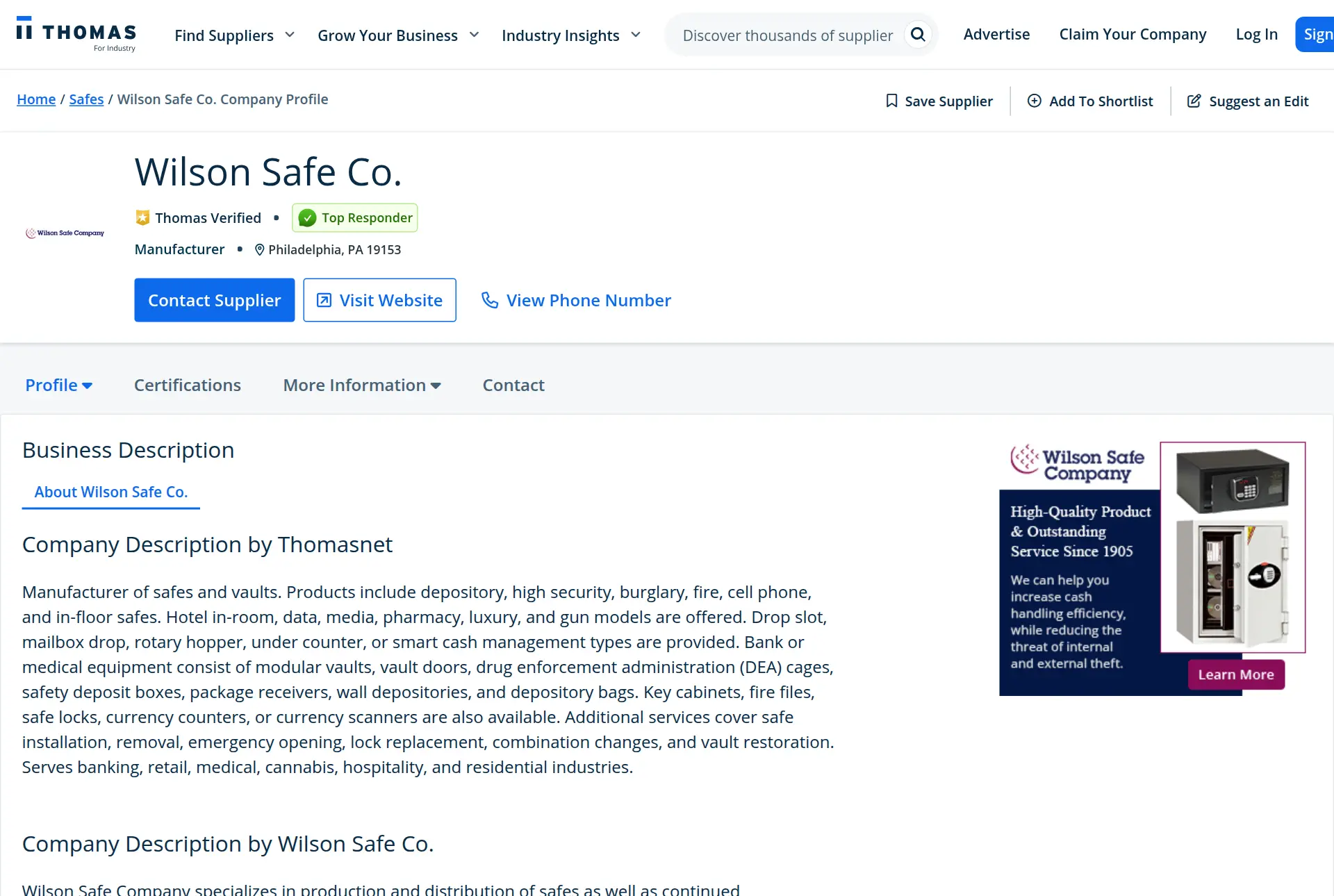
What it is used for
- Compare suppliers before a quote
- Set suppliers side by side by
company_type,annual_sales,employees, year founded and certifications before you ask any of them to quote. - Complete a supplier record
- Add the website, telephone, full address with coordinates, brands and logo to the suppliers you hold, keyed by
supplier_id. - Feed a sourcing database
- Load the categories, product families and up to 50 catalogue products of each supplier into your search, so buyers find them by what they make.
What you send
ThomasNet's id of a supplier, the number that ends the name in its profile's address, or that address. It is the one input.
supplierstring Required- ThomasNet's id of the supplier, the number that ends the name in its profile's address, e.g.
148490; or that address itself (https://www.thomasnet.com/company/wilson-safe-co-148490/profile).
A request, ready to send
It starts a run with the input shown at the top of this page, waits up to 60 seconds for it, and reads its records. Put your key in the variable it reads.
# Start a run and wait up to 60 seconds for it to finish
curl -X POST "https://api.enrichednow.com/v1/scrapers/thomasnet.supplier/runs?wait=60" \
  -H "Authorization: Bearer $ENRICHEDNOW_API_KEY" \
  -H "Content-Type: application/json" \
  -d '{"input":{"supplier":"148490"}}'

# Read its records, with the id the first call answered
curl "https://api.enrichednow.com/v1/runs/$RUN_ID/records?limit=100" \
  -H "Authorization: Bearer $ENRICHEDNOW_API_KEY"
from enrichednow import EnrichedNow
client = EnrichedNow() # reads ENRICHEDNOW_API_KEY
# Start a run, wait for it to end, and get its records
result = client.scrape("thomasnet.supplier", {"supplier": "148490"})
print(result.run.id, result.run.status, result.run.record_count)
# Read its records: pages are fetched as you go
for record in result.records:
print(record)Install it with pip install enrichednow, then save as run.py and run python3 run.py
import EnrichedNow from "enrichednow";

const client = new EnrichedNow(); // reads ENRICHEDNOW_API_KEY

// Start a run, wait for it to end, and get its records
const { run, records } = await client.scrape("thomasnet.supplier", { supplier: "148490" });
console.log(run.id, run.status, run.record_count);

// Read its records: pages are fetched as you go
for await (const record of records) console.log(record);
Install it with npm install enrichednow, then save as run.mjs and run node run.mjs
package main

import (
	"context"
	"fmt"
	"log"
	"time"

	enrichednow "github.com/enrichednow/enrichednow-go"
)

func main() {
	client, err := enrichednow.NewClient() // reads ENRICHEDNOW_API_KEY
	if err != nil {
		log.Fatal(err)
	}
	ctx, cancel := context.WithTimeout(context.Background(), 10*time.Minute)
	defer cancel()

	// Start a run, wait for it to end, and get its records
	run, records, err := client.Scrape(ctx, "thomasnet.supplier", map[string]any{"supplier": "148490"})
	if err != nil {
		log.Fatal(err)
	}
	fmt.Println(run.ID, run.Status, run.RecordCount)

	// Read its records: pages are fetched as you go
	for records.Next() {
		fmt.Println(string(records.Current()))
	}
	if err := records.Err(); err != nil {
		log.Fatal(err)
	}
}
Install it with go get github.com/enrichednow/enrichednow-go@latest, then save as run.go and run go run run.go
import com.enrichednow.EnrichedNowClient;
import com.enrichednow.ScrapeResult;
import java.util.Map;

public class Run {
    public static void main(String[] args) {
        EnrichedNowClient client = EnrichedNowClient.fromEnv(); // reads ENRICHEDNOW_API_KEY

        // Start a run, wait for it to end, and get its records
        ScrapeResult result = client.scrape("thomasnet.supplier", Map.of("supplier", "148490"));
        System.out.println(result.run().id() + " " + result.run().status() + " " + result.run().recordCount());

        // Read its records: pages are fetched as you go
        for (Map<String, Object> record : result.records()) {
            System.out.println(record);
        }
    }
}
Add com.enrichednow:enrichednow-java:0.4.0 to your Maven or Gradle build, then save as Run.java
enrichednow run thomasnet.supplier --input-json '{"supplier":"148490"}'Install it with curl -fsSL https://raw.githubusercontent.com/enrichednow/enrichednow-cli/main/install.sh | sh
What comes back
What its profile states: what the supplier makes, its type and other activities, address and coordinates, phone, website, annual sales and employee bands, year founded, brands, product families, categories, certification counts and catalogue products. A record has 33 fields. One we could not read is null, never an empty string or a zero.
{
  "supplier_id": "148490",
  "name": "Wilson Safe Co.",
  "url": "https://www.thomasnet.com/company/wilson-safe-co-148490/profile",
  "description": "Manufacturer of safes and vaults. Products include depository, high security, burglary, fire, cell phone, and in-floor safes. Hotel in-room, data, media, pharmacy, luxury, and gun models are offered. Drop slot, mailbox drop, rotary hopper, … [truncated]",
  "description_by_company": "Wilson Safe Company specializes in production and distribution of safes as well as continued advancements in cash handling systems. With headquarters in Philadelphia and New York, we service the entire nation and beyond. Our knowledgeable … [truncated]",
  "company_type": "Manufacturer",
  "additional_activities": [
    "Distributor",
    "Service Company"
  ],
  "website": "https://www.wilsonsafe.com/",
  "phone": null,
  "street_address": "3031 Island Ave.",
  "address_lines": [
    "3031 Island Ave."
  ],
  "city": "Philadelphia",
  "state": "PA",
  "state_name": "Pennsylvania",
  "postal_code": "19153",
  "country": "USA",
  "latitude": 39.88803796,
  "longitude": -75.2561604,
  "annual_sales": "$1 - 4.9 Mil",
  "employees": "10-49",
  "year_founded": 1905,
  "is_claimed": true,
  "badge": "VERIFIED",
  "xometry_verified": false,
  "is_multi_location": false,
  "main_location_id": null,
  "brands": [
    "Amsec",
    "Chubb",
    "Collier"
  ],
  "product_families": [
    "Bags",
    "Bank Equipment",
    "Boxes"
  ],
  "categories": [],
  "certifications": [
    {
      "type": "REGISTRATION",
      "count": 1
    }
  ],
  "products": [],
  "logo": "https://cdn.thomasnet.com/ccp/00148490/166241.jpg",
  "fetched_at": "2026-11-19T18:07:41.462993Z"
}
The scraper returned this record for the input above, reading a saved copy of the page, not the live site.
Values shortened for this page: description: 808 characters, the first 239 shown; description_by_company: 858 characters, the first 238 shown.
Values withheld: phone: the example keeps no contact details.
The fields of a record
supplier_idstring- ThomasNet's id of the supplier: the number that ends the name in its profile's address.
namestring- The supplier's name.
urlstring- The supplier's profile on thomasnet.com.
descriptionstring or null- ThomasNet's description of what the supplier makes or does.
description_by_companystring or null- The supplier's description of itself, in its own words.
company_typestring or null- The supplier's primary type, e.g.
Manufacturer,Distributor,Custom Manufacturer. additional_activitieslist of strings- What else the supplier is, e.g.
Distributor,Service Company. websitestring or null- The supplier's own website.
phonestring or null- The supplier's telephone number, as the page writes it.
street_addressstring or null- The first line of the address.
address_lineslist of strings- Every line of the street address, in order.
citystring or null- The city or town.
statestring or null- The state or province code, e.g.
PA. state_namestring or null- The state or province in full, e.g.
Pennsylvania. postal_codestring or null- The postal code.
countrystring or null- The country as the page writes it, e.g.
USA. latitudenumber or null- The latitude of the address, in decimal degrees.
longitudenumber or null- The longitude of the address.
annual_salesstring or null- The annual sales band, in the page's words, e.g.
$1 - 4.9 Mil. employeesstring or null- The number-of-employees band, in the page's words, e.g.
10-49. year_foundedinteger or null- The year the supplier was founded.
is_claimedboolean or null- True when the supplier has claimed its profile.
badgestring or null- The supplier's ThomasNet badge as the page's data names it, e.g.
VERIFIED. Null for a supplier without one. xometry_verifiedboolean or null- True when the profile carries the Xometry Verified mark.
is_multi_locationboolean or null- True when the supplier has more than one location on ThomasNet.
main_location_idstring or null- ThomasNet's id of the supplier's main location, when this profile is another of its locations.
brandslist of strings- The brands the supplier makes or carries.
product_familieslist of strings- The product families ThomasNet groups the supplier's offer into, e.g.
Bank Equipment. categorieslist of objects- The categories the supplier is listed under, with what it offers in each. Up to 200.Each holds
name,description. certificationslist of objects- How many certifications of each kind the profile lists.Each holds
type,count. productslist of objects- The products of the supplier's catalogue the profile shows. Up to 50.Each holds
name,description,url,image. logostring or null- The supplier's logo.
fetched_atdatetime- When the page was read, in UTC.
Units and limits
- Counted per request
- Billed per request: a run that returns data costs 1 unit, however many records it returns.
- A miss costs nothing
- A run that fails, that meets something not supported yet, or that you cancel costs nothing. You pay for runs that return data.
- What bounds a run
- A run may take up to 5 minutes. Its records are read in pages of up to 1,000 and are kept for 7 days.
What it does not do
- One run reads one supplier. A supplier is named by its profile: there is no search by product or place.
- The profile's key personnel are people, and are not returned.
- Categories and catalogue products are the ones the profile itself carries: up to 200 categories and 50 products.
- An id ThomasNet has no supplier for ends as failed, with the reason not_found, and costs nothing.
Questions
What does ThomasNet supplier return?
What its profile states: what the supplier makes, its type and other activities, address and coordinates, phone, website, annual sales and employee bands, year founded, brands, product families, categories, certification counts and catalogue products. A record has 33 fields, among them supplier_id, name, url, description, description_by_company and company_type. A value that could not be read is null, never an empty string or a zero.
What do I send?
ThomasNet's id of a supplier, the number that ends the name in its profile's address, or that address. The input supplier is required.
How is it counted?
Billed per request: a run that returns data costs 1 unit, however many records it returns. A run that fails, that meets something not supported yet, or that you cancel costs nothing. The first 1,000 units each month are free.
What does it not do?
One run reads one supplier. A supplier is named by its profile: there is no search by product or place. The profile's key personnel are people, and are not returned. Categories and catalogue products are the ones the profile itself carries: up to 200 categories and 50 products. An id ThomasNet has no supplier for ends as failed, with the reason not_found, and costs nothing.
How long are the records kept, and in what format do they come?
Records are kept for 7 days after the run ended, and read in pages of up to 1,000. They come as JSON, as NDJSON with one record a line, or as CSV with a column for each field.
Can an AI assistant call it?
Yes. Through the EnrichedNow MCP server an assistant calls the tool run_scraper with the scraper_id thomasnet.supplier and the same input. It costs what the same API call costs.
Used in this playbook
A playbook runs ThomasNet supplier as one of its steps and hands back the finished list. Its runs of this scraper cost what they cost here, and the playbook adds nothing.
Public sector
Supplier Discovery
Suppliers of a product from IndiaMART, Google Maps, Gelbe Seiten and ThomasNet, each with location, website and email.
ThomasNet
An industrial supplier's public profile on ThomasNet, as a visitor who is not signed in sees it.
- Industry
- Companies and B2B
- Where
- United States
Run it on an input of your own.
Create an account, make a key, and send the request above with your own input. The first 1,000 units each month are free.