Scraper API
TED
ted.noticesAvailable
EU tenders (TED)
Notices: title, stage, buyer and country, publication date, deadline, CPV codes, places, value and winners, with the addresses of the notice and its PDF.
Give it Words, a stage, a buyer's country, a CPV code or dates.
1 unit a run, for runs that return data. Runs that fail cost nothing. How units work
- Counted
- 1 unit a run
- Inputs
- 8
- Record
- 20 fields
- A run takes
- up to 5 minutes
- Records kept
- 7 days
- Measured
- its success, on the status page
POST/v1/scrapers/ted.notices/runs
sent, and answered
a record of the run20 fields
ok1 unit a run
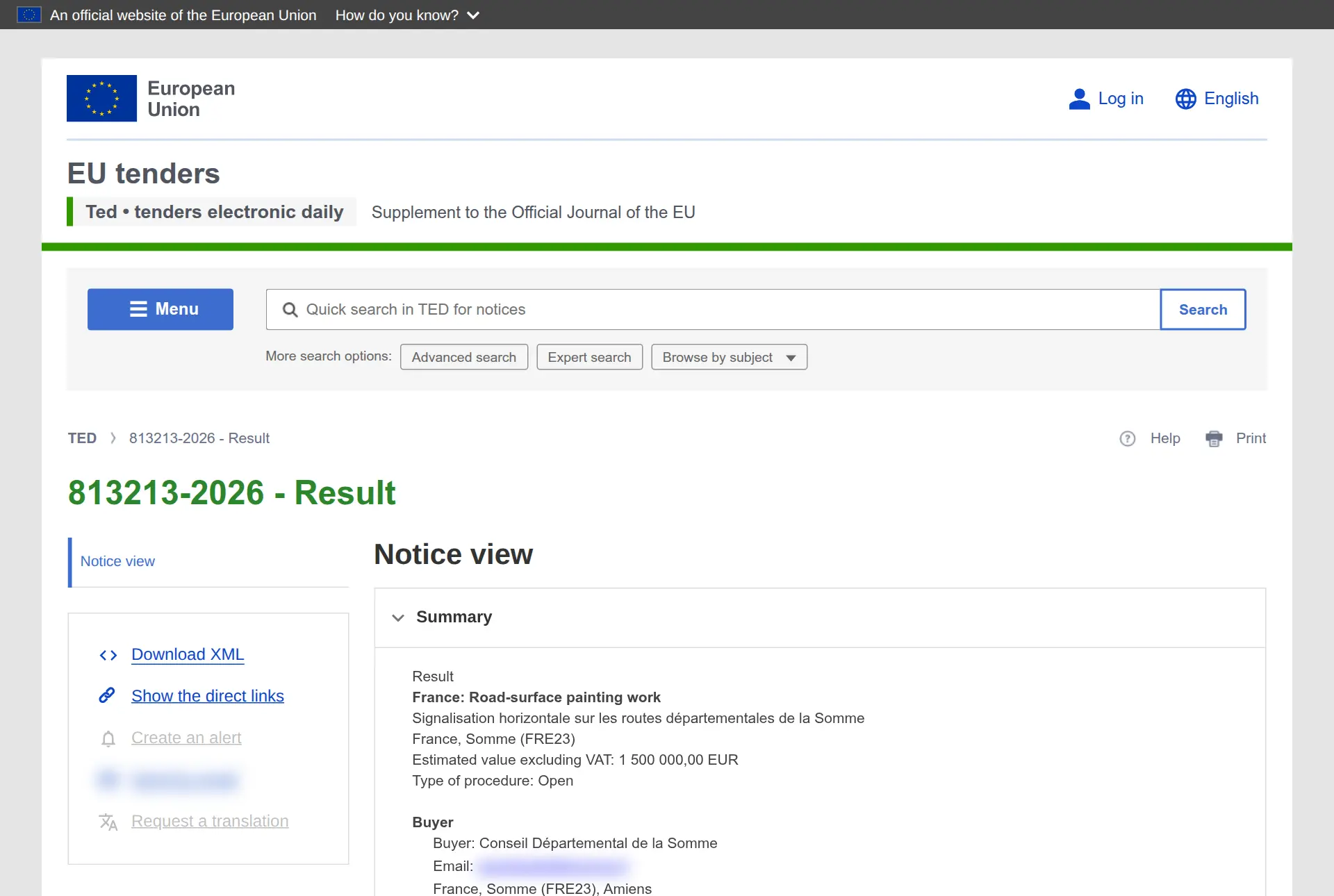
A record this scraper returned for this input. The first 9 of its 20 fields are set down here; the whole record is below.
What it is used for
- Get tender alerts
- Read new notices by
cpvandcountryevery day and pass on what fits. - Beat the deadline
- Keep each
deadline_dateandbuyerso bids are planned on time. - See who wins in Europe
- Read award notices for their
winners,valueandcurrency, by market.
What you send
Words, a stage, a buyer's country, a CPV code or dates. These are its 8 inputs, as its schema has them.
querystring Optional- A word or phrase anywhere in the notice.
stagestring Optional- tender, award, planning or any.Default
any countrystring Optional- Only buyers in this country, as a three-letter code such as DEU.
cpvstring Optional- Only notices with this CPV code, eight digits.
published_fromstring Optional- Only notices published on or after this day. Default: the last 30 days.
published_tostring Optional- Only notices published on or before this day.
max_resultsinteger Optional- Notices a page, up to 100.Default
25 pageinteger Optional- The page of results, from 1.Default
1
A request, ready to send
It starts a run with the input shown at the top of this page, waits up to 60 seconds for it, and reads its records. Put your key in the variable it reads.
# Start a run and wait up to 60 seconds for it to finish
curl -X POST "https://api.enrichednow.com/v1/scrapers/ted.notices/runs?wait=60" \
  -H "Authorization: Bearer $ENRICHEDNOW_API_KEY" \
  -H "Content-Type: application/json" \
  -d '{"input":{"stage":"tender","country":"DEU","cpv":"72000000","published_from":"2026-11-01","published_to":"2026-11-23","max_results":2}}'

# Read its records, with the id the first call answered
curl "https://api.enrichednow.com/v1/runs/$RUN_ID/records?limit=100" \
  -H "Authorization: Bearer $ENRICHEDNOW_API_KEY"
from enrichednow import EnrichedNow
client = EnrichedNow() # reads ENRICHEDNOW_API_KEY
# Start a run, wait for it to end, and get its records
result = client.scrape("ted.notices", {
"stage": "tender",
"country": "DEU",
"cpv": "72000000",
"published_from": "2026-11-01",
"published_to": "2026-11-23",
"max_results": 2,
})
print(result.run.id, result.run.status, result.run.record_count)
# Read its records: pages are fetched as you go
for record in result.records:
print(record)Install it with pip install enrichednow, then save as run.py and run python3 run.py
import EnrichedNow from "enrichednow";

const client = new EnrichedNow(); // reads ENRICHEDNOW_API_KEY

// Start a run, wait for it to end, and get its records
const { run, records } = await client.scrape("ted.notices", {
  stage: "tender",
  country: "DEU",
  cpv: "72000000",
  published_from: "2026-11-01",
  published_to: "2026-11-23",
  max_results: 2,
});
console.log(run.id, run.status, run.record_count);

// Read its records: pages are fetched as you go
for await (const record of records) console.log(record);
Install it with npm install enrichednow, then save as run.mjs and run node run.mjs
package main

import (
	"context"
	"fmt"
	"log"
	"time"

	enrichednow "github.com/enrichednow/enrichednow-go"
)

func main() {
	client, err := enrichednow.NewClient() // reads ENRICHEDNOW_API_KEY
	if err != nil {
		log.Fatal(err)
	}
	ctx, cancel := context.WithTimeout(context.Background(), 10*time.Minute)
	defer cancel()

	// Start a run, wait for it to end, and get its records
	run, records, err := client.Scrape(ctx, "ted.notices", map[string]any{"stage": "tender", "country": "DEU", "cpv": "72000000", "published_from": "2026-11-01", "published_to": "2026-11-23", "max_results": 2})
	if err != nil {
		log.Fatal(err)
	}
	fmt.Println(run.ID, run.Status, run.RecordCount)

	// Read its records: pages are fetched as you go
	for records.Next() {
		fmt.Println(string(records.Current()))
	}
	if err := records.Err(); err != nil {
		log.Fatal(err)
	}
}
Install it with go get github.com/enrichednow/enrichednow-go@latest, then save as run.go and run go run run.go
import com.enrichednow.EnrichedNowClient;
import com.enrichednow.ScrapeResult;
import java.util.Map;

public class Run {
    public static void main(String[] args) {
        EnrichedNowClient client = EnrichedNowClient.fromEnv(); // reads ENRICHEDNOW_API_KEY

        // Start a run, wait for it to end, and get its records
        ScrapeResult result = client.scrape("ted.notices", Map.of("stage", "tender", "country", "DEU", "cpv", "72000000", "published_from", "2026-11-01", "published_to", "2026-11-23", "max_results", 2));
        System.out.println(result.run().id() + " " + result.run().status() + " " + result.run().recordCount());

        // Read its records: pages are fetched as you go
        for (Map<String, Object> record : result.records()) {
            System.out.println(record);
        }
    }
}
Add com.enrichednow:enrichednow-java:0.4.0 to your Maven or Gradle build, then save as Run.java
enrichednow run ted.notices --input-json '{"stage":"tender","country":"DEU","cpv":"72000000","published_from":"2026-11-01","published_to":"2026-11-23","max_results":2}'Install it with curl -fsSL https://raw.githubusercontent.com/enrichednow/enrichednow-cli/main/install.sh | sh
What comes back
Notices: title, stage, buyer and country, publication date, deadline, CPV codes, places, value and winners, with the addresses of the notice and its PDF. A record has 20 fields. One we could not read is null, never an empty string or a zero.
{
  "notice_id": "813257-2026",
  "url": "https://ted.europa.eu/en/notice/-/detail/813257-2026",
  "pdf_url": "https://ted.europa.eu/en/notice/813257-2026/pdf",
  "title": "Germany – Business and management consultancy and related services – Beratung Digitalisierung - Lose 2 bis 5",
  "language": "eng",
  "stage": "tender",
  "notice_type": "cn-standard",
  "procedure": "neg-w-call",
  "contract_nature": "services",
  "buyer": "Studierendenwerk Münster AÖR",
  "buyer_country": "DEU",
  "published_date": "2026-11-23",
  "deadline_date": null,
  "cpv_codes": [
    "79400000",
    "72222000",
    "72000000"
  ],
  "places": [
    "DEA33",
    "DEU"
  ],
  "value": null,
  "currency": null,
  "winners": [],
  "total_results": 304,
  "fetched_at": "2026-11-23T23:24:05.072895Z"
}
The scraper returned this record for the input above, reading a saved copy of the page, not the live site.
The fields of a record
notice_idstring- TED's publication number, e.g.
814181-2026. urlstring- The notice's page on ted.europa.eu.
pdf_urlstring or null- The notice as a PDF, in English where TED has it.
titlestring or null- The notice's title.
languagestring or null- The three-letter language of the title, e.g.
eng,deu. stagestring or nulltender(a call for tenders),award(a contract award) orplanning(a prior notice).notice_typestring or null- TED's type of notice, e.g.
cn-standard,can-standard. procedurestring or null- The procedure, e.g.
open,restricted. contract_naturestring or nullworks,suppliesorservices.buyerstring or null- The public body buying.
buyer_countrystring or null- Its country, as a three-letter code, e.g.
DEU. published_datestring or null- The day the notice was published,
YYYY-MM-DD. deadline_datestring or null- The day tenders are due,
YYYY-MM-DD, for a call for tenders. cpv_codeslist of strings- The notice's CPV codes (the EU's vocabulary of what is bought).
placeslist of strings- Where the work is done, as NUTS regions and country codes.
valuenumber or null- The notice's total value, where it states one.
currencystring or null- The currency of that value, e.g.
EUR. winnerslist of strings- Who won, on an award notice.
total_resultsinteger or null- How many notices match the search in all.
fetched_atdatetime- When TED was asked, in UTC.
Units and limits
- Counted per request
- Billed per request: a run that returns data costs 1 unit, however many records it returns.
- A miss costs nothing
- A run that fails, that meets something not supported yet, or that you cancel costs nothing. You pay for runs that return data.
- What bounds a run
- A run may take up to 5 minutes. Its records are read in pages of up to 1,000 and are kept for 7 days.
What it does not do
- Text is in English where the notice has it, otherwise in its own language: language says which.
- A notice states a value only when the buyer published one.
The bounds its schema sets
stage- any, tender, award, planning; any unless you say otherwise
max_results- 1 to 100; 25 unless you say otherwise
page- 1 to 150; 1 unless you say otherwise
Questions
What does EU tenders (TED) return?
Notices: title, stage, buyer and country, publication date, deadline, CPV codes, places, value and winners, with the addresses of the notice and its PDF. A record has 20 fields, among them notice_id, url, pdf_url, title, language and stage. A value that could not be read is null, never an empty string or a zero.
What do I send?
Words, a stage, a buyer's country, a CPV code or dates. Optional: query, stage, country, cpv, published_from, published_to, max_results and page.
How is it counted?
Billed per request: a run that returns data costs 1 unit, however many records it returns. A run that fails, that meets something not supported yet, or that you cancel costs nothing. The first 1,000 units each month are free.
How much does one run return?
Its schema sets these bounds: stage any, tender, award, planning (any unless you say otherwise); max_results 1 to 100 (25 unless you say otherwise); page 1 to 150 (1 unless you say otherwise). A run may take up to 5 minutes.
What does it not do?
Text is in English where the notice has it, otherwise in its own language: language says which. A notice states a value only when the buyer published one.
How long are the records kept, and in what format do they come?
Records are kept for 7 days after the run ended, and read in pages of up to 1,000. They come as JSON, as NDJSON with one record a line, or as CSV with a column for each field.
Can an AI assistant call it?
Yes. Through the EnrichedNow MCP server an assistant calls the tool run_scraper with the scraper_id ted.notices and the same input. It costs what the same API call costs.
Used in these playbooks
A playbook runs EU tenders (TED) as one of its steps and hands back the finished list. Its runs of this scraper cost what they cost here, and the playbook adds nothing.
Public sector
Award Teaming Leads
Companies that just won government contracts in your field, with what they won, their website and the email they publish.
Public sector
Tender Alerts
New public tenders that match your words and codes, from the EU, UK and US, with buyer, deadline, value and link.
TED
EU public tenders and contract awards from TED, Tenders Electronic Daily: buyers, deadlines, CPV codes, values and winners.
- Industry
- Government and public records
- Where
- AustriaBelgiumCzechiaDenmarkFranceGermanyIrelandItalyNetherlandsPolandPortugalSpainSweden22 countries in all
- For
- Researchers
Run it on an input of your own.
Create an account, make a key, and send the request above with your own input. The first 1,000 units each month are free.