Scraper API
Target
target.productAvailable
Target product
Its price, availability, seller, rating, description, specifications, images and every version it comes in.
Give it a Target product's address, or its item number (TCIN).
1 unit a run, for runs that return data. Runs that fail cost nothing. How units work
- Counted
- 1 unit a run
- Inputs
- 2
- Record
- 26 fields
- A run takes
- up to 5 minutes
- Records kept
- 7 days
- Measured
- its success, on the status page
POST/v1/scrapers/target.product/runs
sent, and answered
a record of the run26 fields
ok1 unit a run
A record this scraper returned for this input. The first 9 of its 26 fields are set down here; the whole record is below.
What it is used for
- Monitor prices
- Read a product's
priceandregular_priceon a schedule and know the day it changes, with its availability. - Complete a product catalogue
- Title, brand, description, highlights, specifications, images, versions and UPC for an item, keyed by Target's own id.
- Watch availability
availabilityandsold_outsay whether an item can be bought now. Run a list and be told when one sells out.
What you send
A Target product's address, or its item number (TCIN). These are its 2 inputs, as its schema has them.
urlstring One of the two- The product's address, e.g. https://www.target.com/p/some-product/-/A-51298018.
tcinstring One of the two- Target's item number (TCIN): the number after A- in the product's address.
A request, ready to send
It starts a run with the input shown at the top of this page, waits up to 60 seconds for it, and reads its records. Put your key in the variable it reads.
# Start a run and wait up to 60 seconds for it to finish
curl -X POST "https://api.enrichednow.com/v1/scrapers/target.product/runs?wait=60" \
  -H "Authorization: Bearer $ENRICHEDNOW_API_KEY" \
  -H "Content-Type: application/json" \
  -d '{"input":{"tcin":"51298018"}}'

# Read its records, with the id the first call answered
curl "https://api.enrichednow.com/v1/runs/$RUN_ID/records?limit=100" \
  -H "Authorization: Bearer $ENRICHEDNOW_API_KEY"
from enrichednow import EnrichedNow
client = EnrichedNow() # reads ENRICHEDNOW_API_KEY
# Start a run, wait for it to end, and get its records
result = client.scrape("target.product", {"tcin": "51298018"})
print(result.run.id, result.run.status, result.run.record_count)
# Read its records: pages are fetched as you go
for record in result.records:
print(record)Install it with pip install enrichednow, then save as run.py and run python3 run.py
import EnrichedNow from "enrichednow";

const client = new EnrichedNow(); // reads ENRICHEDNOW_API_KEY

// Start a run, wait for it to end, and get its records
const { run, records } = await client.scrape("target.product", { tcin: "51298018" });
console.log(run.id, run.status, run.record_count);

// Read its records: pages are fetched as you go
for await (const record of records) console.log(record);
Install it with npm install enrichednow, then save as run.mjs and run node run.mjs
package main

import (
	"context"
	"fmt"
	"log"
	"time"

	enrichednow "github.com/enrichednow/enrichednow-go"
)

func main() {
	client, err := enrichednow.NewClient() // reads ENRICHEDNOW_API_KEY
	if err != nil {
		log.Fatal(err)
	}
	ctx, cancel := context.WithTimeout(context.Background(), 10*time.Minute)
	defer cancel()

	// Start a run, wait for it to end, and get its records
	run, records, err := client.Scrape(ctx, "target.product", map[string]any{"tcin": "51298018"})
	if err != nil {
		log.Fatal(err)
	}
	fmt.Println(run.ID, run.Status, run.RecordCount)

	// Read its records: pages are fetched as you go
	for records.Next() {
		fmt.Println(string(records.Current()))
	}
	if err := records.Err(); err != nil {
		log.Fatal(err)
	}
}
Install it with go get github.com/enrichednow/enrichednow-go@latest, then save as run.go and run go run run.go
import com.enrichednow.EnrichedNowClient;
import com.enrichednow.ScrapeResult;
import java.util.Map;

public class Run {
    public static void main(String[] args) {
        EnrichedNowClient client = EnrichedNowClient.fromEnv(); // reads ENRICHEDNOW_API_KEY

        // Start a run, wait for it to end, and get its records
        ScrapeResult result = client.scrape("target.product", Map.of("tcin", "51298018"));
        System.out.println(result.run().id() + " " + result.run().status() + " " + result.run().recordCount());

        // Read its records: pages are fetched as you go
        for (Map<String, Object> record : result.records()) {
            System.out.println(record);
        }
    }
}
Add com.enrichednow:enrichednow-java:0.4.0 to your Maven or Gradle build, then save as Run.java
enrichednow run target.product --input-json '{"tcin":"51298018"}'Install it with curl -fsSL https://raw.githubusercontent.com/enrichednow/enrichednow-cli/main/install.sh | sh
What comes back
Its price, availability, seller, rating, description, specifications, images and every version it comes in. A record has 26 fields. One we could not read is null, never an empty string or a zero.
{
  "tcin": "51298018",
  "parent_tcin": null,
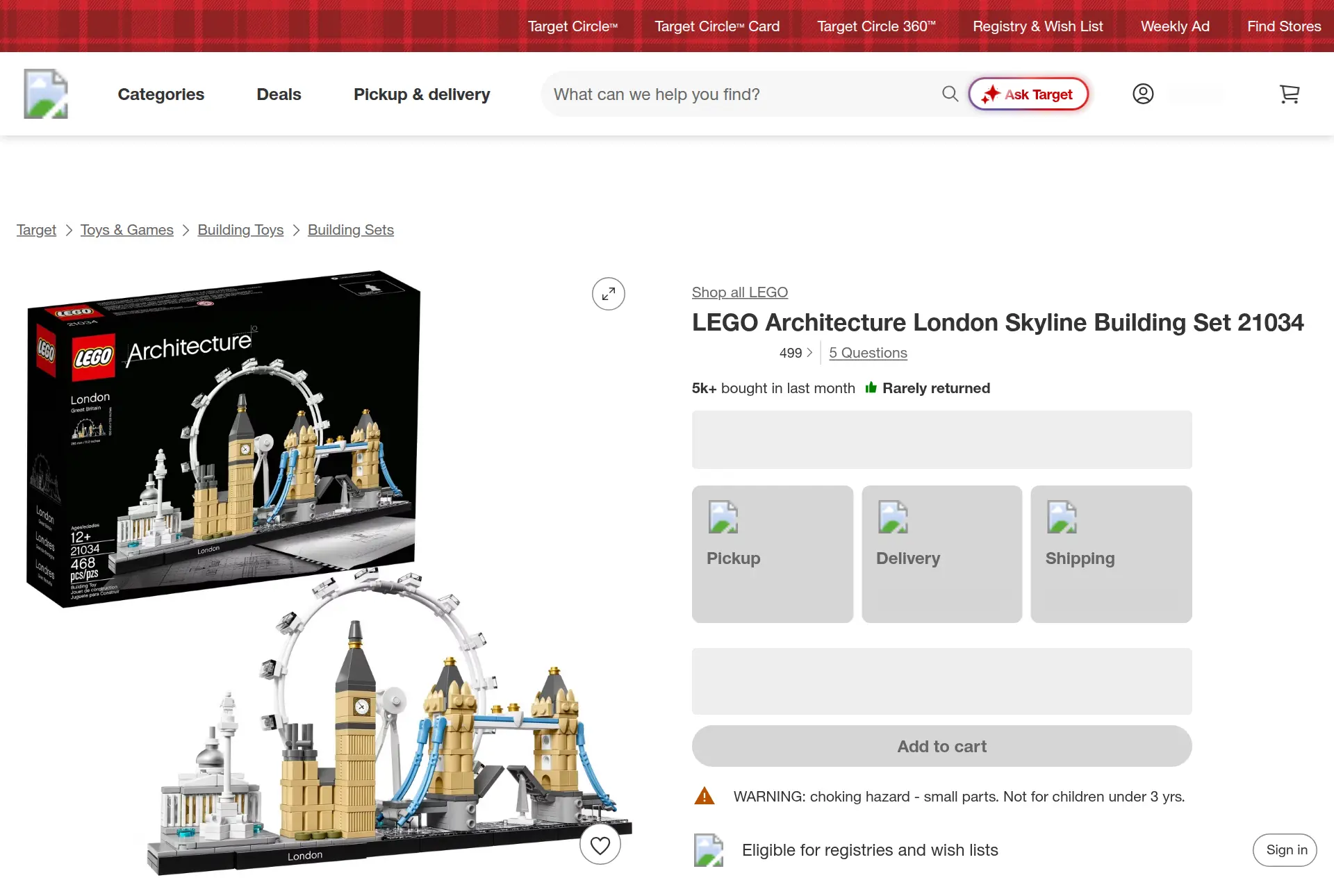
  "url": "https://www.target.com/p/lego-architecture-london-skyline-building-set-21034/-/A-51298018",
  "title": "LEGO Architecture London Skyline Building Set 21034",
  "brand": "LEGO",
  "description": "Celebrate the architectural diversity of London with this detailed LEGO brick model. The LEGO Architecture Skyline Collection offers models suitable for display and decor in the home and office, and has been developed for all with an … [truncated]",
  "highlights": [
    "Build a detailed LEGO Architecture model interpretation of the London skyline featuring famous landmarks!",
    "The model building kit for adults and kids aged 12+ features the National Gallery, Nelson’s Column, London Eye, Big Ben and Tower Bridge",
    "London’s Thames River is represented by transparent baseplate tiles"
  ],
  "specifications": [
    {
      "name": "Number of Pieces",
      "value": "468"
    },
    {
      "name": "Suggested Age",
      "value": "12 Years and Up"
    },
    {
      "name": "Assembled Dimensions",
      "value": "7.52 Inches (H) x 2.4 Inches (D)"
    }
  ],
  "price": {
    "amount": 23.99,
    "currency": "USD"
  },
  "regular_price": {
    "amount": 39.99,
    "currency": "USD"
  },
  "price_text": "$23.99",
  "price_type": "sale",
  "unit_price_text": null,
  "availability": "IN_STOCK",
  "sold_out": false,
  "upc": "673419264419",
  "dpci": "204-00-1859",
  "seller_name": null,
  "seller_id": null,
  "rating": 4.76,
  "rating_count": 499,
  "review_count": 182,
  "category_path": [
    "Toys & Games",
    "Building Toys",
    "Building Sets"
  ],
  "images": [
    "https://target.scene7.com/is/image/Target/GUEST_301af2b3-f5bc-4536-a78e-c0928b2a7626",
    "https://target.scene7.com/is/image/Target/GUEST_5a3f6645-2511-49d1-9726-a2408da5c4a7",
    "https://target.scene7.com/is/image/Target/GUEST_963236e8-8291-4d1b-9897-0e5af49fe601"
  ],
  "variants": [],
  "fetched_at": "2026-11-19T18:07:41.361836Z"
}
The scraper returned this record for the input above, reading a saved copy of the page, not the live site.
Values shortened for this page: description: 807 characters, the first 233 shown; highlights: 6 items, the first 3 shown; specifications: 8 items, the first 3 shown; images: 4 items, the first 3 shown.
The fields of a record
tcinstring- Target's item number (TCIN) of the product asked for.
parent_tcinstring or null- The TCIN of the product this one is a version of (one colour, one size), when it is one.
urlstring or null- The product's address on target.com.
titlestring- The product's name.
brandstring or null- The brand.
descriptionstring or null- The product description, as text.
highlightslist of strings- The highlights listed on the page, in its order.
specificationslist of objects- The product's specifications, each a name and a value, in the page's order.
priceobject or null- The current online price; for a product with several versions, the lowest of them.Holds
amount,currency. regular_priceobject or null- The regular price Target states beside the current one (for several versions, the highest); the same amount when the product is not reduced.
price_textstring or null- The price as the page writes it, e.g. "$129.99" or "$499.99 - $749.99".
price_typestring or null- Target's word for the kind of price: reg, sale or clearance.
unit_price_textstring or null- The price per unit as the page writes it, when it states one.
availabilitystring or null- Whether Target ships the product, in its own code, e.g. IN_STOCK, OUT_OF_STOCK, PRE_ORDER_SELLABLE; null for a product with several versions (each version says for itself) and when Target does not say.
sold_outboolean or null- True when Target marks the product as sold out; null for a product with several versions.
upcstring or null- The barcode number (UPC), when Target states it; a product with several versions has one per version.
dpcistring or null- Target's department-class-item number, e.g. 008-07-4671, when it states one.
seller_namestring or null- The partner that sells the product on target.com, when it is not Target itself.
seller_idstring or null- Target's id of that partner.
ratingnumber or null- Average rating, 0 to 5; null for a product nobody has rated.
rating_countinteger or null- Number of ratings.
review_countinteger or null- Number of written reviews.
category_pathlist of strings- The category, from the department down.
imageslist of strings- The addresses of the product's pictures, the main one first.
variantslist of objects- Every version of the product (colour, size), with the choices that lead to it.Each holds
tcin,options,url,ships,sold_out. fetched_atdatetime- When the product was read, in UTC.
Units and limits
- Counted per request
- Billed per request: a run that returns data costs 1 unit, however many records it returns.
- A miss costs nothing
- A run that fails, that meets something not supported yet, or that you cancel costs nothing. You pay for runs that return data.
- What bounds a run
- A run may take up to 5 minutes. Its records are read in pages of up to 1,000 and are kept for 7 days.
What it does not do
- A product that comes in versions lists each with whether it ships; its own availability is then empty.
- Prices and availability are those of Target's online store, without a chosen shop or delivery address.
Questions
What does Target product return?
Its price, availability, seller, rating, description, specifications, images and every version it comes in. A record has 26 fields, among them tcin, parent_tcin, url, title, brand and description. A value that could not be read is null, never an empty string or a zero.
What do I send?
A Target product's address, or its item number (TCIN). Of url and tcin, send one of the two.
How is it counted?
Billed per request: a run that returns data costs 1 unit, however many records it returns. A run that fails, that meets something not supported yet, or that you cancel costs nothing. The first 1,000 units each month are free.
What does it not do?
A product that comes in versions lists each with whether it ships; its own availability is then empty. Prices and availability are those of Target's online store, without a chosen shop or delivery address.
How long are the records kept, and in what format do they come?
Records are kept for 7 days after the run ended, and read in pages of up to 1,000. They come as JSON, as NDJSON with one record a line, or as CSV with a column for each field.
Can an AI assistant call it?
Yes. Through the EnrichedNow MCP server an assistant calls the tool run_scraper with the scraper_id target.product and the same input. It costs what the same API call costs.
Used in these playbooks
A playbook runs Target product as one of its steps and hands back the finished list. Its runs of this scraper cost what they cost here, and the playbook adds nothing.
Finance
E-commerce Panel
A brand's listings on Amazon, Walmart and Target, with price, stock, rating and ratings count, and what changed since the last run.
E-commerce
Out-of-Stock Opportunity
Amazon best sellers that are out of stock on Amazon, and the US retailers that have the same product in stock now.
E-commerce
Price and Seller Watch
Who sells each of your products on Amazon, Best Buy, Target and Newegg, at what price, what changed, and who is under your minimum.
Target
Target's public search results, products and customer reviews.
Target search
target.searchA search query. The products on a page of Target's search results: prices, ratings, brands and sellers, with advertisements marked.
Target product reviews
target.reviewsA Target product's address or item number (TCIN), and which page of its reviews. The reviews on that page: stars, title, text, date, verified purchase, helpful votes and pictures.
- Industry
- Shopping and retail
- Where
- United States
- For
- E-commerce
Run it on an input of your own.
Create an account, make a key, and send the request above with your own input. The first 1,000 units each month are free.