Scraper API
Stack Overflow
stackexchange.questionAvailable
Stack Overflow question
The question — title, text, tags, score, views, who asked it, dates — and its answers: text, score, which one was accepted, who wrote each, and dates.
Give it a question's id, or its address on Stack Overflow or another Stack Exchange site.
1 unit a run, for runs that return data. Runs that fail cost nothing. How units work
- Counted
- 1 unit a run
- Inputs
- 4, 1 required
- Record
- 22 fields
- A run takes
- up to 5 minutes
- Records kept
- 7 days
- Measured
- its success, on the status page
POST/v1/scrapers/stackexchange.question/runs
sent, and answered
a record of the run22 fields
ok1 unit a run
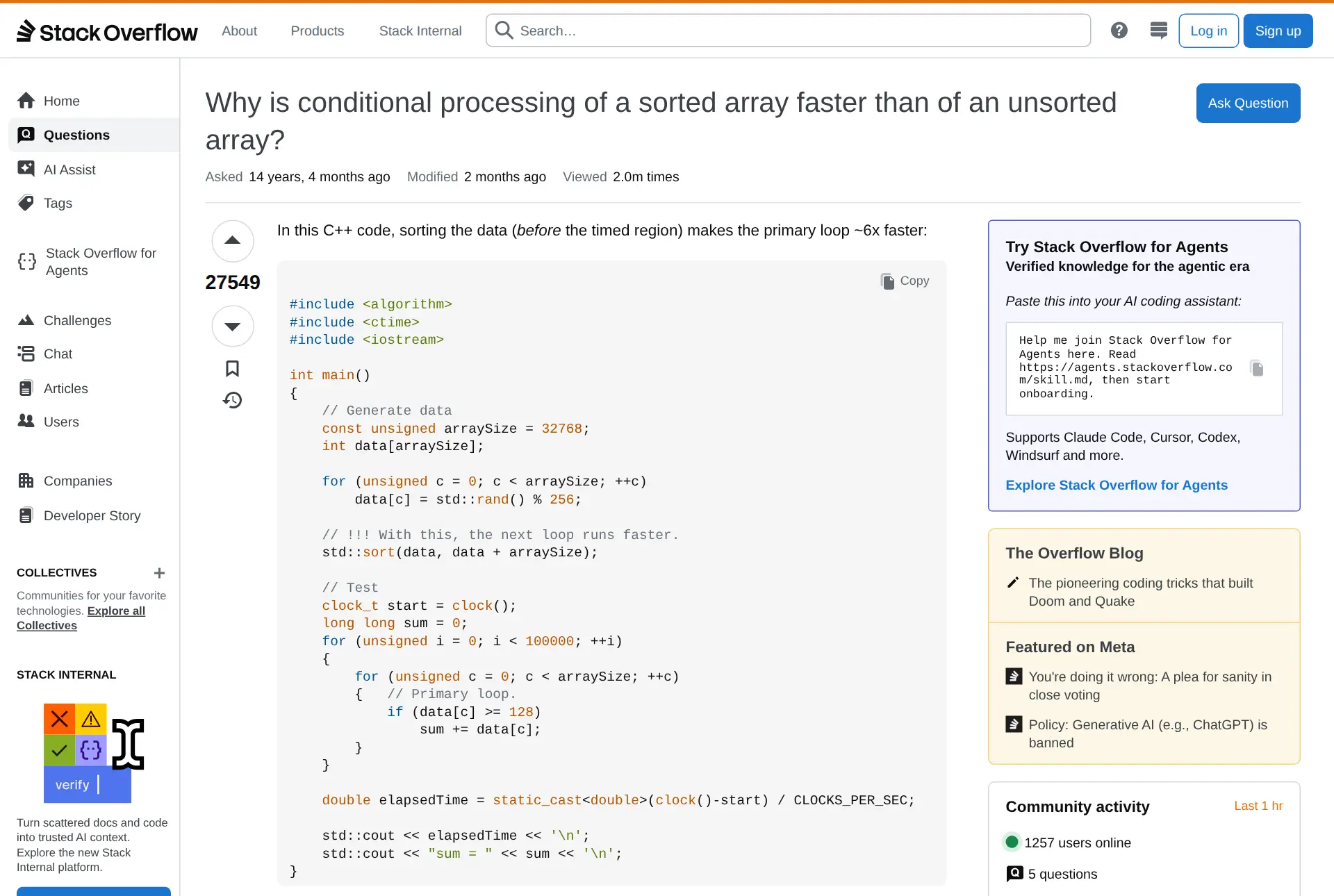
A record this scraper returned for this input. The first 9 of its 22 fields are set down here; the whole record is below.
What it is used for
- Read a question with its answers
- A question on Stack Overflow or another Stack Exchange site, with its answers, their scores, the accepted one and when each was posted.
- Give answers to a language model
- Hand a question and its best answers to a model as plain text with the code kept, with the
licensethe text is published under. - Follow a question you rely on
- Read it again and check
last_activity_atandaccepted_answer_idto see whether a new answer was posted or a different one accepted.
What you send
A question's id, or its address on Stack Overflow or another Stack Exchange site. These are its 4 inputs, as its schema has them.
questionstring Required- The question's id, or its address on the site.
sitestring Optional- The site the id belongs to; stackoverflow unless you say otherwise. An address names its own site.Default
stackoverflow max_answersinteger Optional- Return at most this many answers: 30 unless you say otherwise, up to 100; 0 returns none.Default
30 answer_sortstring Optional- votes (highest first), creation or activity. votes unless you say otherwise.Default
votes
A request, ready to send
It starts a run with the input shown at the top of this page, waits up to 60 seconds for it, and reads its records. Put your key in the variable it reads.
# Start a run and wait up to 60 seconds for it to finish
curl -X POST "https://api.enrichednow.com/v1/scrapers/stackexchange.question/runs?wait=60" \
  -H "Authorization: Bearer $ENRICHEDNOW_API_KEY" \
  -H "Content-Type: application/json" \
  -d '{"input":{"question":"11227809","max_answers":3}}'

# Read its records, with the id the first call answered
curl "https://api.enrichednow.com/v1/runs/$RUN_ID/records?limit=100" \
  -H "Authorization: Bearer $ENRICHEDNOW_API_KEY"
from enrichednow import EnrichedNow
client = EnrichedNow() # reads ENRICHEDNOW_API_KEY
# Start a run, wait for it to end, and get its records
result = client.scrape("stackexchange.question", {
"question": "11227809",
"max_answers": 3,
})
print(result.run.id, result.run.status, result.run.record_count)
# Read its records: pages are fetched as you go
for record in result.records:
print(record)Install it with pip install enrichednow, then save as run.py and run python3 run.py
import EnrichedNow from "enrichednow";

const client = new EnrichedNow(); // reads ENRICHEDNOW_API_KEY

// Start a run, wait for it to end, and get its records
const { run, records } = await client.scrape("stackexchange.question", {
  question: "11227809",
  max_answers: 3,
});
console.log(run.id, run.status, run.record_count);

// Read its records: pages are fetched as you go
for await (const record of records) console.log(record);
Install it with npm install enrichednow, then save as run.mjs and run node run.mjs
package main

import (
	"context"
	"fmt"
	"log"
	"time"

	enrichednow "github.com/enrichednow/enrichednow-go"
)

func main() {
	client, err := enrichednow.NewClient() // reads ENRICHEDNOW_API_KEY
	if err != nil {
		log.Fatal(err)
	}
	ctx, cancel := context.WithTimeout(context.Background(), 10*time.Minute)
	defer cancel()

	// Start a run, wait for it to end, and get its records
	run, records, err := client.Scrape(ctx, "stackexchange.question", map[string]any{"question": "11227809", "max_answers": 3})
	if err != nil {
		log.Fatal(err)
	}
	fmt.Println(run.ID, run.Status, run.RecordCount)

	// Read its records: pages are fetched as you go
	for records.Next() {
		fmt.Println(string(records.Current()))
	}
	if err := records.Err(); err != nil {
		log.Fatal(err)
	}
}
Install it with go get github.com/enrichednow/enrichednow-go@latest, then save as run.go and run go run run.go
import com.enrichednow.EnrichedNowClient;
import com.enrichednow.ScrapeResult;
import java.util.Map;

public class Run {
    public static void main(String[] args) {
        EnrichedNowClient client = EnrichedNowClient.fromEnv(); // reads ENRICHEDNOW_API_KEY

        // Start a run, wait for it to end, and get its records
        ScrapeResult result = client.scrape("stackexchange.question", Map.of("question", "11227809", "max_answers", 3));
        System.out.println(result.run().id() + " " + result.run().status() + " " + result.run().recordCount());

        // Read its records: pages are fetched as you go
        for (Map<String, Object> record : result.records()) {
            System.out.println(record);
        }
    }
}
Add com.enrichednow:enrichednow-java:0.4.0 to your Maven or Gradle build, then save as Run.java
enrichednow run stackexchange.question --input-json '{"question":"11227809","max_answers":3}'Install it with curl -fsSL https://raw.githubusercontent.com/enrichednow/enrichednow-cli/main/install.sh | sh
What comes back
The question — title, text, tags, score, views, who asked it, dates — and its answers: text, score, which one was accepted, who wrote each, and dates. A record has 22 fields. One we could not read is null, never an empty string or a zero.
{
  "site": "stackoverflow",
  "question_id": 11227809,
  "title": "Why is conditional processing of a sorted array faster than of an unsorted array?",
  "url": "https://stackoverflow.com/questions/11227809/why-is-conditional-processing-of-a-sorted-array-faster-than-of-an-unsorted-array",
  "tags": [
    "java",
    "c++",
    "performance"
  ],
  "score": 27549,
  "answer_count": 25,
  "view_count": 2034929,
  "is_answered": true,
  "accepted_answer_id": 11227902,
  "body": "In this C++ code, sorting the data (before the timed region) makes the primary loop ~6x faster:\n\n#include <algorithm>\n#include <ctime>\n#include <iostream>\n\nint main()\n{\n    // Generate data\n    const unsigned arraySize = 32768;\n    int … [truncated]",
  "owner_name": "GManNickG",
  "owner_id": 87234,
  "owner_reputation": 507457,
  "owner_url": "https://stackoverflow.com/users/87234/gmannickg",
  "created_at": "2012-06-27T13:51:36Z",
  "last_activity_at": "2026-09-04T02:36:50Z",
  "last_edited_at": "2026-04-08T05:35:32Z",
  "closed_reason": null,
  "license": "CC BY-SA 4.0",
  "answers": [
    {
      "answer_id": 11227902,
      "url": "https://stackoverflow.com/a/11227902",
      "is_accepted": true,
      "score": 35296,
      "body": "You are a victim of branch prediction fail.\n\nWhat is Branch Prediction?\n\nConsider a railroad junction:\n\nImage by Mecanismo, via Wikimedia Commons. Used under the CC-By-SA 3.0 license.\n\nNow for the sake of argument, suppose this is back in … [truncated]",
      "owner_name": "Mysticial",
      "owner_id": 922184,
      "owner_reputation": 473543,
      "owner_url": "https://stackoverflow.com/users/922184/mysticial",
      "created_at": "2012-06-27T13:56:42Z",
      "last_edited_at": "2024-03-04T17:37:13Z",
      "license": "CC BY-SA 4.0"
    },
    {
      "answer_id": 11227877,
      "url": "https://stackoverflow.com/a/11227877",
      "is_accepted": false,
      "score": 4767,
      "body": "Branch prediction.\n\nWith a sorted array, the condition data[c] >= 128 is first false for a streak of values, then becomes true for all later values. That's easy to predict. With an unsorted array, you pay for the branching cost.",
      "owner_name": "Daniel Fischer",
      "owner_id": 1011995,
      "owner_reputation": 184644,
      "owner_url": "https://stackoverflow.com/users/1011995/daniel-fischer",
      "created_at": "2012-06-27T13:54:45Z",
      "last_edited_at": "2020-06-20T09:12:55Z",
      "license": "CC BY-SA 4.0"
    }
  ],
  "fetched_at": "2026-11-19T18:07:41.316308Z"
}
The scraper returned this record for the input above, reading a saved copy of the page, not the live site.
Values shortened for this page: tags: 5 items, the first 3 shown; body: 3,023 characters, the first 235 shown; answers: 3 items, the first 2 shown; answers[0].body: 6,995 characters, the first 238 shown.
The fields of a record
sitestring- The Stack Exchange site the question is on, as it was asked for: stackoverflow, superuser, math, or a host name.
question_idinteger- The site's id of the question.
titlestring- The question's title.
urlstring or null- The question's address on the site.
tagslist of strings- The question's tags, e.g. ["python", "asyncio"].
scoreinteger or null- The question's votes: up minus down.
answer_countinteger or null- How many answers the question has.
view_countinteger or null- How often the question was viewed.
is_answeredboolean or null- True when an answer was accepted or has a positive score.
accepted_answer_idinteger or null- The id of the accepted answer; null when none was accepted.
bodystring or null- The question as plain text: paragraphs on their own lines, code kept as written.
owner_namestring or null- The display name of the account that posted it; null when the account was deleted.
owner_idinteger or null- The site's numeric id of that account.
owner_reputationinteger or null- That account's reputation on the site.
owner_urlstring or null- That account's public profile on the site.
created_atdatetime or null- When the question was asked, in UTC.
last_activity_atdatetime or null- When the question, an answer or a comment last changed, in UTC.
last_edited_atdatetime or null- When the question was last edited, in UTC; null when it never was.
closed_reasonstring or null- Why the question was closed, in the site's words, e.g. "Duplicate"; null for an open question.
licensestring or null- The licence the text is published under, e.g. "CC BY-SA 4.0".
answerslist of objects- The question's answers in the order asked for, as many as max_answers allows.Each holds
answer_id,url,is_accepted,score,body,owner_name,owner_id,owner_reputation,owner_url,created_at,last_edited_at,license. fetched_atdatetime- When the question was read, in UTC.
Units and limits
- Counted per request
- Billed per request: a run that returns data costs 1 unit, however many records it returns.
- A miss costs nothing
- A run that fails, that meets something not supported yet, or that you cancel costs nothing. You pay for runs that return data.
- What bounds a run
- A run may take up to 5 minutes. Its records are read in pages of up to 1,000 and are kept for 7 days.
What it does not do
- Comments on the question and on its answers are not read.
- Text is returned as plain text, with code as written; formulae on sites that use them stay in their TeX form.
- Stack Exchange's API answers a caller without an application key about 300 requests a day from one network address; these scrapers use no key, so the allowance is shared and heavy use can reach it. A question is two requests, one with max_answers 0. When the allowance is used up the run ends as failed, with the reason rate_limited, and costs nothing.
The bounds its schema sets
max_answers- 0 to 100; 30 unless you say otherwise
answer_sort- votes, creation, activity; votes unless you say otherwise
Questions
What does Stack Overflow question return?
The question — title, text, tags, score, views, who asked it, dates — and its answers: text, score, which one was accepted, who wrote each, and dates. A record has 22 fields, among them site, question_id, title, url, tags and score. A value that could not be read is null, never an empty string or a zero.
What do I send?
A question's id, or its address on Stack Overflow or another Stack Exchange site. The input question is required. Optional: site, max_answers and answer_sort.
How is it counted?
Billed per request: a run that returns data costs 1 unit, however many records it returns. A run that fails, that meets something not supported yet, or that you cancel costs nothing. The first 1,000 units each month are free.
How much does one run return?
Its schema sets these bounds: max_answers 0 to 100 (30 unless you say otherwise); answer_sort votes, creation, activity (votes unless you say otherwise). A run may take up to 5 minutes.
What does it not do?
Comments on the question and on its answers are not read. Text is returned as plain text, with code as written; formulae on sites that use them stay in their TeX form. Stack Exchange's API answers a caller without an application key about 300 requests a day from one network address; these scrapers use no key, so the allowance is shared and heavy use can reach it. A question is two requests, one with max_answers 0. When the allowance is used up the run ends as failed, with the reason rate_limited, and costs nothing.
How long are the records kept, and in what format do they come?
Records are kept for 7 days after the run ended, and read in pages of up to 1,000. They come as JSON, as NDJSON with one record a line, or as CSV with a column for each field.
Can an AI assistant call it?
Yes. Through the EnrichedNow MCP server an assistant calls the tool run_scraper with the scraper_id stackexchange.question and the same input. It costs what the same API call costs.
Stack Overflow
Questions and answers on Stack Overflow and every other Stack Exchange site: Super User, Server Fault, Ask Ubuntu, Mathematics and the rest.
Stack Overflow search
stackexchange.searchWords, tags or both, and the Stack Exchange site to search: Stack Overflow unless you name another. A page of the questions found: title, the question's text, tags, score, answer and view counts, whether it has an accepted answer, who asked it, and dates.
- Industry
- Code and research
- Where
- Worldwide
Run it on an input of your own.
Create an account, make a key, and send the request above with your own input. The first 1,000 units each month are free.