Scraper API
Shopify
shopify.productsAvailable
Shopify store products
A page of the store's catalogue: each product with its versions, prices, availability, options, tags and images.
Give it a Shopify store's domain, and optionally one of its collections.
1 unit a run, for runs that return data. Runs that fail cost nothing. How units work
- Counted
- 1 unit a run
- Inputs
- 4, 1 required
- Record
- 23 fields
- A run takes
- up to 5 minutes
- Records kept
- 7 days
- Measured
- its success, on the status page
POST/v1/scrapers/shopify.products/runs
sent, and answered
a record of the run23 fields
ok1 unit a run
A record this scraper returned for this input. The first 9 of its 23 fields are set down here; the whole record is below.
What it is used for
- Read a store's catalogue
- A page of a Shopify store's products, or of one of its collections, each with its versions, prices and whether it can be bought now.
- Watch a competitor's range
- Read a store's catalogue on a schedule and compare
product_idbetween runs: what is new was added, what is missing was taken down. - Survey a shop's pricing
- Count a store's products by type and tag and read the lowest and highest price of each, with the earlier prices shown beside reductions.
What you send
A Shopify store's domain, and optionally one of its collections. These are its 4 inputs, as its schema has them.
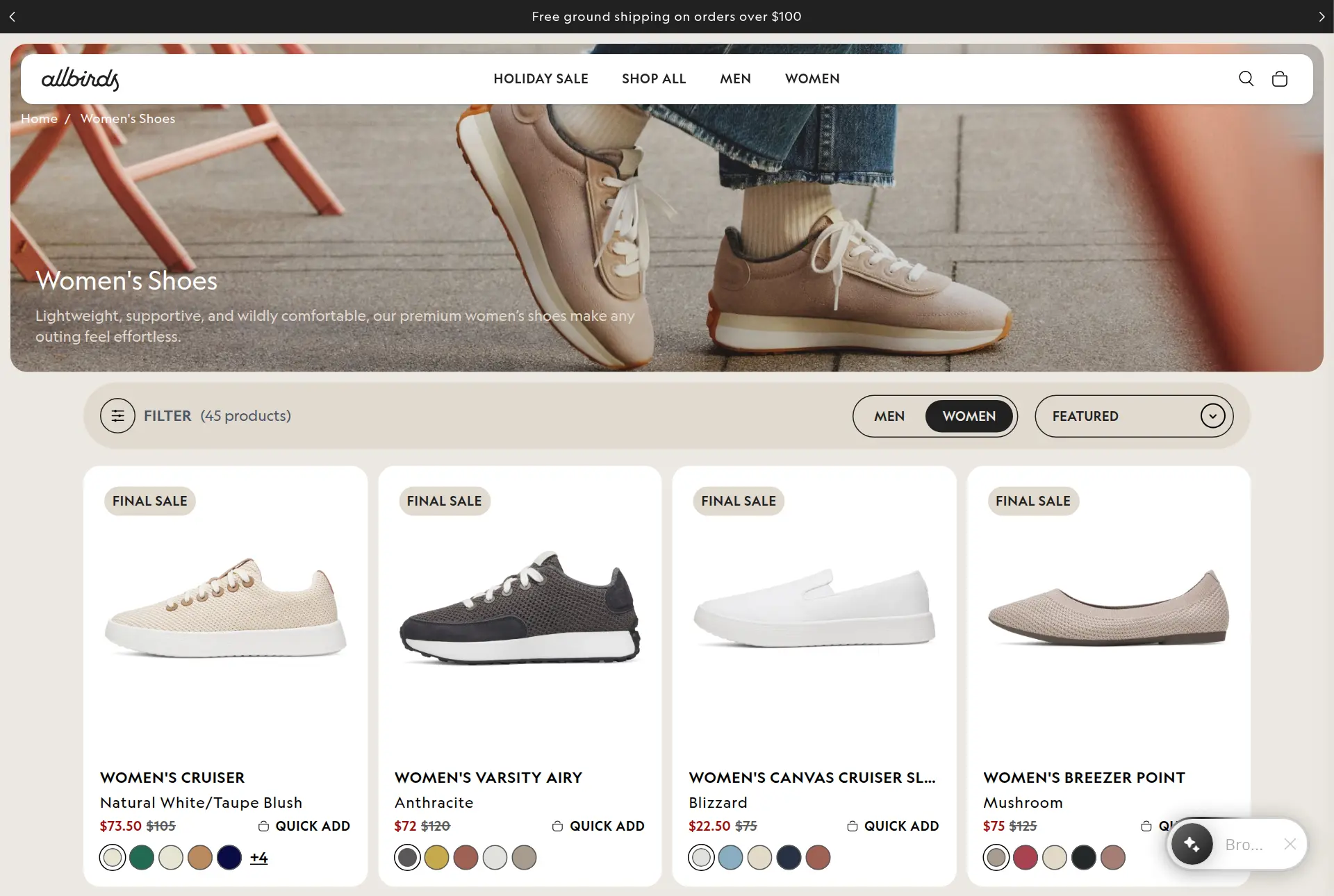
storestring Required- The shop's domain, or any address on it, e.g. allbirds.com.
collectionstring Optional- Only the products of this collection: its handle (the name in /collections/<handle>) or its address. The whole catalogue when not given.
pageinteger Optional- The page of the list, from 1.Default
1 limitinteger Optional- Products a page, at most 250.Default
250
A request, ready to send
It starts a run with the input shown at the top of this page, waits up to 60 seconds for it, and reads its records. Put your key in the variable it reads.
# Start a run and wait up to 60 seconds for it to finish
curl -X POST "https://api.enrichednow.com/v1/scrapers/shopify.products/runs?wait=60" \
  -H "Authorization: Bearer $ENRICHEDNOW_API_KEY" \
  -H "Content-Type: application/json" \
  -d '{"input":{"store":"allbirds.com","limit":5}}'

# Read its records, with the id the first call answered
curl "https://api.enrichednow.com/v1/runs/$RUN_ID/records?limit=100" \
  -H "Authorization: Bearer $ENRICHEDNOW_API_KEY"
from enrichednow import EnrichedNow
client = EnrichedNow() # reads ENRICHEDNOW_API_KEY
# Start a run, wait for it to end, and get its records
result = client.scrape("shopify.products", {
"store": "allbirds.com",
"limit": 5,
})
print(result.run.id, result.run.status, result.run.record_count)
# Read its records: pages are fetched as you go
for record in result.records:
print(record)Install it with pip install enrichednow, then save as run.py and run python3 run.py
import EnrichedNow from "enrichednow";

const client = new EnrichedNow(); // reads ENRICHEDNOW_API_KEY

// Start a run, wait for it to end, and get its records
const { run, records } = await client.scrape("shopify.products", { store: "allbirds.com", limit: 5 });
console.log(run.id, run.status, run.record_count);

// Read its records: pages are fetched as you go
for await (const record of records) console.log(record);
Install it with npm install enrichednow, then save as run.mjs and run node run.mjs
package main

import (
	"context"
	"fmt"
	"log"
	"time"

	enrichednow "github.com/enrichednow/enrichednow-go"
)

func main() {
	client, err := enrichednow.NewClient() // reads ENRICHEDNOW_API_KEY
	if err != nil {
		log.Fatal(err)
	}
	ctx, cancel := context.WithTimeout(context.Background(), 10*time.Minute)
	defer cancel()

	// Start a run, wait for it to end, and get its records
	run, records, err := client.Scrape(ctx, "shopify.products", map[string]any{"store": "allbirds.com", "limit": 5})
	if err != nil {
		log.Fatal(err)
	}
	fmt.Println(run.ID, run.Status, run.RecordCount)

	// Read its records: pages are fetched as you go
	for records.Next() {
		fmt.Println(string(records.Current()))
	}
	if err := records.Err(); err != nil {
		log.Fatal(err)
	}
}
Install it with go get github.com/enrichednow/enrichednow-go@latest, then save as run.go and run go run run.go
import com.enrichednow.EnrichedNowClient;
import com.enrichednow.ScrapeResult;
import java.util.Map;

public class Run {
    public static void main(String[] args) {
        EnrichedNowClient client = EnrichedNowClient.fromEnv(); // reads ENRICHEDNOW_API_KEY

        // Start a run, wait for it to end, and get its records
        ScrapeResult result = client.scrape("shopify.products", Map.of("store", "allbirds.com", "limit", 5));
        System.out.println(result.run().id() + " " + result.run().status() + " " + result.run().recordCount());

        // Read its records: pages are fetched as you go
        for (Map<String, Object> record : result.records()) {
            System.out.println(record);
        }
    }
}
Add com.enrichednow:enrichednow-java:0.4.0 to your Maven or Gradle build, then save as Run.java
enrichednow run shopify.products --input store=allbirds.com --input limit=5Install it with curl -fsSL https://raw.githubusercontent.com/enrichednow/enrichednow-cli/main/install.sh | sh
What comes back
A page of the store's catalogue: each product with its versions, prices, availability, options, tags and images. A record has 23 fields. One we could not read is null, never an empty string or a zero.
{
  "store": "allbirds.com",
  "store_name": "Allbirds",
  "product_id": "7215082405968",
  "handle": "womens-wool-runner-nz-shadow-blue-natural-white-sole",
  "url": "https://allbirds.com/products/womens-wool-runner-nz-shadow-blue-natural-white-sole",
  "title": "Women's Wool Runner NZ - Shadow Blue (Natural White Sole)",
  "brand": "Allbirds",
  "product_type": null,
  "tags": [
    "11/3/26 DROP",
    "allbirds::cfId => color-edf97af257c1e36d936a28375fac5f9c",
    "allbirds::hue => blue"
  ],
  "description": "Rethinking a classic isn’t easy, but breaking new ground rarely is. The Wool Runner NZ manages both, combining the original Wool Runner’s DNA with next-level comfort and more refined styling, while nodding to our New Zealand roots.",
  "price": {
    "amount": 120,
    "currency": "USD"
  },
  "price_max": {
    "amount": 120,
    "currency": "USD"
  },
  "compare_at_price": null,
  "available": true,
  "options": [
    {
      "name": "Size",
      "values": [
        "5"
      ]
    }
  ],
  "variants": [
    {
      "variant_id": "41314103427152",
      "title": "5",
      "sku": "A12799W050",
      "barcode": null,
      "options": {
        "Size": "5"
      },
      "price": {
        "amount": 120,
        "currency": "USD"
      },
      "compare_at_price": null,
      "available": true,
      "weight_grams": 1000,
      "requires_shipping": true,
      "image": null,
      "url": "https://allbirds.com/products/womens-wool-runner-nz-shadow-blue-natural-white-sole?variant=41314103427152"
    }
  ],
  "images": [
    "https://cdn.shopify.com/s/files/1/1104/4168/files/A12799W-SHADOWBLUE_SIDE_TRANSPARENT.png?v=1793835066",
    "https://cdn.shopify.com/s/files/1/1104/4168/files/A12799W-SHADOWBLUE_HEEL_TRANSPARENT.png?v=1793835066"
  ],
  "published_at": "2026-11-04T15:32:48-08:00",
  "created_at": "2025-08-27T09:16:36-07:00",
  "updated_at": "2026-11-18T14:52:38-08:00",
  "position": 2,
  "page": 1,
  "fetched_at": "2026-11-19T18:07:41.267607Z"
}
The scraper returned this record for the input above, reading a saved copy of the page, not the live site.
Values shortened for this page: tags: 5 items, the first 3 shown.
The fields of a record
storestring- The shop's host name, as asked for.
store_namestring or null- The shop's name, as the shop states it.
product_idstring- Shopify's id of the product.
handlestring- The product's name in its address: /products/<handle>.
urlstring- The product's address in the shop.
titlestring- The product's name.
brandstring or null- The brand or maker the shop files the product under.
product_typestring or null- The kind of product, in the shop's own words; many shops leave it empty.
tagslist of strings- The shop's tags on the product.
descriptionstring or null- The product description, as text without markup.
priceobject or null- The lowest price among the product's versions.Holds
amount,currency. price_maxobject or null- The highest price among the product's versions; the same as price when all cost the same.Holds
amount,currency. compare_at_priceobject or null- The highest struck-through earlier price among the versions, when the shop sets one.Holds
amount,currency. availableboolean or null- True when at least one version can be bought now; null when the shop does not say.
optionslist of objects- The options the product is offered in. A product sold as it is has none.Each holds
name,values. variantslist of objects- Every version of the product, in the shop's order.Each holds
variant_id,title,sku,barcode,options,price,compare_at_price,available,weight_grams,requires_shipping,image,url. imageslist of strings- The addresses of the product's pictures, in the shop's order.
published_atdatetime or null- When the shop published the product.
created_atdatetime or null- When the product was created in the shop.
updated_atdatetime or null- When the product was last changed. A list of products carries it; a single product's answer does not.
positioninteger or null- The product's place in the whole list asked for, from 1: 251 is the first product of page 2. Null for a single product.
pageinteger or null- The page of the list the product was on. Null for a single product.
fetched_atdatetime- When the shop was read, in UTC.
Units and limits
- Counted per request
- Billed per request: a run that returns data costs 1 unit, however many records it returns.
- A miss costs nothing
- A run that fails, that meets something not supported yet, or that you cancel costs nothing. You pay for runs that return data.
- What bounds a run
- A run may take up to 5 minutes. Its records are read in pages of up to 1,000 and are kept for 7 days.
What it does not do
- One run reads one page of up to 250 products.
- A site that is not a Shopify store ends as failed, and says so.
- Some Shopify stores do not publish their catalogue this way; such a run ends as failed.
The bounds its schema sets
page- 1 to 100; 1 unless you say otherwise
limit- 1 to 250; 250 unless you say otherwise
Questions
What does Shopify store products return?
A page of the store's catalogue: each product with its versions, prices, availability, options, tags and images. A record has 23 fields, among them store, store_name, product_id, handle, url and title. A value that could not be read is null, never an empty string or a zero.
What do I send?
A Shopify store's domain, and optionally one of its collections. The input store is required. Optional: collection, page and limit.
How is it counted?
Billed per request: a run that returns data costs 1 unit, however many records it returns. A run that fails, that meets something not supported yet, or that you cancel costs nothing. The first 1,000 units each month are free.
How much does one run return?
Its schema sets these bounds: page 1 to 100 (1 unless you say otherwise); limit 1 to 250 (250 unless you say otherwise). A run may take up to 5 minutes.
What does it not do?
One run reads one page of up to 250 products. A site that is not a Shopify store ends as failed, and says so. Some Shopify stores do not publish their catalogue this way; such a run ends as failed.
How long are the records kept, and in what format do they come?
Records are kept for 7 days after the run ended, and read in pages of up to 1,000. They come as JSON, as NDJSON with one record a line, or as CSV with a column for each field.
Can an AI assistant call it?
Yes. Through the EnrichedNow MCP server an assistant calls the tool run_scraper with the scraper_id shopify.products and the same input. It costs what the same API call costs.
Used in these playbooks
A playbook runs Shopify store products as one of its steps and hands back the finished list. Its runs of this scraper cost what they cost here, and the playbook adds nothing.
E-commerce
Competitor Price Tracker
Every product and price of competitors' Shopify stores and Amazon listings, read on a schedule, with what changed since last time.
E-commerce
Shopify Niche Research
The products of a niche's Shopify stores, with price, newness and reductions, and similar products on AliExpress with the margin.
Shopify
Any store built on Shopify, by its domain: its catalogue, one product, its collections.
Shopify store product
shopify.productA product's address in a Shopify store, or the store's domain and the product's handle. The product: every version with its price, availability, SKU and barcode, the description, options, tags and images.
Shopify store collections
shopify.collectionsA Shopify store's domain. A page of the store's collections: name, handle, description, number of products and picture.
- Industry
- Shopping and retail
- Where
- Worldwide
- For
- E-commerce
Run it on an input of your own.
Create an account, make a key, and send the request above with your own input. The first 1,000 units each month are free.