Scraper API
PyPI
pypi.packageAvailable
PyPI package
Its summary, latest version, licence, Python requirement, dependencies, links, classifiers, its releases with the date of each, the latest version's files, known vulnerabilities, and its downloads in the last day, week and month.
Give it a project's name, or its address on pypi.org.
1 unit a run, for runs that return data. Runs that fail cost nothing. How units work
- Counted
- 1 unit a run
- Inputs
- 3, 1 required
- Record
- 27 fields
- A run takes
- up to 5 minutes
- Records kept
- 7 days
- Measured
- its success, on the status page
POST/v1/scrapers/pypi.package/runs
sent, and answered
a record of the run27 fields
ok1 unit a run
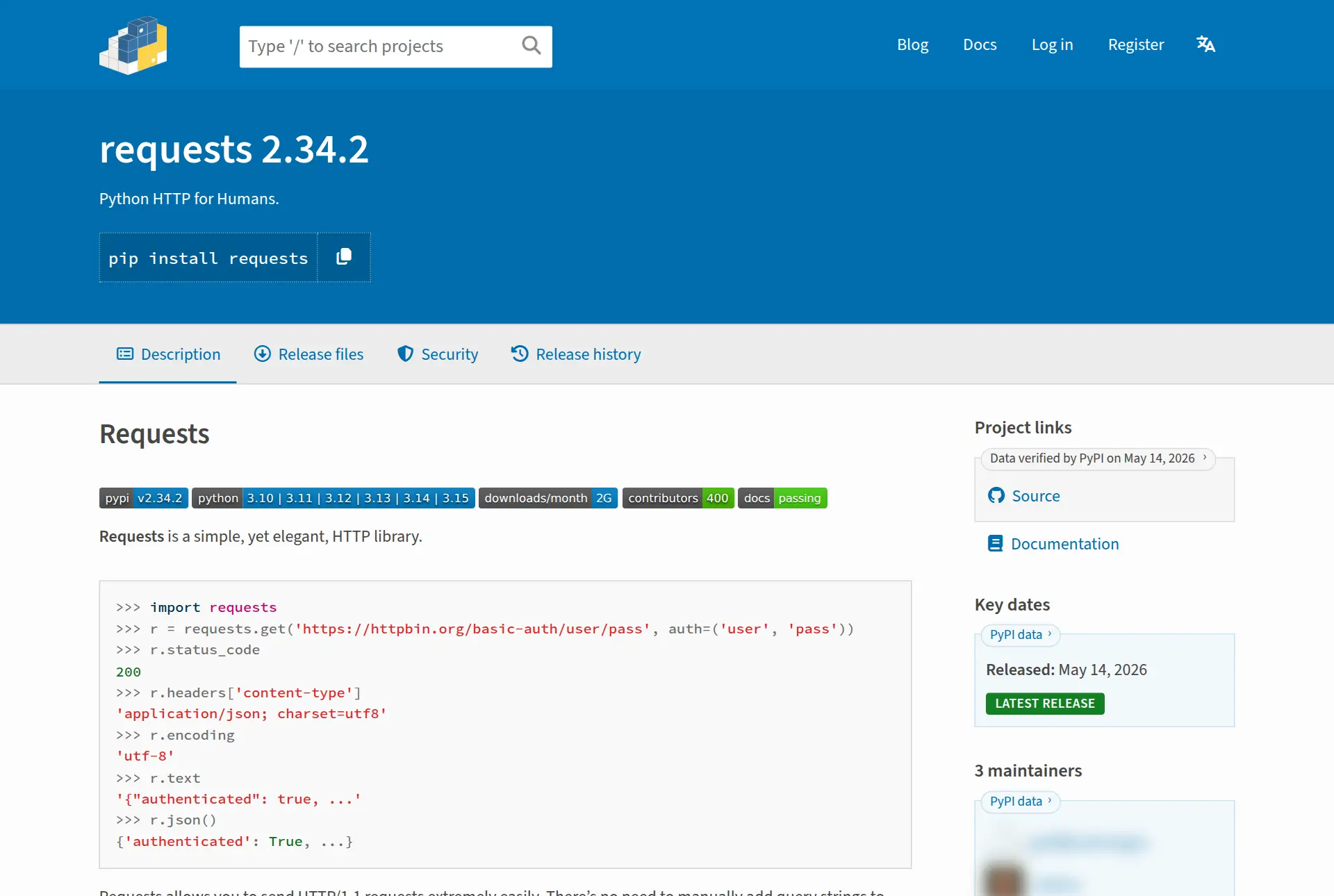
A record this scraper returned for this input. The first 9 of its 27 fields are set down here; the whole record is below.
What it is used for
- Check a dependency's health
- The latest version and when it was uploaded, the yanked flag, the releases and any known
vulnerabilities, before a project goes into your requirements. - Measure adoption
- Downloads of the last day, week and month beside the release count, to compare Python projects that do the same job.
- Audit what you install
- The licence,
requires_python, the declared dependencies and the files of the latest release with their sizes, for every project in a lockfile.
What you send
A project's name, or its address on pypi.org. These are its 3 inputs, as its schema has them.
packagestring Required- The project's name, such as requests or scikit-learn, or its address on pypi.org.
max_releasesinteger Optional- Return this many of its releases, newest first: 20 unless you say otherwise; 0 returns none.Default
20 include_descriptionboolean Optional- true also returns the project's long description, its README, as written.Default
false
A request, ready to send
It starts a run with the input shown at the top of this page, waits up to 60 seconds for it, and reads its records. Put your key in the variable it reads.
# Start a run and wait up to 60 seconds for it to finish
curl -X POST "https://api.enrichednow.com/v1/scrapers/pypi.package/runs?wait=60" \
  -H "Authorization: Bearer $ENRICHEDNOW_API_KEY" \
  -H "Content-Type: application/json" \
  -d '{"input":{"package":"sampleproject","max_releases":3}}'

# Read its records, with the id the first call answered
curl "https://api.enrichednow.com/v1/runs/$RUN_ID/records?limit=100" \
  -H "Authorization: Bearer $ENRICHEDNOW_API_KEY"
from enrichednow import EnrichedNow
client = EnrichedNow() # reads ENRICHEDNOW_API_KEY
# Start a run, wait for it to end, and get its records
result = client.scrape("pypi.package", {
"package": "sampleproject",
"max_releases": 3,
})
print(result.run.id, result.run.status, result.run.record_count)
# Read its records: pages are fetched as you go
for record in result.records:
print(record)Install it with pip install enrichednow, then save as run.py and run python3 run.py
import EnrichedNow from "enrichednow";

const client = new EnrichedNow(); // reads ENRICHEDNOW_API_KEY

// Start a run, wait for it to end, and get its records
const { run, records } = await client.scrape("pypi.package", {
  package: "sampleproject",
  max_releases: 3,
});
console.log(run.id, run.status, run.record_count);

// Read its records: pages are fetched as you go
for await (const record of records) console.log(record);
Install it with npm install enrichednow, then save as run.mjs and run node run.mjs
package main

import (
	"context"
	"fmt"
	"log"
	"time"

	enrichednow "github.com/enrichednow/enrichednow-go"
)

func main() {
	client, err := enrichednow.NewClient() // reads ENRICHEDNOW_API_KEY
	if err != nil {
		log.Fatal(err)
	}
	ctx, cancel := context.WithTimeout(context.Background(), 10*time.Minute)
	defer cancel()

	// Start a run, wait for it to end, and get its records
	run, records, err := client.Scrape(ctx, "pypi.package", map[string]any{"package": "sampleproject", "max_releases": 3})
	if err != nil {
		log.Fatal(err)
	}
	fmt.Println(run.ID, run.Status, run.RecordCount)

	// Read its records: pages are fetched as you go
	for records.Next() {
		fmt.Println(string(records.Current()))
	}
	if err := records.Err(); err != nil {
		log.Fatal(err)
	}
}
Install it with go get github.com/enrichednow/enrichednow-go@latest, then save as run.go and run go run run.go
import com.enrichednow.EnrichedNowClient;
import com.enrichednow.ScrapeResult;
import java.util.Map;

public class Run {
    public static void main(String[] args) {
        EnrichedNowClient client = EnrichedNowClient.fromEnv(); // reads ENRICHEDNOW_API_KEY

        // Start a run, wait for it to end, and get its records
        ScrapeResult result = client.scrape("pypi.package", Map.of("package", "sampleproject", "max_releases", 3));
        System.out.println(result.run().id() + " " + result.run().status() + " " + result.run().recordCount());

        // Read its records: pages are fetched as you go
        for (Map<String, Object> record : result.records()) {
            System.out.println(record);
        }
    }
}
Add com.enrichednow:enrichednow-java:0.4.0 to your Maven or Gradle build, then save as Run.java
enrichednow run pypi.package --input package=sampleproject --input max_releases=3Install it with curl -fsSL https://raw.githubusercontent.com/enrichednow/enrichednow-cli/main/install.sh | sh
What comes back
Its summary, latest version, licence, Python requirement, dependencies, links, classifiers, its releases with the date of each, the latest version's files, known vulnerabilities, and its downloads in the last day, week and month. A record has 27 fields. One we could not read is null, never an empty string or a zero.
{
  "name": "sampleproject",
  "url": "https://pypi.org/project/sampleproject/",
  "version": "4.0.0",
  "summary": "A sample Python project",
  "description": null,
  "description_content_type": "text/markdown",
  "author": "A. Random Developer",
  "maintainer": "A. Great Maintainer",
  "license": "MIT License",
  "keywords": [
    "sample",
    "setuptools",
    "development"
  ],
  "classifiers": [
    "Development Status :: 3 - Alpha",
    "Intended Audience :: Developers",
    "License :: OSI Approved :: MIT License"
  ],
  "requires_python": ">=3.9",
  "requires_dist": [
    "peppercorn",
    "check-manifest; extra == \"dev\"",
    "coverage; extra == \"test\""
  ],
  "project_urls": {
    "Bug Reports": "https://github.com/pypa/sampleproject/issues",
    "Funding": "https://donate.pypi.org",
    "Homepage": "https://github.com/pypa/sampleproject",
    "Say Thanks!": "http://saythanks.io/to/example",
    "Source": "https://github.com/pypa/sampleproject/"
  },
  "homepage": "https://github.com/pypa/sampleproject",
  "yanked": false,
  "yanked_reason": null,
  "release_count": 7,
  "releases": [
    {
      "version": "4.0.0",
      "uploaded_at": "2024-11-06T22:37:09.220617Z",
      "files": 2,
      "yanked": false
    },
    {
      "version": "3.0.0",
      "uploaded_at": "2022-12-01T18:51:00.007372Z",
      "files": 2,
      "yanked": false
    }
  ],
  "first_uploaded_at": "2015-06-14T14:37:56.383366Z",
  "latest_uploaded_at": "2024-11-06T22:37:09.220617Z",
  "files": [
    {
      "filename": "sampleproject-4.0.0-py3-none-any.whl",
      "package_type": "bdist_wheel",
      "python_version": "py3",
      "size_bytes": 4661,
      "url": "https://files.pythonhosted.org/packages/d7/73/c16e5f3f0d37c60947e70865c255a58dc408780a6474de0523afd0ec553a/sampleproject-4.0.0-py3-none-any.whl",
      "uploaded_at": "2024-11-06T22:37:09.220617Z",
      "sha256": "c23e447ea90d796d1e645c35c4b2de125040add12a845825546f91c93f391b6b"
    },
    {
      "filename": "sampleproject-4.0.0.tar.gz",
      "package_type": "sdist",
      "python_version": "source",
      "size_bytes": 5760,
      "url": "https://files.pythonhosted.org/packages/48/8c/c18d25735962870ccb6d1cd2ac7bde40008a332211055e260cb7ec4c6bab/sampleproject-4.0.0.tar.gz",
      "uploaded_at": "2024-11-06T22:37:10.868088Z",
      "sha256": "0ace7980f82c5815ede4cd7bf9f6693684cec2ae47b9b7ade9add533b8627c6b"
    }
  ],
  "vulnerabilities": [],
  "downloads_last_day": 16542,
  "downloads_last_week": 119851,
  "downloads_last_month": 505681,
  "fetched_at": "2026-11-19T18:07:41.099216Z"
}
The scraper returned this record for the input above, reading a saved copy of the page, not the live site.
Values shortened for this page: classifiers: 11 items, the first 3 shown; releases: 3 items, the first 2 shown.
The fields of a record
namestring- The project's name as PyPI writes it, e.g. "Flask".
urlstring- The project's page on pypi.org.
versionstring or null- The latest version.
summarystring or null- The project's one-line summary.
descriptionstring or null- The project's long description (its README) as written, when include_description asked for it.
description_content_typestring or null- The format of the long description, e.g. "text/markdown", "text/x-rst".
authorstring or null- The author's name as the project's metadata states it.
maintainerstring or null- The maintainer's name as the project's metadata states it; null when it names none.
licensestring or null- The licence: the expression or short name the metadata states, else the licence its classifiers name.
keywordslist of strings- The project's keywords.
classifierslist of strings- The project's trove classifiers, e.g. "Programming Language :: Python :: 3.12".
requires_pythonstring or null- The Python versions the latest release supports, e.g. ">=3.9".
requires_distlist of strings- The latest release's dependencies as requirement strings, extras included, e.g. "urllib3<3,>=1.21.1".
project_urlsobject- The links the project names, by label, e.g. {"Documentation": "https://…", "Source": "https://…"}.
homepagestring or null- The project's home page, when it names one.
yankedboolean- True when the latest release was withdrawn by its maintainers.
yanked_reasonstring or null- The reason the maintainers gave for withdrawing it.
release_countinteger- How many releases the project has.
releaseslist of objects- The newest releases first, as many as max_releases asked for.Each holds
version,uploaded_at,files,yanked. first_uploaded_atdatetime or null- When the project's first file was uploaded, in UTC.
latest_uploaded_atdatetime or null- When the latest version was uploaded, in UTC.
fileslist of objects- The files of the latest version.Each holds
filename,package_type,python_version,size_bytes,url,uploaded_at,sha256. vulnerabilitieslist of strings- The identifiers of the known vulnerabilities PyPI lists for the latest version, e.g. "GHSA-…", "PYSEC-…". Empty when it lists none.
downloads_last_dayinteger or null- Downloads on the last day counted, as pypistats.org states them.
downloads_last_weekinteger or null- Downloads in the last seven days counted.
downloads_last_monthinteger or null- Downloads in the last thirty days counted.
fetched_atdatetime- When the project was read, in UTC.
Units and limits
- Counted per request
- Billed per request: a run that returns data costs 1 unit, however many records it returns.
- A miss costs nothing
- A run that fails, that meets something not supported yet, or that you cancel costs nothing. You pay for runs that return data.
- What bounds a run
- A run may take up to 5 minutes. Its records are read in pages of up to 1,000 and are kept for 7 days.
What it does not do
- PyPI itself publishes no download counts: they are those of pypistats.org, and a project it has no counts for has them null.
- The author and the maintainer are returned by name. Email addresses are not returned.
- There is no search: PyPI offers none to read.
The bounds its schema sets
max_releases- 0 to 2,000; 20 unless you say otherwise
Questions
What does PyPI package return?
Its summary, latest version, licence, Python requirement, dependencies, links, classifiers, its releases with the date of each, the latest version's files, known vulnerabilities, and its downloads in the last day, week and month. A record has 27 fields, among them name, url, version, summary, description and description_content_type. A value that could not be read is null, never an empty string or a zero.
What do I send?
A project's name, or its address on pypi.org. The input package is required. Optional: max_releases and include_description.
How is it counted?
Billed per request: a run that returns data costs 1 unit, however many records it returns. A run that fails, that meets something not supported yet, or that you cancel costs nothing. The first 1,000 units each month are free.
How much does one run return?
Its schema sets these bounds: max_releases 0 to 2,000 (20 unless you say otherwise). A run may take up to 5 minutes.
What does it not do?
PyPI itself publishes no download counts: they are those of pypistats.org, and a project it has no counts for has them null. The author and the maintainer are returned by name. Email addresses are not returned. There is no search: PyPI offers none to read.
How long are the records kept, and in what format do they come?
Records are kept for 7 days after the run ended, and read in pages of up to 1,000. They come as JSON, as NDJSON with one record a line, or as CSV with a column for each field.
Can an AI assistant call it?
Yes. Through the EnrichedNow MCP server an assistant calls the tool run_scraper with the scraper_id pypi.package and the same input. It costs what the same API call costs.
PyPI
Projects of the Python Package Index: a project's details, releases, files and download counts.
- Industry
- Code and research
- Where
- Worldwide
Run it on an input of your own.
Create an account, make a key, and send the request above with your own input. The first 1,000 units each month are free.