Scraper API
PubMed
pubmed.searchAvailable
PubMed search
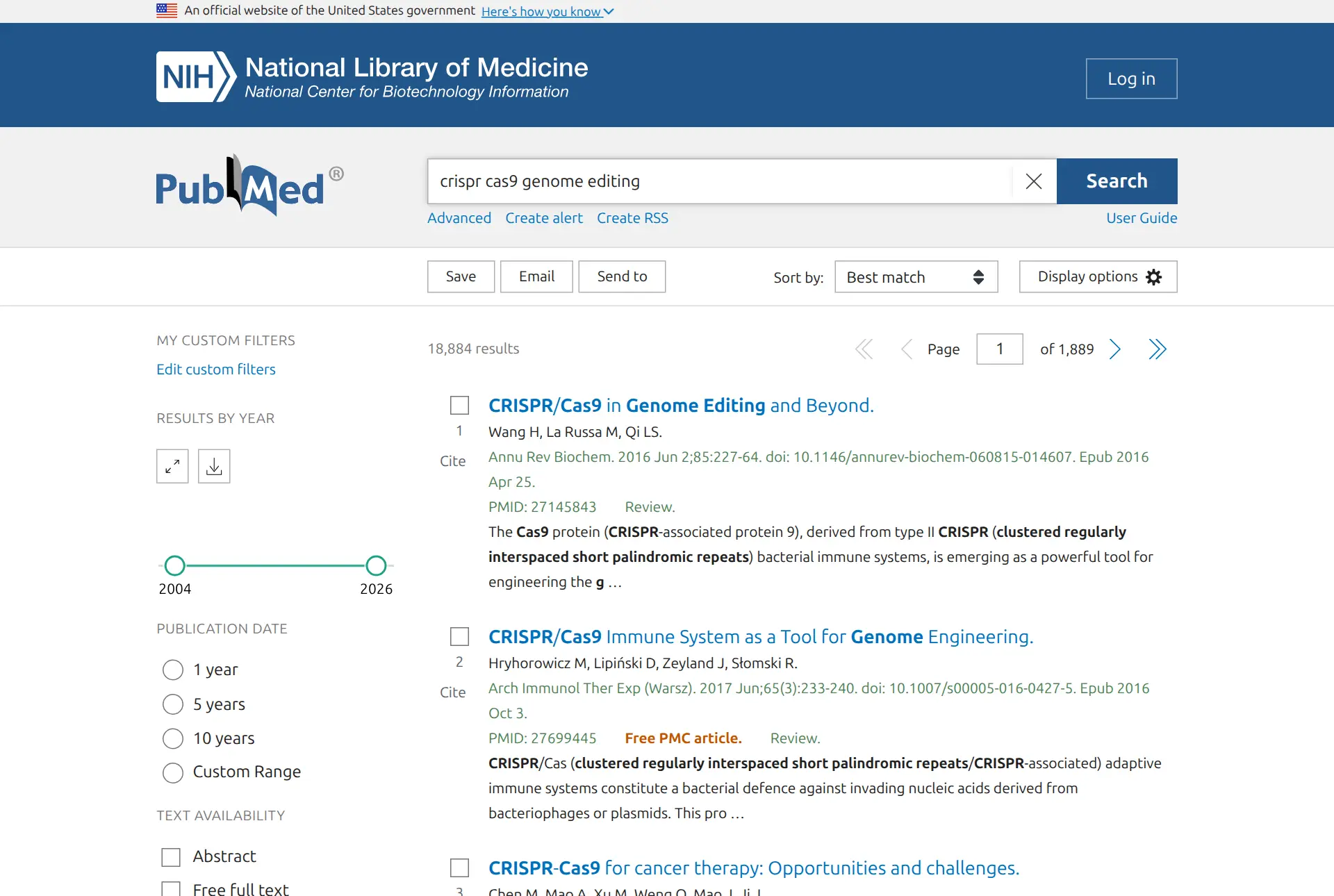
A page of the citations that match: PubMed id, title, authors, journal, publication date, volume, issue and pages, DOI, PubMed Central id and publication types.
Give it a search as you would type it into PubMed, with its field tags and operators, and optionally a page, a page size and an order.
1 unit a run, for runs that return data. Runs that fail cost nothing. How units work
- Counted
- 1 unit a run
- Inputs
- 4, 1 required
- Record
- 19 fields
- A run takes
- up to 5 minutes
- Records kept
- 7 days
- Measured
- its success, on the status page
POST/v1/scrapers/pubmed.search/runs
sent, and answered
a record of the run19 fields
ok1 unit a run
A record this scraper returned for this input. The first 9 of its 19 fields are set down here; the whole record is below.
What it is used for
- Follow new research
- Run a PubMed search on a schedule, newest first, and pass on the citations you have not seen, with journal, authors and DOI.
- Map a field's literature
- Read the citations for a subject page by page and count them by journal, year and publication type.
- Build a reading list
- Search a subject with PubMed's own field tags and keep the
pmidof each citation to read its abstract with pubmed.article.
What you send
A search as you would type it into PubMed, with its field tags and operators, and optionally a page, a page size and an order. These are its 4 inputs, as its schema has them.
querystring Required- The search, as typed into PubMed's search box. Its field tags and operators work:
crispr AND review[pt],Doudna JA[au],2024:2026[dp],"gene editing"[ti]. max_resultsinteger Optional- How many citations a page holds (default 20, up to 100).Default
20 pageinteger Optional- Which page of the results, from 1. PubMed serves the first 9,999 citations of a search.Default
1 sortstring Optional- The order: PubMed's best match (default), newest publication first, by first author, or by journal.Default
relevance
A request, ready to send
It starts a run with the input shown at the top of this page, waits up to 60 seconds for it, and reads its records. Put your key in the variable it reads.
# Start a run and wait up to 60 seconds for it to finish
curl -X POST "https://api.enrichednow.com/v1/scrapers/pubmed.search/runs?wait=60" \
  -H "Authorization: Bearer $ENRICHEDNOW_API_KEY" \
  -H "Content-Type: application/json" \
  -d '{"input":{"query":"crispr gene editing","max_results":5}}'

# Read its records, with the id the first call answered
curl "https://api.enrichednow.com/v1/runs/$RUN_ID/records?limit=100" \
  -H "Authorization: Bearer $ENRICHEDNOW_API_KEY"
from enrichednow import EnrichedNow
client = EnrichedNow() # reads ENRICHEDNOW_API_KEY
# Start a run, wait for it to end, and get its records
result = client.scrape("pubmed.search", {
"query": "crispr gene editing",
"max_results": 5,
})
print(result.run.id, result.run.status, result.run.record_count)
# Read its records: pages are fetched as you go
for record in result.records:
print(record)Install it with pip install enrichednow, then save as run.py and run python3 run.py
import EnrichedNow from "enrichednow";

const client = new EnrichedNow(); // reads ENRICHEDNOW_API_KEY

// Start a run, wait for it to end, and get its records
const { run, records } = await client.scrape("pubmed.search", {
  query: "crispr gene editing",
  max_results: 5,
});
console.log(run.id, run.status, run.record_count);

// Read its records: pages are fetched as you go
for await (const record of records) console.log(record);
Install it with npm install enrichednow, then save as run.mjs and run node run.mjs
package main

import (
	"context"
	"fmt"
	"log"
	"time"

	enrichednow "github.com/enrichednow/enrichednow-go"
)

func main() {
	client, err := enrichednow.NewClient() // reads ENRICHEDNOW_API_KEY
	if err != nil {
		log.Fatal(err)
	}
	ctx, cancel := context.WithTimeout(context.Background(), 10*time.Minute)
	defer cancel()

	// Start a run, wait for it to end, and get its records
	run, records, err := client.Scrape(ctx, "pubmed.search", map[string]any{"query": "crispr gene editing", "max_results": 5})
	if err != nil {
		log.Fatal(err)
	}
	fmt.Println(run.ID, run.Status, run.RecordCount)

	// Read its records: pages are fetched as you go
	for records.Next() {
		fmt.Println(string(records.Current()))
	}
	if err := records.Err(); err != nil {
		log.Fatal(err)
	}
}
Install it with go get github.com/enrichednow/enrichednow-go@latest, then save as run.go and run go run run.go
import com.enrichednow.EnrichedNowClient;
import com.enrichednow.ScrapeResult;
import java.util.Map;

public class Run {
    public static void main(String[] args) {
        EnrichedNowClient client = EnrichedNowClient.fromEnv(); // reads ENRICHEDNOW_API_KEY

        // Start a run, wait for it to end, and get its records
        ScrapeResult result = client.scrape("pubmed.search", Map.of("query", "crispr gene editing", "max_results", 5));
        System.out.println(result.run().id() + " " + result.run().status() + " " + result.run().recordCount());

        // Read its records: pages are fetched as you go
        for (Map<String, Object> record : result.records()) {
            System.out.println(record);
        }
    }
}
Add com.enrichednow:enrichednow-java:0.4.0 to your Maven or Gradle build, then save as Run.java
enrichednow run pubmed.search --input 'query=crispr gene editing' --input max_results=5Install it with curl -fsSL https://raw.githubusercontent.com/enrichednow/enrichednow-cli/main/install.sh | sh
What comes back
A page of the citations that match: PubMed id, title, authors, journal, publication date, volume, issue and pages, DOI, PubMed Central id and publication types. A record has 19 fields. One we could not read is null, never an empty string or a zero.
{
  "position": 1,
  "pmid": "38786024",
  "url": "https://pubmed.ncbi.nlm.nih.gov/38786024/",
  "title": "CRISPR-Based Gene Therapies: From Preclinical to Clinical Treatments.",
  "authors": [
    "Laurent M",
    "Geoffroy M",
    "Pavani G"
  ],
  "journal": "Cells",
  "journal_full": "Cells",
  "publication_date": "2024 May 8",
  "electronic_date": "2024 May 8",
  "volume": "13",
  "issue": "10",
  "pages": null,
  "doi": "10.3390/cells13100800",
  "pmc_id": "PMC11119143",
  "publication_types": [
    "Journal Article",
    "Review",
    "Research Support, Non-U.S. Gov't"
  ],
  "languages": [
    "eng"
  ],
  "has_abstract": true,
  "total_results": 25887,
  "fetched_at": "2026-11-19T18:07:41.096543Z"
}
The scraper returned this record for the input above, reading a saved copy of the page, not the live site.
Values shortened for this page: authors: 4 items, the first 3 shown.
The fields of a record
positioninteger- The citation's place in the whole list, from 1.
pmidstring- The citation's PubMed id.
urlstring- The citation's page on PubMed.
titlestring or null- The article's title.
authorslist of strings- The authors as PubMed lists them, family name and initials (
Doudna JA), in the article's order. journalstring or null- The journal's abbreviated title, e.g.
Sci Rep. journal_fullstring or null- The journal's full title.
publication_datestring or null- The publication date as PubMed writes it:
2021 Mar 29,2019 Jul,2019. electronic_datestring or null- The date the article went online ahead of print, in the same writing; null when PubMed gives none.
volumestring or null- The journal volume.
issuestring or null- The journal issue.
pagesstring or null- The pages, or the article number.
doistring or null- The article's DOI, e.g.
10.1038/s41598-021-86429-2. pmc_idstring or null- The id of the free full text in PubMed Central (
PMC8007589), when there is one. publication_typeslist of strings- What kind of publication it is, in PubMed's terms:
Journal Article,Review,Clinical Trial, ... languageslist of strings- The languages of the article, as three-letter codes (
eng). has_abstractboolean or null- True when PubMed holds an abstract for the citation.
total_resultsinteger or null- How many citations PubMed says match the query, the same on every record.
fetched_atdatetime- When PubMed answered, in UTC.
Units and limits
- Counted per request
- Billed per request: a run that returns data costs 1 unit, however many records it returns.
- A miss costs nothing
- A run that fails, that meets something not supported yet, or that you cancel costs nothing. You pay for runs that return data.
- What bounds a run
- A run may take up to 5 minutes. Its records are read in pages of up to 1,000 and are kept for 7 days.
What it does not do
- One run reads one page: up to 100 citations. PubMed serves the first 9,999 citations of a search.
- A search record carries no abstract: pubmed.article returns it for one citation.
- The query is PubMed's own syntax and PubMed decides what it means.
The bounds its schema sets
max_results- 1 to 100; 20 unless you say otherwise
page- 1 to 9,999; 1 unless you say otherwise
sort- relevance, newest, first_author, journal; relevance unless you say otherwise
Questions
What does PubMed search return?
A page of the citations that match: PubMed id, title, authors, journal, publication date, volume, issue and pages, DOI, PubMed Central id and publication types. A record has 19 fields, among them position, pmid, url, title, authors and journal. A value that could not be read is null, never an empty string or a zero.
What do I send?
A search as you would type it into PubMed, with its field tags and operators, and optionally a page, a page size and an order. The input query is required. Optional: max_results, page and sort.
How is it counted?
Billed per request: a run that returns data costs 1 unit, however many records it returns. A run that fails, that meets something not supported yet, or that you cancel costs nothing. The first 1,000 units each month are free.
How much does one run return?
Its schema sets these bounds: max_results 1 to 100 (20 unless you say otherwise); page 1 to 9,999 (1 unless you say otherwise); sort relevance, newest, first_author, journal (relevance unless you say otherwise). A run may take up to 5 minutes.
What does it not do?
One run reads one page: up to 100 citations. PubMed serves the first 9,999 citations of a search. A search record carries no abstract: pubmed.article returns it for one citation. The query is PubMed's own syntax and PubMed decides what it means.
How long are the records kept, and in what format do they come?
Records are kept for 7 days after the run ended, and read in pages of up to 1,000. They come as JSON, as NDJSON with one record a line, or as CSV with a column for each field.
Can an AI assistant call it?
Yes. Through the EnrichedNow MCP server an assistant calls the tool run_scraper with the scraper_id pubmed.search and the same input. It costs what the same API call costs.
Used in this playbook
A playbook runs PubMed search as one of its steps and hands back the finished list. Its runs of this scraper cost what they cost here, and the playbook adds nothing.
Research
Literature Sweep
New papers on your subject from PubMed, arXiv and Crossref, each paper once, with its abstract, DOI and free full text.
PubMed
PubMed's index of biomedical literature: a search in PubMed's own syntax, and one citation with its abstract.
PubMed article
pubmed.articleA citation's PubMed id, or the address of its page on PubMed. The citation: title, abstract, authors with the institutions stated for them, journal, volume, issue and pages, dates, DOI, PubMed Central id, publication types, MeSH headings and keywords.
- Industry
- Code and research
- Where
- Worldwide
Run it on an input of your own.
Create an account, make a key, and send the request above with your own input. The first 1,000 units each month are free.