Scraper API
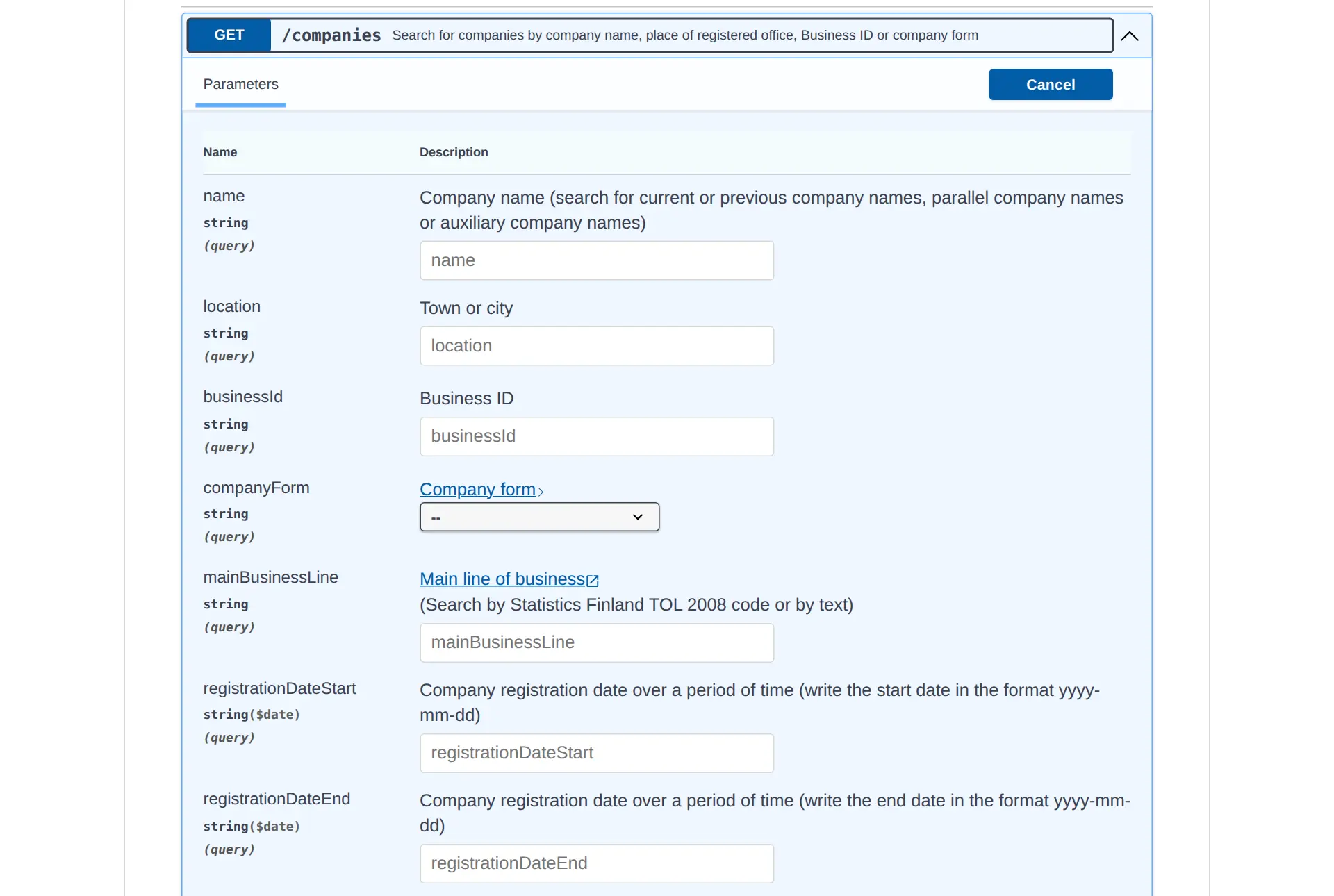
PRHprh.companyAvailable
Finnish company
The company: name, parallel, auxiliary and previous names, status and end date, EUID, form, main line of business, website, street and postal addresses, registration dates, whether it is in liquidation or bankruptcy, and whether it is in the trade, VAT and employer registers.
Give it a Finnish business ID (Y-tunnus), or the company's address in the Business Information System.
1 unit a run, for runs that return data. Runs that fail cost nothing. How units work
- Counted
- 1 unit a run
- Inputs
- 1, 1 required
- Record
- 22 fields
- A run takes
- up to 5 minutes
- Records kept
- 7 days
- Measured
- its success, on the status page
POST/v1/scrapers/prh.company/runs
sent, and answered
a record of the run22 fields
ok1 unit a run
A record this scraper returned for this input. The first 9 of its 22 fields are set down here; the whole record is below.
What it is used for
- Verify a Finnish company
- Read
status,legal_formandsituationsbefore you sign. A ceased company says so, with itsend_date, and so does one in liquidation or bankruptcy. - Connect the register to the web
- Read
websitewith the business ID, the link between the register and the company's own domain. - Know every name it trades under
- Read
other_namesandprevious_namesto match invoices and listings that use an older or auxiliary name.
What you send
A Finnish business ID (Y-tunnus), or the company's address in the Business Information System. It is the one input.
companystring Required- The business ID, e.g. 0112038-9. prh.search finds it by name.
A request, ready to send
It starts a run with the input shown at the top of this page, waits up to 60 seconds for it, and reads its records. Put your key in the variable it reads.
# Start a run and wait up to 60 seconds for it to finish
curl -X POST "https://api.enrichednow.com/v1/scrapers/prh.company/runs?wait=60" \
  -H "Authorization: Bearer $ENRICHEDNOW_API_KEY" \
  -H "Content-Type: application/json" \
  -d '{"input":{"company":"0112038-9"}}'

# Read its records, with the id the first call answered
curl "https://api.enrichednow.com/v1/runs/$RUN_ID/records?limit=100" \
  -H "Authorization: Bearer $ENRICHEDNOW_API_KEY"
from enrichednow import EnrichedNow
client = EnrichedNow() # reads ENRICHEDNOW_API_KEY
# Start a run, wait for it to end, and get its records
result = client.scrape("prh.company", {"company": "0112038-9"})
print(result.run.id, result.run.status, result.run.record_count)
# Read its records: pages are fetched as you go
for record in result.records:
print(record)Install it with pip install enrichednow, then save as run.py and run python3 run.py
import EnrichedNow from "enrichednow";

const client = new EnrichedNow(); // reads ENRICHEDNOW_API_KEY

// Start a run, wait for it to end, and get its records
const { run, records } = await client.scrape("prh.company", { company: "0112038-9" });
console.log(run.id, run.status, run.record_count);

// Read its records: pages are fetched as you go
for await (const record of records) console.log(record);
Install it with npm install enrichednow, then save as run.mjs and run node run.mjs
package main

import (
	"context"
	"fmt"
	"log"
	"time"

	enrichednow "github.com/enrichednow/enrichednow-go"
)

func main() {
	client, err := enrichednow.NewClient() // reads ENRICHEDNOW_API_KEY
	if err != nil {
		log.Fatal(err)
	}
	ctx, cancel := context.WithTimeout(context.Background(), 10*time.Minute)
	defer cancel()

	// Start a run, wait for it to end, and get its records
	run, records, err := client.Scrape(ctx, "prh.company", map[string]any{"company": "0112038-9"})
	if err != nil {
		log.Fatal(err)
	}
	fmt.Println(run.ID, run.Status, run.RecordCount)

	// Read its records: pages are fetched as you go
	for records.Next() {
		fmt.Println(string(records.Current()))
	}
	if err := records.Err(); err != nil {
		log.Fatal(err)
	}
}
Install it with go get github.com/enrichednow/enrichednow-go@latest, then save as run.go and run go run run.go
import com.enrichednow.EnrichedNowClient;
import com.enrichednow.ScrapeResult;
import java.util.Map;

public class Run {
    public static void main(String[] args) {
        EnrichedNowClient client = EnrichedNowClient.fromEnv(); // reads ENRICHEDNOW_API_KEY

        // Start a run, wait for it to end, and get its records
        ScrapeResult result = client.scrape("prh.company", Map.of("company", "0112038-9"));
        System.out.println(result.run().id() + " " + result.run().status() + " " + result.run().recordCount());

        // Read its records: pages are fetched as you go
        for (Map<String, Object> record : result.records()) {
            System.out.println(record);
        }
    }
}
Add com.enrichednow:enrichednow-java:0.4.0 to your Maven or Gradle build, then save as Run.java
enrichednow run prh.company --input company=0112038-9Install it with curl -fsSL https://raw.githubusercontent.com/enrichednow/enrichednow-cli/main/install.sh | sh
What comes back
The company: name, parallel, auxiliary and previous names, status and end date, EUID, form, main line of business, website, street and postal addresses, registration dates, whether it is in liquidation or bankruptcy, and whether it is in the trade, VAT and employer registers. A record has 22 fields. One we could not read is null, never an empty string or a zero.
{
  "business_id": "0112038-9",
  "url": "https://tietopalvelu.ytj.fi/yritys/0112038-9",
  "name": "Nokia Oyj",
  "status": "active",
  "end_date": null,
  "other_names": [
    "Nokia Networks",
    "Nokia Matkapuhelimet",
    "Nokia Telecommunications"
  ],
  "previous_names": [
    "Oy Nokia Ab"
  ],
  "eu_id": "FIFPRO.0112038-9",
  "legal_form": "Public limited company",
  "legal_form_code": "17",
  "business_line": {
    "code": "70100",
    "description": "Activities of head offices"
  },
  "website": "www.nokia.com",
  "street_address": {
    "street": "Karakaari 7",
    "postal_code": "02610",
    "city": "ESPOO",
    "country": null
  },
  "postal_address": {
    "street": "PL 226",
    "postal_code": "00045",
    "city": "NOKIA GROUP",
    "country": null
  },
  "registered_date": "1896-12-19",
  "business_id_date": "1978-03-15",
  "situations": [],
  "in_trade_register": true,
  "vat_registered": true,
  "employer_registered": true,
  "last_modified": "2026-11-10",
  "fetched_at": "2026-11-24T22:35:24.263640Z"
}
The scraper returned this record for the input above, reading a saved copy of the page, not the live site.
Values shortened for this page: other_names: 13 items, the first 3 shown.
The fields of a record
business_idstring- The company's business ID (Y-tunnus), e.g.
0112038-9. urlstring- The company's page in the Business Information System.
namestring- The company's registered name; for a ceased company, the last one it had.
statusstring or nullactive, orceasedfor a company struck from the register.end_datestring or null- The day a ceased company ended,
YYYY-MM-DD. other_nameslist of strings- Its parallel and auxiliary names in use.
previous_nameslist of strings- Names it was registered under before.
eu_idstring or null- Its EUID in the European business register network, e.g.
FIFPRO.0112038-9. legal_formstring or null- Its form in English, e.g.
Public limited company. legal_form_codestring or null- PRH's number of that form, e.g.
17. business_lineobject or null- Its main line of business.Holds
code,description. websitestring or null- The website it registered, e.g.
www.nokia.com. street_addressobject or null- Its street address.
postal_addressobject or null- Its postal address.Holds
street,postal_code,city,country. registered_datestring or null- The day it was registered,
YYYY-MM-DD. business_id_datestring or null- The day its business ID was given,
YYYY-MM-DD. situationslist of strings- What it is going through, where anything:
liquidation,bankruptcy,re-organisation. in_trade_registerboolean or null- Whether it is in the Trade Register now.
vat_registeredboolean or null- Whether it is in the VAT register now.
employer_registeredboolean or null- Whether it is in the employer register now.
last_modifiedstring or null- The day PRH's record last changed,
YYYY-MM-DD. fetched_atdatetime- When PRH was asked, in UTC.
Units and limits
- Counted per request
- Billed per request: a run that returns data costs 1 unit, however many records it returns.
- A miss costs nothing
- A run that fails, that meets something not supported yet, or that you cancel costs nothing. You pay for runs that return data.
- What bounds a run
- A run may take up to 5 minutes. Its records are read in pages of up to 1,000 and are kept for 7 days.
What it does not do
- Private traders are not in the open data; a registered partnership is, even when named after its partners.
- A ceased company is returned under its last name, with status ceased and its end date.
- The open data hold no e-mail address or telephone number, and are updated once a day.
Questions
What does Finnish company return?
The company: name, parallel, auxiliary and previous names, status and end date, EUID, form, main line of business, website, street and postal addresses, registration dates, whether it is in liquidation or bankruptcy, and whether it is in the trade, VAT and employer registers. A record has 22 fields, among them business_id, url, name, status, end_date and other_names. A value that could not be read is null, never an empty string or a zero.
What do I send?
A Finnish business ID (Y-tunnus), or the company's address in the Business Information System. The input company is required.
How is it counted?
Billed per request: a run that returns data costs 1 unit, however many records it returns. A run that fails, that meets something not supported yet, or that you cancel costs nothing. The first 1,000 units each month are free.
What does it not do?
Private traders are not in the open data; a registered partnership is, even when named after its partners. A ceased company is returned under its last name, with status ceased and its end date. The open data hold no e-mail address or telephone number, and are updated once a day.
How long are the records kept, and in what format do they come?
Records are kept for 7 days after the run ended, and read in pages of up to 1,000. They come as JSON, as NDJSON with one record a line, or as CSV with a column for each field.
Can an AI assistant call it?
Yes. Through the EnrichedNow MCP server an assistant calls the tool run_scraper with the scraper_id prh.company and the same input. It costs what the same API call costs.
PRH
Finnish companies from the Trade Register of the Finnish Patent and Registration Office: business ID, names, form, line of business, website and addresses.
Finnish company search
prh.searchWords of a name, a town, a form, a line of business, a postal code or registration dates. Finnish companies: business ID, name, status, form, line of business, website, addresses and registration dates.
- Industry
- Companies and B2B
- Where
- Finland
Run it on an input of your own.
Create an account, make a key, and send the request above with your own input. The first 1,000 units each month are free.