Scraper API
OpenSea
opensea.itemAvailable
OpenSea item
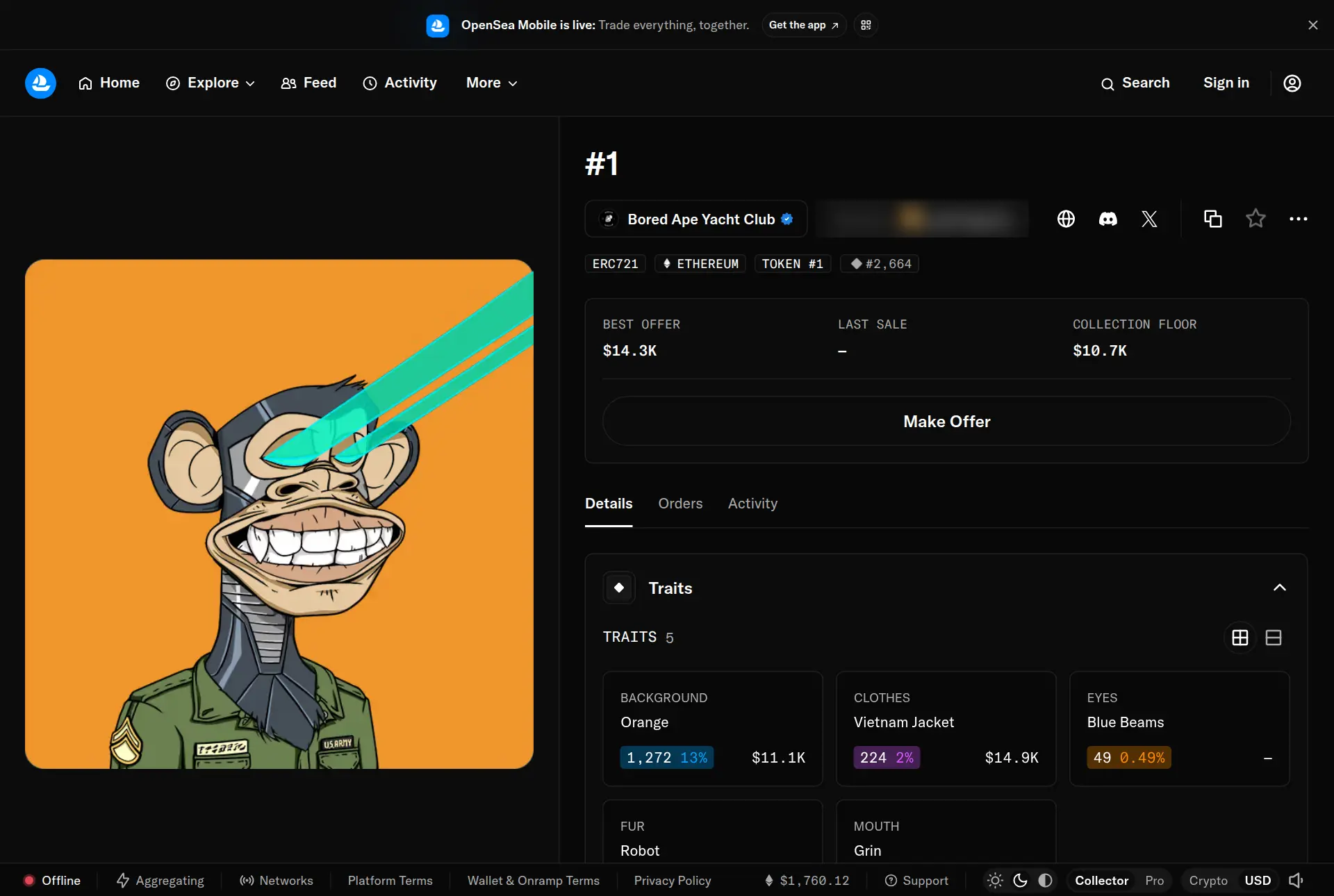
The NFT: name, traits, rarity rank, the address of the wallet that holds it, its listing price, best offer and last sale with their US dollar value, the collection's floor, and its picture and metadata address.
Give it an item's page on OpenSea: its chain, contract and token id in the address.
1 unit a run, for runs that return data. Runs that fail cost nothing. How units work
- Counted
- 1 unit a run
- Inputs
- 1, 1 required
- Record
- 31 fields
- A run takes
- up to 5 minutes
- Records kept
- 7 days
- Measured
- its success, on the status page
POST/v1/scrapers/opensea.item/runs
sent, and answered
a record of the run31 fields
ok1 unit a run
A record this scraper returned for this input. The first 9 of its 31 fields are set down here; the whole record is below.
What it is used for
- Value one NFT
- Set an item's
best_offerandlast_saleagainst its collection's floor, with the US dollar value of each. - Read what makes it rare
- Its
traitsandrarity_rankout ofrarity_of, as OpenSea ranks them. - Know which wallet holds it
owner_addressis the holding wallet's address, as the page shows it.
What you send
An item's page on OpenSea: its chain, contract and token id in the address. It is the one input.
itemstring Required- The item's page on OpenSea, e.g.
https://opensea.io/item/ethereum/0xbc4ca0eda7647a8ab7c2061c2e118a18a936f13d/1.
A request, ready to send
It starts a run with the input shown at the top of this page, waits up to 60 seconds for it, and reads its records. Put your key in the variable it reads.
# Start a run and wait up to 60 seconds for it to finish
curl -X POST "https://api.enrichednow.com/v1/scrapers/opensea.item/runs?wait=60" \
  -H "Authorization: Bearer $ENRICHEDNOW_API_KEY" \
  -H "Content-Type: application/json" \
  -d '{"input":{"item":"https://opensea.io/item/ethereum/0xbc4ca0eda7647a8ab7c2061c2e118a18a936f13d/1"}}'

# Read its records, with the id the first call answered
curl "https://api.enrichednow.com/v1/runs/$RUN_ID/records?limit=100" \
  -H "Authorization: Bearer $ENRICHEDNOW_API_KEY"
from enrichednow import EnrichedNow
client = EnrichedNow() # reads ENRICHEDNOW_API_KEY
# Start a run, wait for it to end, and get its records
result = client.scrape("opensea.item", {
"item": "https://opensea.io/item/ethereum/0xbc4ca0eda7647a8ab7c2061c2e118a18a936f13d/1",
})
print(result.run.id, result.run.status, result.run.record_count)
# Read its records: pages are fetched as you go
for record in result.records:
print(record)Install it with pip install enrichednow, then save as run.py and run python3 run.py
import EnrichedNow from "enrichednow";

const client = new EnrichedNow(); // reads ENRICHEDNOW_API_KEY

// Start a run, wait for it to end, and get its records
const { run, records } = await client.scrape("opensea.item", {
  item: "https://opensea.io/item/ethereum/0xbc4ca0eda7647a8ab7c2061c2e118a18a936f13d/1",
});
console.log(run.id, run.status, run.record_count);

// Read its records: pages are fetched as you go
for await (const record of records) console.log(record);
Install it with npm install enrichednow, then save as run.mjs and run node run.mjs
package main

import (
	"context"
	"fmt"
	"log"
	"time"

	enrichednow "github.com/enrichednow/enrichednow-go"
)

func main() {
	client, err := enrichednow.NewClient() // reads ENRICHEDNOW_API_KEY
	if err != nil {
		log.Fatal(err)
	}
	ctx, cancel := context.WithTimeout(context.Background(), 10*time.Minute)
	defer cancel()

	// Start a run, wait for it to end, and get its records
	run, records, err := client.Scrape(ctx, "opensea.item", map[string]any{"item": "https://opensea.io/item/ethereum/0xbc4ca0eda7647a8ab7c2061c2e118a18a936f13d/1"})
	if err != nil {
		log.Fatal(err)
	}
	fmt.Println(run.ID, run.Status, run.RecordCount)

	// Read its records: pages are fetched as you go
	for records.Next() {
		fmt.Println(string(records.Current()))
	}
	if err := records.Err(); err != nil {
		log.Fatal(err)
	}
}
Install it with go get github.com/enrichednow/enrichednow-go@latest, then save as run.go and run go run run.go
import com.enrichednow.EnrichedNowClient;
import com.enrichednow.ScrapeResult;
import java.util.Map;

public class Run {
    public static void main(String[] args) {
        EnrichedNowClient client = EnrichedNowClient.fromEnv(); // reads ENRICHEDNOW_API_KEY

        // Start a run, wait for it to end, and get its records
        ScrapeResult result = client.scrape("opensea.item", Map.of("item", "https://opensea.io/item/ethereum/0xbc4ca0eda7647a8ab7c2061c2e118a18a936f13d/1"));
        System.out.println(result.run().id() + " " + result.run().status() + " " + result.run().recordCount());

        // Read its records: pages are fetched as you go
        for (Map<String, Object> record : result.records()) {
            System.out.println(record);
        }
    }
}
Add com.enrichednow:enrichednow-java:0.4.0 to your Maven or Gradle build, then save as Run.java
enrichednow run opensea.item --input item=https://opensea.io/item/ethereum/0xbc4ca0eda7647a8ab7c2061c2e118a18a936f13d/1Install it with curl -fsSL https://raw.githubusercontent.com/enrichednow/enrichednow-cli/main/install.sh | sh
What comes back
The NFT: name, traits, rarity rank, the address of the wallet that holds it, its listing price, best offer and last sale with their US dollar value, the collection's floor, and its picture and metadata address. A record has 31 fields. One we could not read is null, never an empty string or a zero.
{
  "chain": "ethereum",
  "contract_address": "0xbc4ca0eda7647a8ab7c2061c2e118a18a936f13d",
  "token_id": "1",
  "url": "https://opensea.io/item/ethereum/0xbc4ca0eda7647a8ab7c2061c2e118a18a936f13d/1",
  "name": "#1",
  "description": null,
  "standard": "ERC721",
  "collection_slug": "boredapeyachtclub",
  "collection_name": "Bored Ape Yacht Club",
  "traits": [
    {
      "type": "Background",
      "value": "Orange"
    },
    {
      "type": "Clothes",
      "value": "Vietnam Jacket"
    },
    {
      "type": "Eyes",
      "value": "Blue Beams"
    }
  ],
  "rarity_rank": 2664,
  "rarity_of": 9996,
  "owner_address": "0x46efbaedc92067e6d60e84ed6395099723252496",
  "is_burned": false,
  "supply": 1,
  "listing_price": null,
  "listing_currency": null,
  "listing_price_usd": null,
  "best_offer": 8.11,
  "best_offer_currency": "WETH",
  "best_offer_usd": 14427.5278,
  "last_sale": null,
  "last_sale_currency": null,
  "last_sale_usd": null,
  "collection_floor": 6.074,
  "collection_floor_currency": "ETH",
  "image": "https://i2c.seadn.io/matic/0x24728cf6f3ca32b95b496628fc0ccbc626e26c2b/399ac6f35935d93930b68fa64cd307/5d399ac6f35935d93930b68fa64cd307.png",
  "original_image": "https://raw2.seadn.io/matic/0x24728cf6f3ca32b95b496628fc0ccbc626e26c2b/399ac6f35935d93930b68fa64cd307/5d399ac6f35935d93930b68fa64cd307.png",
  "animation": null,
  "token_uri": "https://ipfs2.seadn.io/ipfs/QmeSjSinHpPnmXmspMjwiXyN6zS4E9zccariGR3jxcaWtq/1",
  "fetched_at": "2026-11-19T21:17:46.117252Z"
}
The scraper returned this record for the input above, reading a saved copy of the page, not the live site.
Values shortened for this page: traits: 5 items, the first 3 shown.
The fields of a record
chainstring or null- The blockchain the item is on, e.g.
ethereum. contract_addressstring- The address of the item's contract.
token_idstring- The item's token id in that contract.
urlstring- The item's page on OpenSea.
namestring or null- The item's name, e.g.
#1. descriptionstring or null- The item's own description, where it has one.
standardstring or null- The token standard, e.g.
ERC721. collection_slugstring or null- The slug of the collection it belongs to.
collection_namestring or null- The name of that collection.
traitslist of objects- The item's traits, kind and value.Each holds
type,value. rarity_rankinteger or null- Its rarity rank in the collection, 1 the rarest, where OpenSea ranks it.
rarity_ofinteger or null- How many items the rarity rank is out of.
owner_addressstring or null- The address of the wallet that holds it, as the page shows it. Null for a burned item.
is_burnedboolean- True when the item has been sent to a burn address.
supplyinteger or null- How many tokens of this item exist (1 for a one-of-a-kind item).
listing_pricenumber or null- The lowest price it is listed for, in
listing_currency. Null when it is not for sale. listing_currencystring or null- The currency of the listing price.
listing_price_usdnumber or null- The listing price in US dollars, as OpenSea converts it.
best_offernumber or null- The highest offer for it, in
best_offer_currency. best_offer_currencystring or null- The currency of the best offer, e.g.
WETH. best_offer_usdnumber or null- The best offer in US dollars, as OpenSea converts it.
last_salenumber or null- The price it last sold for, in
last_sale_currency, where OpenSea knows a sale. last_sale_currencystring or null- The currency of the last sale.
last_sale_usdnumber or null- The last sale in US dollars, as OpenSea converts it.
collection_floornumber or null- The collection's floor price, in
collection_floor_currency. collection_floor_currencystring or null- The currency of the collection's floor price.
imagestring or null- The address of the item's picture, as OpenSea serves it.
original_imagestring or null- The address of the picture at its original size.
animationstring or null- The address of the item's animation or video, where it has one.
token_uristring or null- The address of the token's metadata.
fetched_atdatetime- When the page was read, in UTC.
Units and limits
- Counted per request
- Billed per request: a run that returns data costs 1 unit, however many records it returns.
- A miss costs nothing
- A run that fails, that meets something not supported yet, or that you cancel costs nothing. You pay for runs that return data.
- What bounds a run
- A run may take up to 5 minutes. Its records are read in pages of up to 1,000 and are kept for 7 days.
What it does not do
- The owner is given by their wallet address only, never the name they chose on OpenSea.
- A token OpenSea does not have ends as failed, with the reason not_found, and costs nothing.
Questions
What does OpenSea item return?
The NFT: name, traits, rarity rank, the address of the wallet that holds it, its listing price, best offer and last sale with their US dollar value, the collection's floor, and its picture and metadata address. A record has 31 fields, among them chain, contract_address, token_id, url, name and description. A value that could not be read is null, never an empty string or a zero.
What do I send?
An item's page on OpenSea: its chain, contract and token id in the address. The input item is required.
How is it counted?
Billed per request: a run that returns data costs 1 unit, however many records it returns. A run that fails, that meets something not supported yet, or that you cancel costs nothing. The first 1,000 units each month are free.
What does it not do?
The owner is given by their wallet address only, never the name they chose on OpenSea. A token OpenSea does not have ends as failed, with the reason not_found, and costs nothing.
How long are the records kept, and in what format do they come?
Records are kept for 7 days after the run ended, and read in pages of up to 1,000. They come as JSON, as NDJSON with one record a line, or as CSV with a column for each field.
Can an AI assistant call it?
Yes. Through the EnrichedNow MCP server an assistant calls the tool run_scraper with the scraper_id opensea.item and the same input. It costs what the same API call costs.
OpenSea
NFT collections and items on OpenSea: floor prices, offers, volumes, owners and traits, as its public pages show them.
OpenSea collection
opensea.collectionA collection's name in its OpenSea address, or its page. The collection: floor price and top offer with their US dollar value, the floor's change over a day, volumes over a day, a week, a month and in all, items, owners and listings, chain, contract, token standard, creator fee, and its links.
- Industry
- Markets and funding
- Where
- Worldwide
- For
- Investors
Run it on an input of your own.
Create an account, make a key, and send the request above with your own input. The first 1,000 units each month are free.