Scraper API
OpenRent
openrent.searchAvailable
OpenRent search
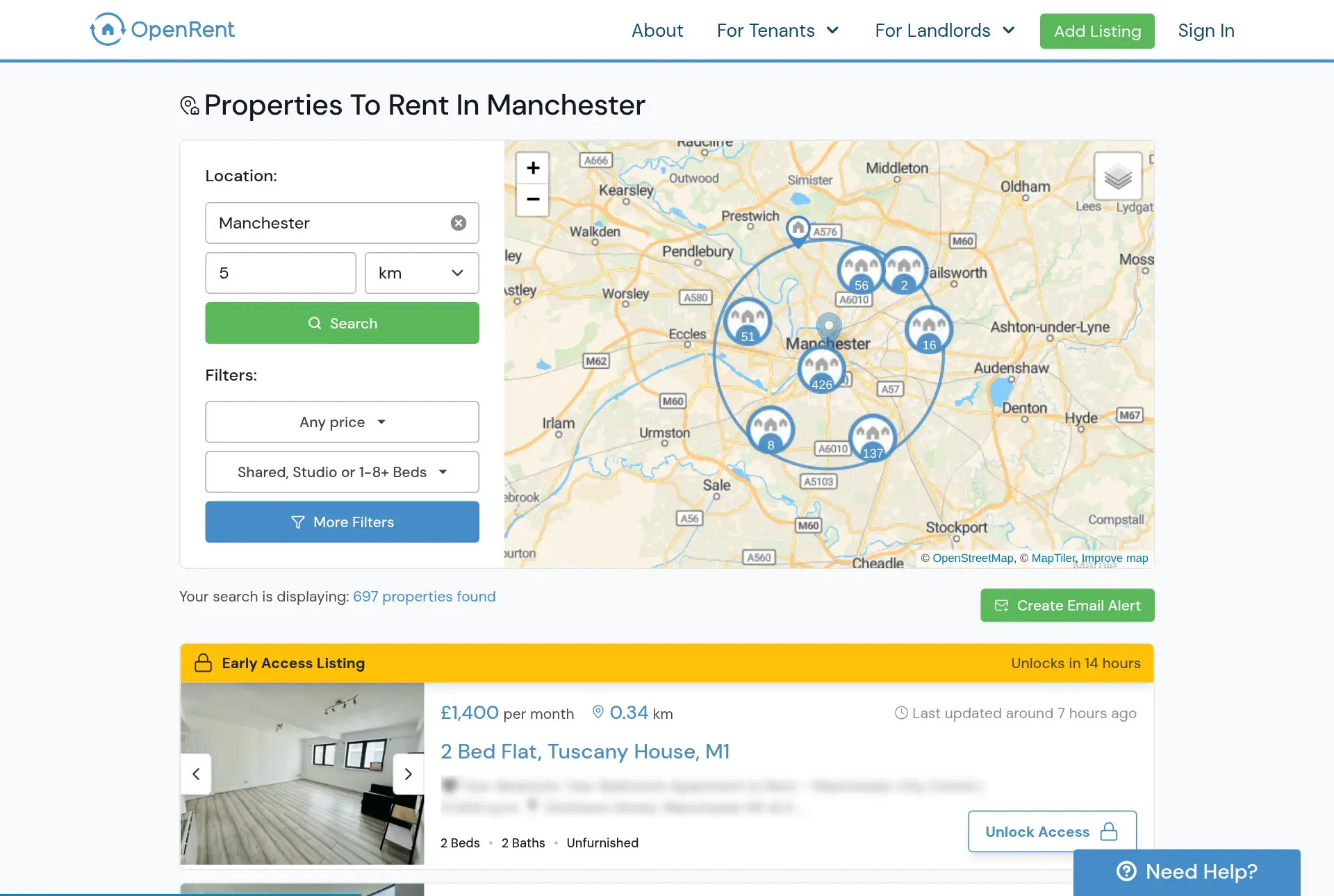
A page of 20 properties to rent, nearest to the place first: title, rent a month and a week, bedrooms, bathrooms, furnishing, distance, when it was updated, map position, the opening of the description and a photo, and how many OpenRent found.
Give it a town, city, area or postcode district in the United Kingdom, and a page number.
1 unit a run, for runs that return data. Runs that fail cost nothing. How units work
- Counted
- 1 unit a run
- Inputs
- 2, 1 required
- Record
- 18 fields
- A run takes
- up to 5 minutes
- Records kept
- 7 days
- Measured
- its success, on the status page
POST/v1/scrapers/openrent.search/runs
sent, and answered
a record of the run18 fields
ok1 unit a run
A record this scraper returned for this input. The first 9 of its 18 fields are set down here; the whole record is below.
What it is used for
- Track rents in a town
- Read the 20 nearest properties to a place on a schedule and follow
rent_per_month,bedroomsandlast_updatedover time. - Map what is available
- Every property comes with its
latitudeandlongitude, ready for a map of a city's rentals. - Spot paid placements
is_featuredmarks the properties landlords paid to show among the results.
What you send
A town, city, area or postcode district in the United Kingdom, and a page number. These are its 2 inputs, as its schema has them.
locationstring Required- A town, city, area or postcode district in the United Kingdom, e.g.
Manchester,CamdenorSW1P. pageinteger Optional- The results page, from 1; 20 properties a page, nearest first.Default
1
A request, ready to send
It starts a run with the input shown at the top of this page, waits up to 60 seconds for it, and reads its records. Put your key in the variable it reads.
# Start a run and wait up to 60 seconds for it to finish
curl -X POST "https://api.enrichednow.com/v1/scrapers/openrent.search/runs?wait=60" \
  -H "Authorization: Bearer $ENRICHEDNOW_API_KEY" \
  -H "Content-Type: application/json" \
  -d '{"input":{"location":"Manchester"}}'

# Read its records, with the id the first call answered
curl "https://api.enrichednow.com/v1/runs/$RUN_ID/records?limit=100" \
  -H "Authorization: Bearer $ENRICHEDNOW_API_KEY"
from enrichednow import EnrichedNow
client = EnrichedNow() # reads ENRICHEDNOW_API_KEY
# Start a run, wait for it to end, and get its records
result = client.scrape("openrent.search", {"location": "Manchester"})
print(result.run.id, result.run.status, result.run.record_count)
# Read its records: pages are fetched as you go
for record in result.records:
print(record)Install it with pip install enrichednow, then save as run.py and run python3 run.py
import EnrichedNow from "enrichednow";

const client = new EnrichedNow(); // reads ENRICHEDNOW_API_KEY

// Start a run, wait for it to end, and get its records
const { run, records } = await client.scrape("openrent.search", { location: "Manchester" });
console.log(run.id, run.status, run.record_count);

// Read its records: pages are fetched as you go
for await (const record of records) console.log(record);
Install it with npm install enrichednow, then save as run.mjs and run node run.mjs
package main

import (
	"context"
	"fmt"
	"log"
	"time"

	enrichednow "github.com/enrichednow/enrichednow-go"
)

func main() {
	client, err := enrichednow.NewClient() // reads ENRICHEDNOW_API_KEY
	if err != nil {
		log.Fatal(err)
	}
	ctx, cancel := context.WithTimeout(context.Background(), 10*time.Minute)
	defer cancel()

	// Start a run, wait for it to end, and get its records
	run, records, err := client.Scrape(ctx, "openrent.search", map[string]any{"location": "Manchester"})
	if err != nil {
		log.Fatal(err)
	}
	fmt.Println(run.ID, run.Status, run.RecordCount)

	// Read its records: pages are fetched as you go
	for records.Next() {
		fmt.Println(string(records.Current()))
	}
	if err := records.Err(); err != nil {
		log.Fatal(err)
	}
}
Install it with go get github.com/enrichednow/enrichednow-go@latest, then save as run.go and run go run run.go
import com.enrichednow.EnrichedNowClient;
import com.enrichednow.ScrapeResult;
import java.util.Map;

public class Run {
    public static void main(String[] args) {
        EnrichedNowClient client = EnrichedNowClient.fromEnv(); // reads ENRICHEDNOW_API_KEY

        // Start a run, wait for it to end, and get its records
        ScrapeResult result = client.scrape("openrent.search", Map.of("location", "Manchester"));
        System.out.println(result.run().id() + " " + result.run().status() + " " + result.run().recordCount());

        // Read its records: pages are fetched as you go
        for (Map<String, Object> record : result.records()) {
            System.out.println(record);
        }
    }
}
Add com.enrichednow:enrichednow-java:0.4.0 to your Maven or Gradle build, then save as Run.java
enrichednow run openrent.search --input location=ManchesterInstall it with curl -fsSL https://raw.githubusercontent.com/enrichednow/enrichednow-cli/main/install.sh | sh
What comes back
A page of 20 properties to rent, nearest to the place first: title, rent a month and a week, bedrooms, bathrooms, furnishing, distance, when it was updated, map position, the opening of the description and a photo, and how many OpenRent found. A record has 18 fields. One we could not read is null, never an empty string or a zero.
{
  "position": 1,
  "page": 1,
  "property_id": "3117777",
  "url": "https://www.openrent.co.uk/property-to-rent/manchester/2-bed-flat-tuscany-house-m1/3117777",
  "title": "Unlocks in 14 hours",
  "rent_per_month": 1400,
  "rent_per_week": 323,
  "distance": "0.34 km",
  "last_updated": "Last updated around 7 hours ago",
  "summary": "❤️ Two-Bedroom, Two-Bathroom Apartment to Rent – Manchester City Centre | £1,400 pcm 📍 Dickinson Street, Manchester M1 4LX ...",
  "bedrooms": 2,
  "bathrooms": 2,
  "features": [
    "2 Beds",
    "2 Baths",
    "Unfurnished"
  ],
  "photo": "https://imagescdn.openrent.co.uk/listings/3117777/o_1k7pipvi219p07if10aa4tkkkb0.JPG_homepage.JPG",
  "latitude": 53.47756,
  "longitude": -2.2419329,
  "is_featured": false,
  "fetched_at": "2026-11-19T21:17:46.103079Z"
}
The scraper returned this record for the input above, reading a saved copy of the page, not the live site.
The fields of a record
positioninteger- The property's place in the results, nearest first, from 1, counted across pages.
pageinteger- The results page the property is on.
property_idstring- OpenRent's id of the property, e.g.
2865841. urlstring- The property's page on OpenRent.
titlestring- The title OpenRent gives it: the kind of property, the street and the postcode district, e.g.
1 Bed Flat, Craven St, WC2N. rent_per_monthnumber or null- The rent a calendar month, in pounds, as the card prints it (to the pound; the property's page gives the pence).
rent_per_weeknumber or null- The same rent a week, in pounds, as OpenRent works it out.
distancestring or null- How far it is from the place searched, as printed, e.g.
0.21 km. last_updatedstring or null- When the listing was last updated, as printed, e.g.
Last updated around 3 weeks ago. summarystring or null- The opening of the description the card shows; OpenRent cuts it with
.... bedroomsinteger or null- The bedrooms the card lists. Null where it lists none (a studio).
bathroomsinteger or null- The bathrooms the card lists.
featureslist of strings- The facts the card lists, as printed, e.g.
1 Bed,1 Bath,Furnished. photostring or null- The address of the first photo.
latitudenumber or null- The property's latitude, as the search's map places it.
longitudenumber or null- The property's longitude, as the search's map places it.
is_featuredboolean- True for a placement the landlord paid to have shown among the results, marked
Featured. fetched_atdatetime- When the page was read, in UTC.
Units and limits
- Counted per request
- Billed per request: a run that returns data costs 1 unit, however many records it returns.
- A miss costs nothing
- A run that fails, that meets something not supported yet, or that you cancel costs nothing. You pay for runs that return data.
- What bounds a run
- A run may take up to 5 minutes. Its records are read in pages of up to 1,000 and are kept for 7 days.
What it does not do
- OpenRent filters by price, bedrooms and kind of property in the browser after its page loads, so a search here is by place alone.
- Up to 50 pages of a search.
- No landlord is named.
The bounds its schema sets
page- 1 to 50; 1 unless you say otherwise
Questions
What does OpenRent search return?
A page of 20 properties to rent, nearest to the place first: title, rent a month and a week, bedrooms, bathrooms, furnishing, distance, when it was updated, map position, the opening of the description and a photo, and how many OpenRent found. A record has 18 fields, among them position, page, property_id, url, title and rent_per_month. A value that could not be read is null, never an empty string or a zero.
What do I send?
A town, city, area or postcode district in the United Kingdom, and a page number. The input location is required. Optional: page.
How is it counted?
Billed per request: a run that returns data costs 1 unit, however many records it returns. A run that fails, that meets something not supported yet, or that you cancel costs nothing. The first 1,000 units each month are free.
How much does one run return?
Its schema sets these bounds: page 1 to 50 (1 unless you say otherwise). A run may take up to 5 minutes.
What does it not do?
OpenRent filters by price, bedrooms and kind of property in the browser after its page loads, so a search here is by place alone. Up to 50 pages of a search. No landlord is named.
How long are the records kept, and in what format do they come?
Records are kept for 7 days after the run ended, and read in pages of up to 1,000. They come as JSON, as NDJSON with one record a line, or as CSV with a column for each field.
Can an AI assistant call it?
Yes. Through the EnrichedNow MCP server an assistant calls the tool run_scraper with the scraper_id openrent.search and the same input. It costs what the same API call costs.
OpenRent
Flats, houses and rooms to rent from private landlords across the United Kingdom on OpenRent, as a visitor who is not signed in sees them.
OpenRent property
openrent.propertyA property's id on OpenRent, or the address of its page. The property: rent and deposit, whether bills are included, who may rent it (students, families, pets, smokers), when it is available, garden, parking, furnishing, energy rating, map position, the nearest stations, the description and every photo.
- Industry
- Real estate
- Where
- United Kingdom
Run it on an input of your own.
Create an account, make a key, and send the request above with your own input. The first 1,000 units each month are free.