Scraper API
OpenAlex
openalex.workAvailable
OpenAlex work
OpenAlex's record of it: title, type, publication date, authors with their ORCID iDs and institutions, where it was published, open-access status and the best free copy, citation count, field-weighted citation impact, topics, keywords and abstract.
Give it a scholarly work: its OpenAlex id, its DOI, or its PubMed id.
1 unit a run, for runs that return data. Runs that fail cost nothing. How units work
- Counted
- 1 unit a run
- Inputs
- 1, 1 required
- Record
- 36 fields
- A run takes
- up to 5 minutes
- Records kept
- 7 days
- Measured
- its success, on the status page
POST/v1/scrapers/openalex.work/runs
sent, and answered
a record of the run36 fields
ok1 unit a run
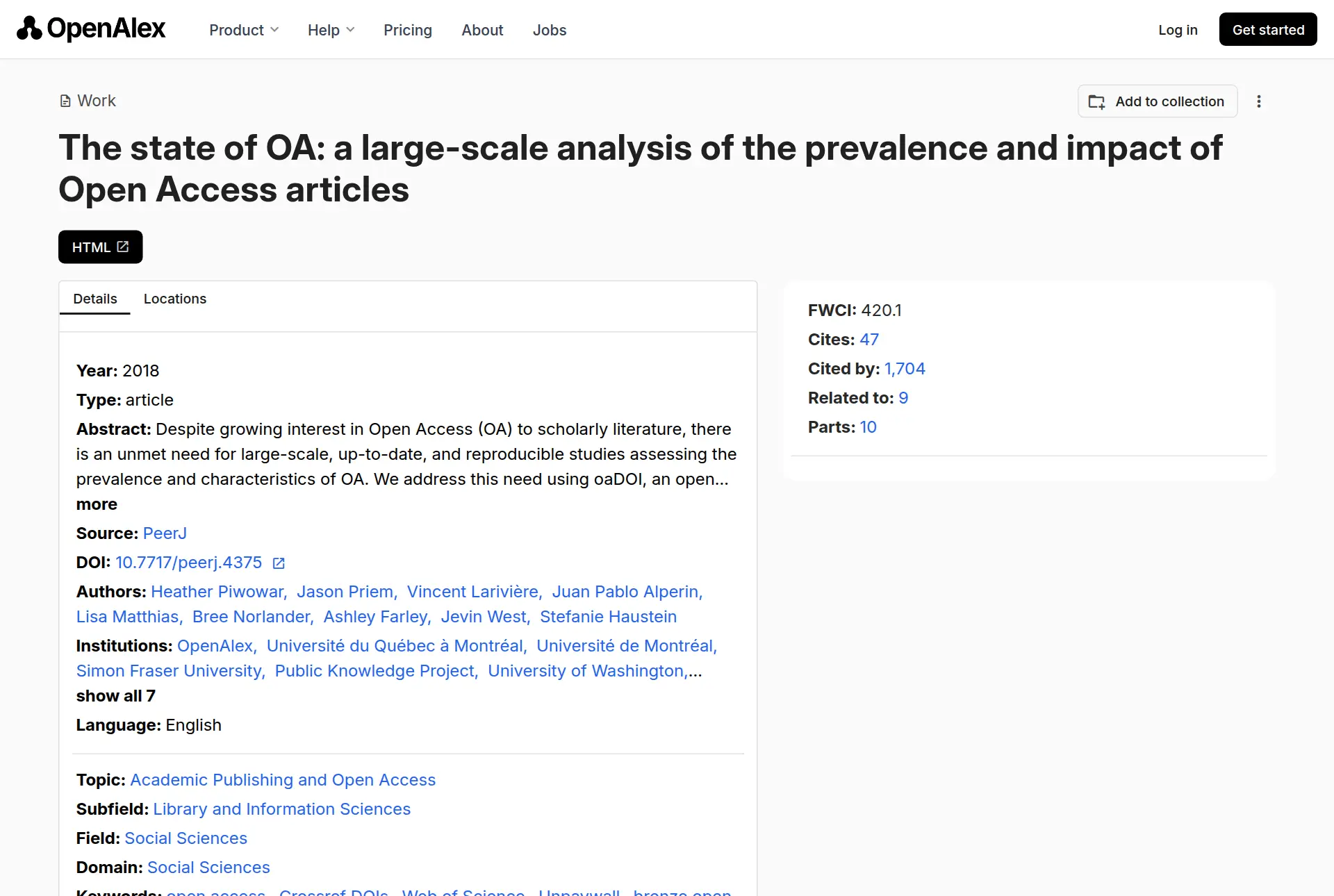
A record this scraper returned for this input. The first 9 of its 36 fields are set down here; the whole record is below.
What it is used for
- Read a work in full
- A scholarly work's authors with their institutions, where it was published, its topics, keywords and abstract.
- Find the open copy
is_open_access,oa_statusandoa_urlsay whether a work can be read free of charge, and where.- Weigh a work's influence
cited_by_countandfwciset its citations against those of works like it.is_retractedflags a withdrawn one.
What you send
A scholarly work: its OpenAlex id, its DOI, or its PubMed id. It is the one input.
workstring Required- An OpenAlex id such as W2741809807, a DOI such as 10.7717/peerj.4375, a PubMed id written pmid:29456894, or the work's address on openalex.org or doi.org.
A request, ready to send
It starts a run with the input shown at the top of this page, waits up to 60 seconds for it, and reads its records. Put your key in the variable it reads.
# Start a run and wait up to 60 seconds for it to finish
curl -X POST "https://api.enrichednow.com/v1/scrapers/openalex.work/runs?wait=60" \
  -H "Authorization: Bearer $ENRICHEDNOW_API_KEY" \
  -H "Content-Type: application/json" \
  -d '{"input":{"work":"W2741809807"}}'

# Read its records, with the id the first call answered
curl "https://api.enrichednow.com/v1/runs/$RUN_ID/records?limit=100" \
  -H "Authorization: Bearer $ENRICHEDNOW_API_KEY"
from enrichednow import EnrichedNow
client = EnrichedNow() # reads ENRICHEDNOW_API_KEY
# Start a run, wait for it to end, and get its records
result = client.scrape("openalex.work", {"work": "W2741809807"})
print(result.run.id, result.run.status, result.run.record_count)
# Read its records: pages are fetched as you go
for record in result.records:
print(record)Install it with pip install enrichednow, then save as run.py and run python3 run.py
import EnrichedNow from "enrichednow";

const client = new EnrichedNow(); // reads ENRICHEDNOW_API_KEY

// Start a run, wait for it to end, and get its records
const { run, records } = await client.scrape("openalex.work", { work: "W2741809807" });
console.log(run.id, run.status, run.record_count);

// Read its records: pages are fetched as you go
for await (const record of records) console.log(record);
Install it with npm install enrichednow, then save as run.mjs and run node run.mjs
package main

import (
	"context"
	"fmt"
	"log"
	"time"

	enrichednow "github.com/enrichednow/enrichednow-go"
)

func main() {
	client, err := enrichednow.NewClient() // reads ENRICHEDNOW_API_KEY
	if err != nil {
		log.Fatal(err)
	}
	ctx, cancel := context.WithTimeout(context.Background(), 10*time.Minute)
	defer cancel()

	// Start a run, wait for it to end, and get its records
	run, records, err := client.Scrape(ctx, "openalex.work", map[string]any{"work": "W2741809807"})
	if err != nil {
		log.Fatal(err)
	}
	fmt.Println(run.ID, run.Status, run.RecordCount)

	// Read its records: pages are fetched as you go
	for records.Next() {
		fmt.Println(string(records.Current()))
	}
	if err := records.Err(); err != nil {
		log.Fatal(err)
	}
}
Install it with go get github.com/enrichednow/enrichednow-go@latest, then save as run.go and run go run run.go
import com.enrichednow.EnrichedNowClient;
import com.enrichednow.ScrapeResult;
import java.util.Map;

public class Run {
    public static void main(String[] args) {
        EnrichedNowClient client = EnrichedNowClient.fromEnv(); // reads ENRICHEDNOW_API_KEY

        // Start a run, wait for it to end, and get its records
        ScrapeResult result = client.scrape("openalex.work", Map.of("work", "W2741809807"));
        System.out.println(result.run().id() + " " + result.run().status() + " " + result.run().recordCount());

        // Read its records: pages are fetched as you go
        for (Map<String, Object> record : result.records()) {
            System.out.println(record);
        }
    }
}
Add com.enrichednow:enrichednow-java:0.4.0 to your Maven or Gradle build, then save as Run.java
enrichednow run openalex.work --input work=W2741809807Install it with curl -fsSL https://raw.githubusercontent.com/enrichednow/enrichednow-cli/main/install.sh | sh
What comes back
OpenAlex's record of it: title, type, publication date, authors with their ORCID iDs and institutions, where it was published, open-access status and the best free copy, citation count, field-weighted citation impact, topics, keywords and abstract. A record has 36 fields. One we could not read is null, never an empty string or a zero.
{
  "id": "W2741809807",
  "url": "https://openalex.org/W2741809807",
  "doi": "10.7717/peerj.4375",
  "title": "The state of OA: a large-scale analysis of the prevalence and impact of Open Access articles",
  "type": "article",
  "publication_year": 2018,
  "publication_date": "2018-02-13",
  "language": "en",
  "authors": [
    {
      "name": "Heather Piwowar",
      "id": "A5048491430",
      "orcid": "0000-0003-1613-5981",
      "position": "first",
      "is_corresponding": true,
      "institutions": [
        "OpenAlex"
      ],
      "countries": [
        "CA"
      ]
    },
    {
      "name": "Jason R Priem",
      "id": "A5023888391",
      "orcid": "0000-0001-6187-6610",
      "position": "middle",
      "is_corresponding": true,
      "institutions": [
        "OpenAlex"
      ],
      "countries": [
        "CA"
      ]
    }
  ],
  "source": "PeerJ",
  "source_type": "journal",
  "publisher": "PeerJ, Inc.",
  "issn": "2167-8359",
  "volume": "6",
  "issue": null,
  "first_page": "e4375",
  "last_page": "e4375",
  "is_open_access": true,
  "oa_status": "gold",
  "oa_url": "https://doi.org/10.7717/peerj.4375",
  "landing_page_url": "https://doi.org/10.7717/peerj.4375",
  "pdf_url": null,
  "license": "cc-by",
  "cited_by_count": 1704,
  "referenced_works_count": 47,
  "fwci": 420.0552,
  "is_retracted": false,
  "primary_topic": "Academic Publishing and Open Access",
  "field": "Social Sciences",
  "topics": [
    "Academic Publishing and Open Access",
    "scientometrics and bibliometrics research",
    "Publishing and Scholarly Communication"
  ],
  "keywords": [
    "open access",
    "Crossref DOIs",
    "Web of Science"
  ],
  "abstract": "Despite growing interest in Open Access (OA) to scholarly literature, there is an unmet need for large-scale, up-to-date, and reproducible studies assessing the prevalence and characteristics of OA. We address this need using oaDOI, an open … [truncated]",
  "pmid": "29456894",
  "pmcid": "PMC5815332",
  "updated_at": "2026-11-18T13:11:19.462570Z",
  "fetched_at": "2026-11-19T18:07:41.044897Z"
}
The scraper returned this record for the input above, reading a saved copy of the page, not the live site.
Values shortened for this page: authors: 9 items, the first 2 shown; keywords: 11 items, the first 3 shown; abstract: 1,630 characters, the first 240 shown.
The fields of a record
idstring- OpenAlex's id of the work, e.g.
W2741809807. urlstring- The work's page on openalex.org.
doistring or null- The work's DOI, e.g.
10.7717/peerj.4375. Null for a work without one. titlestring or null- The work's title. Null for the few works catalogued without one.
typestring or null- OpenAlex's type of work, e.g.
article,preprint,review,book,book-chapter,dissertation. publication_yearinteger or null- The year the work was published.
publication_datestring or null- The day the work was published,
YYYY-MM-DD. Where only a year is known OpenAlex gives 1 January. languagestring or null- The language OpenAlex detected for the work, as a two-letter code.
authorslist of objects- The authors, in the work's order.Each holds
name,id,orcid,position,is_corresponding,institutions,countries. sourcestring or null- Where the work was published: the journal, repository, conference or book series.
source_typestring or null- What kind of place that is:
journal,repository,conference,ebook platform,book series. publisherstring or null- The organisation behind that source.
issnstring or null- The source's linking ISSN (ISSN-L).
volumestring or null- The volume.
issuestring or null- The issue.
first_pagestring or null- The first page, or the article number.
last_pagestring or null- The last page.
is_open_accessboolean or null- True when OpenAlex found a copy anyone can read without paying.
oa_statusstring or null- The kind of open access:
gold,diamond,hybrid,green,bronze, orclosed. oa_urlstring or null- The address of the best free copy OpenAlex found.
landing_page_urlstring or null- The work's page at its publisher or repository.
pdf_urlstring or null- The address of a PDF at that place, when OpenAlex has one.
licensestring or null- The licence of that copy, e.g.
cc-by. cited_by_countinteger or null- How many works in OpenAlex cite this one.
referenced_works_countinteger or null- How many works this one cites.
fwcinumber or null- The field-weighted citation impact: citations relative to works of the same field, type and year, where 1 is average.
is_retractedboolean or null- True when the work has been retracted.
primary_topicstring or null- The topic OpenAlex assigns the work first, e.g.
Academic Publishing and Open Access. fieldstring or null- The field that topic belongs to, e.g.
Social Sciences,Computer Science. topicslist of strings- Every topic OpenAlex assigns the work, best match first.
keywordslist of strings- The keywords OpenAlex assigns the work.
abstractstring or null- The abstract as text, put back together from OpenAlex's word index. Null where OpenAlex has none.
pmidstring or null- The work's PubMed id, when it has one.
pmcidstring or null- The work's PubMed Central id, e.g.
PMC5815332, when it has one. updated_atdatetime or null- When OpenAlex last changed its record of the work, in UTC.
fetched_atdatetime- When OpenAlex was asked, in UTC.
Units and limits
- Counted per request
- Billed per request: a run that returns data costs 1 unit, however many records it returns.
- A miss costs nothing
- A run that fails, that meets something not supported yet, or that you cancel costs nothing. You pay for runs that return data.
- What bounds a run
- A run may take up to 5 minutes. Its records are read in pages of up to 1,000 and are kept for 7 days.
What it does not do
- One run reads one work. There is no search by words here: a work is named by an id.
- The lists of works it cites and of works citing it are not returned, only their counts.
- An id OpenAlex has no work under ends as failed, with the reason not_found, and costs nothing.
Questions
What does OpenAlex work return?
OpenAlex's record of it: title, type, publication date, authors with their ORCID iDs and institutions, where it was published, open-access status and the best free copy, citation count, field-weighted citation impact, topics, keywords and abstract. A record has 36 fields, among them id, url, doi, title, type and publication_year. A value that could not be read is null, never an empty string or a zero.
What do I send?
A scholarly work: its OpenAlex id, its DOI, or its PubMed id. The input work is required.
How is it counted?
Billed per request: a run that returns data costs 1 unit, however many records it returns. A run that fails, that meets something not supported yet, or that you cancel costs nothing. The first 1,000 units each month are free.
What does it not do?
One run reads one work. There is no search by words here: a work is named by an id. The lists of works it cites and of works citing it are not returned, only their counts. An id OpenAlex has no work under ends as failed, with the reason not_found, and costs nothing.
How long are the records kept, and in what format do they come?
Records are kept for 7 days after the run ended, and read in pages of up to 1,000. They come as JSON, as NDJSON with one record a line, or as CSV with a column for each field.
Can an AI assistant call it?
Yes. Through the EnrichedNow MCP server an assistant calls the tool run_scraper with the scraper_id openalex.work and the same input. It costs what the same API call costs.
OpenAlex
A scholarly work as OpenAlex, the open catalogue of research, records it: authors, institutions, open access and citations.
- Industry
- Code and research
- Where
- Worldwide
Run it on an input of your own.
Create an account, make a key, and send the request above with your own input. The first 1,000 units each month are free.