Scraper API
Mastodon
mastodon.profileAvailable
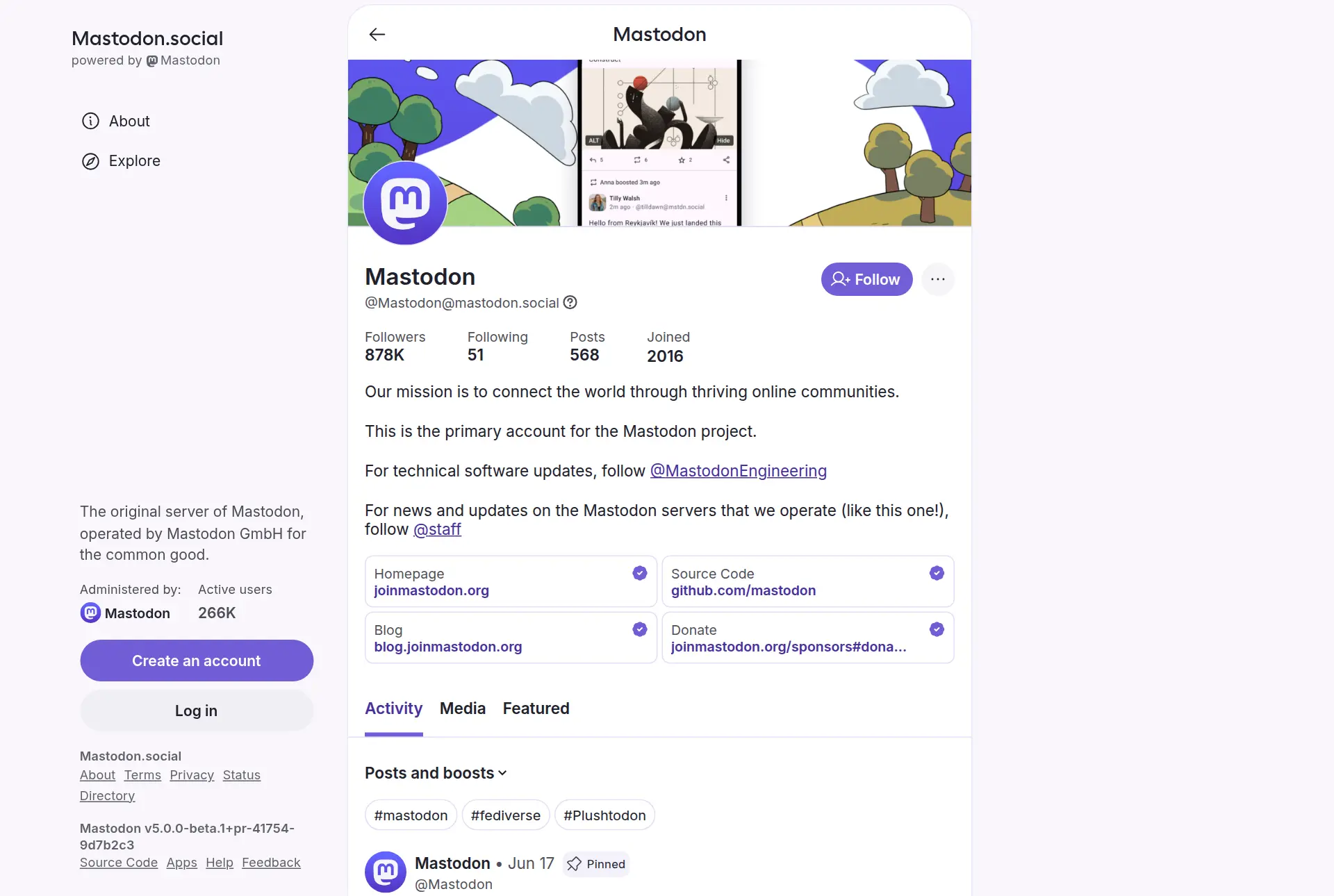
Mastodon profile
Its names, bio, profile fields, pictures, follower, following and post counts, dates and the owner's own settings.
Give it a Mastodon account as @user@server, or its profile address.
1 unit a run, for runs that return data. Runs that fail cost nothing. How units work
- Counted
- 1 unit a run
- Inputs
- 1, 1 required
- Record
- 22 fields
- A run takes
- up to 5 minutes
- Records kept
- 7 days
- Measured
- its success, on the status page
POST/v1/scrapers/mastodon.profile/runs
sent, and answered
a record of the run22 fields
ok1 unit a run
A record this scraper returned for this input. The first 9 of its 22 fields are set down here; the whole record is below.
What it is used for
- Size up an account
- A public Mastodon account's names, bio, profile fields, and its follower, following and post counts.
- Follow an audience
- Read the accounts you watch on a schedule and keep the series of
follower_countandpost_count. - Respect what the owner asked
discoverable,indexableandnoindexsay whether the owner lets the account be featured, searched and indexed.
What you send
A Mastodon account as @user@server, or its profile address. It is the one input.
accountstring Required- The account as @user@server, e.g. @Mastodon@mastodon.social, or its profile address (https://mastodon.social/@Mastodon).
A request, ready to send
It starts a run with the input shown at the top of this page, waits up to 60 seconds for it, and reads its records. Put your key in the variable it reads.
# Start a run and wait up to 60 seconds for it to finish
curl -X POST "https://api.enrichednow.com/v1/scrapers/mastodon.profile/runs?wait=60" \
  -H "Authorization: Bearer $ENRICHEDNOW_API_KEY" \
  -H "Content-Type: application/json" \
  -d '{"input":{"account":"@Mastodon@mastodon.social"}}'

# Read its records, with the id the first call answered
curl "https://api.enrichednow.com/v1/runs/$RUN_ID/records?limit=100" \
  -H "Authorization: Bearer $ENRICHEDNOW_API_KEY"
from enrichednow import EnrichedNow
client = EnrichedNow() # reads ENRICHEDNOW_API_KEY
# Start a run, wait for it to end, and get its records
result = client.scrape("mastodon.profile", {
"account": "@Mastodon@mastodon.social",
})
print(result.run.id, result.run.status, result.run.record_count)
# Read its records: pages are fetched as you go
for record in result.records:
print(record)Install it with pip install enrichednow, then save as run.py and run python3 run.py
import EnrichedNow from "enrichednow";

const client = new EnrichedNow(); // reads ENRICHEDNOW_API_KEY

// Start a run, wait for it to end, and get its records
const { run, records } = await client.scrape("mastodon.profile", {
  account: "@Mastodon@mastodon.social",
});
console.log(run.id, run.status, run.record_count);

// Read its records: pages are fetched as you go
for await (const record of records) console.log(record);
Install it with npm install enrichednow, then save as run.mjs and run node run.mjs
package main

import (
	"context"
	"fmt"
	"log"
	"time"

	enrichednow "github.com/enrichednow/enrichednow-go"
)

func main() {
	client, err := enrichednow.NewClient() // reads ENRICHEDNOW_API_KEY
	if err != nil {
		log.Fatal(err)
	}
	ctx, cancel := context.WithTimeout(context.Background(), 10*time.Minute)
	defer cancel()

	// Start a run, wait for it to end, and get its records
	run, records, err := client.Scrape(ctx, "mastodon.profile", map[string]any{"account": "@Mastodon@mastodon.social"})
	if err != nil {
		log.Fatal(err)
	}
	fmt.Println(run.ID, run.Status, run.RecordCount)

	// Read its records: pages are fetched as you go
	for records.Next() {
		fmt.Println(string(records.Current()))
	}
	if err := records.Err(); err != nil {
		log.Fatal(err)
	}
}
Install it with go get github.com/enrichednow/enrichednow-go@latest, then save as run.go and run go run run.go
import com.enrichednow.EnrichedNowClient;
import com.enrichednow.ScrapeResult;
import java.util.Map;

public class Run {
    public static void main(String[] args) {
        EnrichedNowClient client = EnrichedNowClient.fromEnv(); // reads ENRICHEDNOW_API_KEY

        // Start a run, wait for it to end, and get its records
        ScrapeResult result = client.scrape("mastodon.profile", Map.of("account", "@Mastodon@mastodon.social"));
        System.out.println(result.run().id() + " " + result.run().status() + " " + result.run().recordCount());

        // Read its records: pages are fetched as you go
        for (Map<String, Object> record : result.records()) {
            System.out.println(record);
        }
    }
}
Add com.enrichednow:enrichednow-java:0.4.0 to your Maven or Gradle build, then save as Run.java
enrichednow run mastodon.profile --input account=@Mastodon@mastodon.socialInstall it with curl -fsSL https://raw.githubusercontent.com/enrichednow/enrichednow-cli/main/install.sh | sh
What comes back
Its names, bio, profile fields, pictures, follower, following and post counts, dates and the owner's own settings. A record has 22 fields. One we could not read is null, never an empty string or a zero.
{
  "id": "13179",
  "username": "Mastodon",
  "acct": "Mastodon@mastodon.social",
  "url": "https://mastodon.social/@Mastodon",
  "display_name": "Mastodon",
  "bio": "Our mission is to connect the world through thriving online communities.\nThis is the primary account for the Mastodon project.\nFor technical software updates, follow @MastodonEngineering\nFor news and updates on the Mastodon servers that we … [truncated]",
  "fields": [
    {
      "name": "Homepage",
      "value": "https://joinmastodon.org",
      "verified": true
    },
    {
      "name": "Source Code",
      "value": "https://github.com/mastodon",
      "verified": true
    }
  ],
  "avatar_url": "https://files.mastodon.social/accounts/avatars/000/013/179/original/b4ceb19c9c54ec7e.png",
  "header_url": "https://files.mastodon.social/accounts/headers/000/013/179/original/1375be116fbe0f1d.png",
  "follower_count": 878842,
  "following_count": 51,
  "post_count": 568,
  "created_at": "2016-11-23T00:00:00Z",
  "last_post_on": "2026-11-16T00:00:00Z",
  "bot": false,
  "group": false,
  "locked": false,
  "discoverable": true,
  "indexable": true,
  "noindex": false,
  "moved_to": null,
  "fetched_at": "2026-11-19T18:07:40.973228Z"
}
The scraper returned this record for the input above, reading a saved copy of the page, not the live site.
Values shortened for this page: bio: 279 characters, the first 239 shown; fields: 4 items, the first 2 shown.
The fields of a record
idstring- The account's id on its server.
usernamestring or null- The username, without the server.
acctstring- The account's full address, user@server.
urlstring or null- The profile's address on the web.
display_namestring or null- The display name.
biostring or null- The profile's bio text, links written out; null when there is none.
fieldslist of objects- The label and value pairs the profile shows under the bio.Each holds
name,value,verified. avatar_urlstring or null- The profile picture.
header_urlstring or null- The header image; null when there is none.
follower_countinteger or null- Number of followers; null when the account hides it.
following_countinteger or null- Number of accounts this one follows; null when the account hides it.
post_countinteger or null- Number of posts the account has published.
created_atdatetime or null- When the account was created, in UTC (Mastodon gives the day).
last_post_ondatetime or null- The day of the account's last post, in UTC.
botboolean or null- True when the account says it is automated.
groupboolean or null- True when the account is a group.
lockedboolean or null- True when the account approves its followers by hand.
discoverableboolean or null- True when the owner lets the server feature the account in its directory.
indexableboolean or null- True when the owner lets the account's public posts be found by full-text search.
noindexboolean or null- True when the owner asked search engines not to index the profile.
moved_tostring or null- The account it moved to, as user@server, when it has moved.
fetched_atdatetime- When the answer was read, in UTC.
Units and limits
- Counted per request
- Billed per request: a run that returns data costs 1 unit, however many records it returns.
- A miss costs nothing
- A run that fails, that meets something not supported yet, or that you cancel costs nothing. You pay for runs that return data.
- What bounds a run
- A run may take up to 5 minutes. Its records are read in pages of up to 1,000 and are kept for 7 days.
What it does not do
- The account is read from its own server.
- Followers and following are not read.
- The posts themselves come from mastodon.posts.
Questions
What does Mastodon profile return?
Its names, bio, profile fields, pictures, follower, following and post counts, dates and the owner's own settings. A record has 22 fields, among them id, username, acct, url, display_name and bio. A value that could not be read is null, never an empty string or a zero.
What do I send?
A Mastodon account as @user@server, or its profile address. The input account is required.
How is it counted?
Billed per request: a run that returns data costs 1 unit, however many records it returns. A run that fails, that meets something not supported yet, or that you cancel costs nothing. The first 1,000 units each month are free.
What does it not do?
The account is read from its own server. Followers and following are not read. The posts themselves come from mastodon.posts.
How long are the records kept, and in what format do they come?
Records are kept for 7 days after the run ended, and read in pages of up to 1,000. They come as JSON, as NDJSON with one record a line, or as CSV with a column for each field.
Can an AI assistant call it?
Yes. Through the EnrichedNow MCP server an assistant calls the tool run_scraper with the scraper_id mastodon.profile and the same input. It costs what the same API call costs.
Mastodon
Public Mastodon accounts, their posts, a post's replies and a hashtag's posts, on any Mastodon server, as a visitor who is not signed in sees them.
Mastodon posts of an account
mastodon.postsA Mastodon account, and optionally how many posts, which kind, and where to continue. Its public posts, newest first: text, time, counts, hashtags, links, media, polls and boosts.
Mastodon post
mastodon.postA Mastodon post's address. The post: text, time, author, reply, boost, favourite and quote counts, hashtags, links, media and poll.
Mastodon post and its replies
mastodon.threadA Mastodon post's address, and optionally how many replies. The post, then the replies under it, each with text, author, time, counts and the post it answers.
Mastodon hashtag
mastodon.hashtagA hashtag and a Mastodon server, and optionally only its own users' posts and how many. The public posts with that hashtag the server knows, newest first: text, author, time, counts, links and media.
- Industry
- Social and video
- Where
- Worldwide
Run it on an input of your own.
Create an account, make a key, and send the request above with your own input. The first 1,000 units each month are free.