Scraper API
Macy’s
macys.searchAvailable
Macy’s search
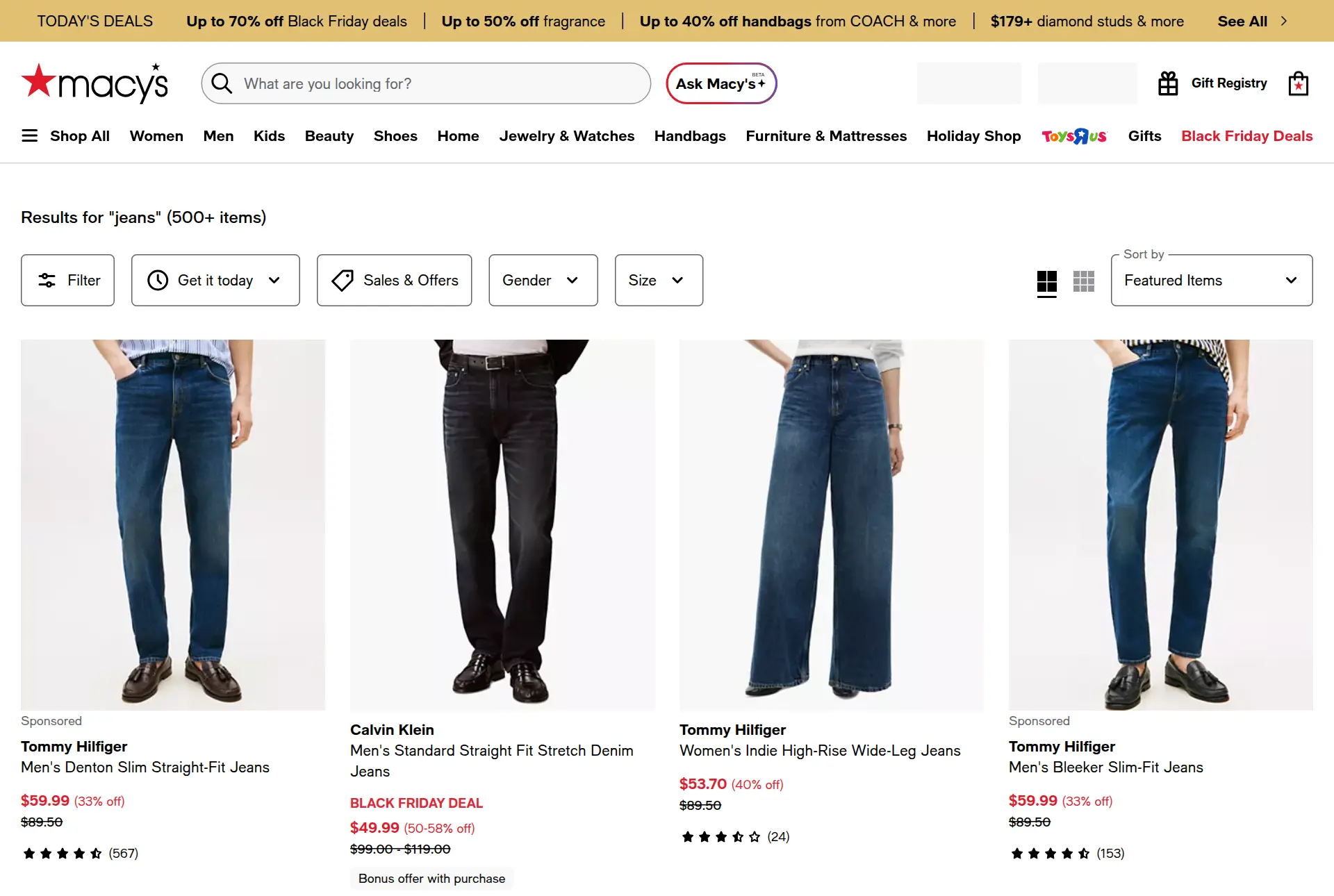
The products on a page of the results: name, brand, price and sale price, saving, rating, colours, picture, and whether it is sponsored.
Give it Words to search for, and a page.
1 unit a run, for runs that return data. Runs that fail cost nothing. How units work
- Counted
- 1 unit a run
- Inputs
- 2, 1 required
- Record
- 15 fields
- A run takes
- up to 5 minutes
- Records kept
- 7 days
- Measured
- its success, on the status page
POST/v1/scrapers/macys.search/runs
sent, and answered
a record of the run15 fields
ok1 unit a run
A record this scraper returned for this input. The first 9 of its 15 fields are set down here; the whole record is below.
What it is used for
- Track prices and sales
- Run the same searches each day and keep
price,regular_priceandpercent_off, to see when a brand goes on sale and by how much. - See a brand's range at Macy's
- Search a brand and list its products with their prices and ratings, to see what Macy's carries and how it is priced.
- Watch sponsored placements
- Count the products marked
sponsoredon a search's first pages, to see which brands pay for a place.
What you send
Words to search for, and a page. These are its 2 inputs, as its schema has them.
querystring Required- Words to search for, such as jeans or michael kors handbag.
pageinteger Optional- The page of results, from 1 to 50.Default
1
A request, ready to send
It starts a run with the input shown at the top of this page, waits up to 60 seconds for it, and reads its records. Put your key in the variable it reads.
# Start a run and wait up to 60 seconds for it to finish
curl -X POST "https://api.enrichednow.com/v1/scrapers/macys.search/runs?wait=60" \
  -H "Authorization: Bearer $ENRICHEDNOW_API_KEY" \
  -H "Content-Type: application/json" \
  -d '{"input":{"query":"jeans"}}'

# Read its records, with the id the first call answered
curl "https://api.enrichednow.com/v1/runs/$RUN_ID/records?limit=100" \
  -H "Authorization: Bearer $ENRICHEDNOW_API_KEY"
from enrichednow import EnrichedNow
client = EnrichedNow() # reads ENRICHEDNOW_API_KEY
# Start a run, wait for it to end, and get its records
result = client.scrape("macys.search", {"query": "jeans"})
print(result.run.id, result.run.status, result.run.record_count)
# Read its records: pages are fetched as you go
for record in result.records:
print(record)Install it with pip install enrichednow, then save as run.py and run python3 run.py
import EnrichedNow from "enrichednow";

const client = new EnrichedNow(); // reads ENRICHEDNOW_API_KEY

// Start a run, wait for it to end, and get its records
const { run, records } = await client.scrape("macys.search", { query: "jeans" });
console.log(run.id, run.status, run.record_count);

// Read its records: pages are fetched as you go
for await (const record of records) console.log(record);
Install it with npm install enrichednow, then save as run.mjs and run node run.mjs
package main

import (
	"context"
	"fmt"
	"log"
	"time"

	enrichednow "github.com/enrichednow/enrichednow-go"
)

func main() {
	client, err := enrichednow.NewClient() // reads ENRICHEDNOW_API_KEY
	if err != nil {
		log.Fatal(err)
	}
	ctx, cancel := context.WithTimeout(context.Background(), 10*time.Minute)
	defer cancel()

	// Start a run, wait for it to end, and get its records
	run, records, err := client.Scrape(ctx, "macys.search", map[string]any{"query": "jeans"})
	if err != nil {
		log.Fatal(err)
	}
	fmt.Println(run.ID, run.Status, run.RecordCount)

	// Read its records: pages are fetched as you go
	for records.Next() {
		fmt.Println(string(records.Current()))
	}
	if err := records.Err(); err != nil {
		log.Fatal(err)
	}
}
Install it with go get github.com/enrichednow/enrichednow-go@latest, then save as run.go and run go run run.go
import com.enrichednow.EnrichedNowClient;
import com.enrichednow.ScrapeResult;
import java.util.Map;

public class Run {
    public static void main(String[] args) {
        EnrichedNowClient client = EnrichedNowClient.fromEnv(); // reads ENRICHEDNOW_API_KEY

        // Start a run, wait for it to end, and get its records
        ScrapeResult result = client.scrape("macys.search", Map.of("query", "jeans"));
        System.out.println(result.run().id() + " " + result.run().status() + " " + result.run().recordCount());

        // Read its records: pages are fetched as you go
        for (Map<String, Object> record : result.records()) {
            System.out.println(record);
        }
    }
}
Add com.enrichednow:enrichednow-java:0.4.0 to your Maven or Gradle build, then save as Run.java
enrichednow run macys.search --input query=jeansInstall it with curl -fsSL https://raw.githubusercontent.com/enrichednow/enrichednow-cli/main/install.sh | sh
What comes back
The products on a page of the results: name, brand, price and sale price, saving, rating, colours, picture, and whether it is sponsored. A record has 15 fields. One we could not read is null, never an empty string or a zero.
{
  "id": "25822310",
  "name": "Men's Standard Straight Fit Stretch Denim Jeans",
  "brand": "Calvin Klein",
  "url": "https://www.macys.com/shop/product/calvin-klein-mens-straight-fit-stretch-denim-jeans?ID=25822310",
  "position": 2,
  "price": 49.99,
  "regular_price": 99,
  "percent_off": 50,
  "price_text": "$49.99",
  "rating": 4.5,
  "review_count": 61,
  "colors": [
    "WINTER HAZE",
    "Klein Blue Black",
    "CK Classic Rinse"
  ],
  "image": "https://slimages.macysassets.com/is/image/MCY/products/7/optimized/40869767_fpx.tif",
  "sponsored": false,
  "fetched_at": "2026-11-19T19:01:03.598353Z"
}
The scraper returned this record for the input above, reading a saved copy of the page, not the live site.
Values shortened for this page: colors: 5 items, the first 3 shown.
The fields of a record
idstring- Macy's id of the product, the
IDin its address. namestring- The product's name, without the brand.
brandstring or null- The brand.
urlstring- The product's page on macys.com.
positioninteger- The product's place on the page, from 1.
pricenumber or null- The price asked now, in US dollars: the sale price when it is on sale, the low end of a range.
regular_pricenumber or null- The regular or original price the page shows beside a sale price; null when it is not on sale.
percent_offinteger or null- The saving the page states, in percent.
price_textstring or null- The price as the page writes it, e.g.
$59.99or$47.99 - $62.39. ratingnumber or null- The average rating out of 5.
review_countinteger or null- How many reviews the rating is from.
colorslist of strings- The colours it comes in, as Macy's names them.
imagestring or null- The product's main picture.
sponsoredboolean- True for a product the page marks as sponsored.
fetched_atdatetime- When the page was read, in UTC.
Units and limits
- Counted per request
- Billed per request: a run that returns data costs 1 unit, however many records it returns.
- A miss costs nothing
- A run that fails, that meets something not supported yet, or that you cancel costs nothing. You pay for runs that return data.
- What bounds a run
- A run may take up to 5 minutes. Its records are read in pages of up to 1,000 and are kept for 7 days.
What it does not do
- One run reads one page of results: about 60 products.
- Macy's shows products for any words, also words it does not know.
The bounds its schema sets
page- 1 to 50; 1 unless you say otherwise
Questions
What does Macy’s search return?
The products on a page of the results: name, brand, price and sale price, saving, rating, colours, picture, and whether it is sponsored. A record has 15 fields, among them id, name, brand, url, position and price. A value that could not be read is null, never an empty string or a zero.
What do I send?
Words to search for, and a page. The input query is required. Optional: page.
How is it counted?
Billed per request: a run that returns data costs 1 unit, however many records it returns. A run that fails, that meets something not supported yet, or that you cancel costs nothing. The first 1,000 units each month are free.
How much does one run return?
Its schema sets these bounds: page 1 to 50 (1 unless you say otherwise). A run may take up to 5 minutes.
What does it not do?
One run reads one page of results: about 60 products. Macy's shows products for any words, also words it does not know.
How long are the records kept, and in what format do they come?
Records are kept for 7 days after the run ended, and read in pages of up to 1,000. They come as JSON, as NDJSON with one record a line, or as CSV with a column for each field.
Can an AI assistant call it?
Yes. Through the EnrichedNow MCP server an assistant calls the tool run_scraper with the scraper_id macys.search and the same input. It costs what the same API call costs.
Macy’s
Macy’s public search results and product pages: names, brands, prices and sale prices, ratings, colours and sizes.
Macy’s product
macys.productA product's id, or the address of its page. The product: name, brand, description, category, the price shown and the regular price, rating, pictures, and every size and colour on offer.
- Industry
- Shopping and retail
- Where
- United States
- For
- E-commerce
Run it on an input of your own.
Create an account, make a key, and send the request above with your own input. The first 1,000 units each month are free.