Scraper API
LinkedIn
linkedin.jobs_searchAvailable
LinkedIn job search
The postings LinkedIn's public job search lists for them.
Give it keywords, a place, and how recently the job was listed.
1 unit a record, for runs that return data. Runs that fail cost nothing. How units work
- Counted
- 1 unit a record
- Inputs
- 6
- Record
- 24 fields
- A run takes
- up to 5 minutes
- Records kept
- 7 days
- Measured
- its success, on the status page
POST/v1/scrapers/linkedin.jobs_search/runs
sent, and answered
a record of the run24 fields
ok1 unit a record
A record this scraper returned for this input. The first 9 of its 24 fields are set down here; the whole record is below.
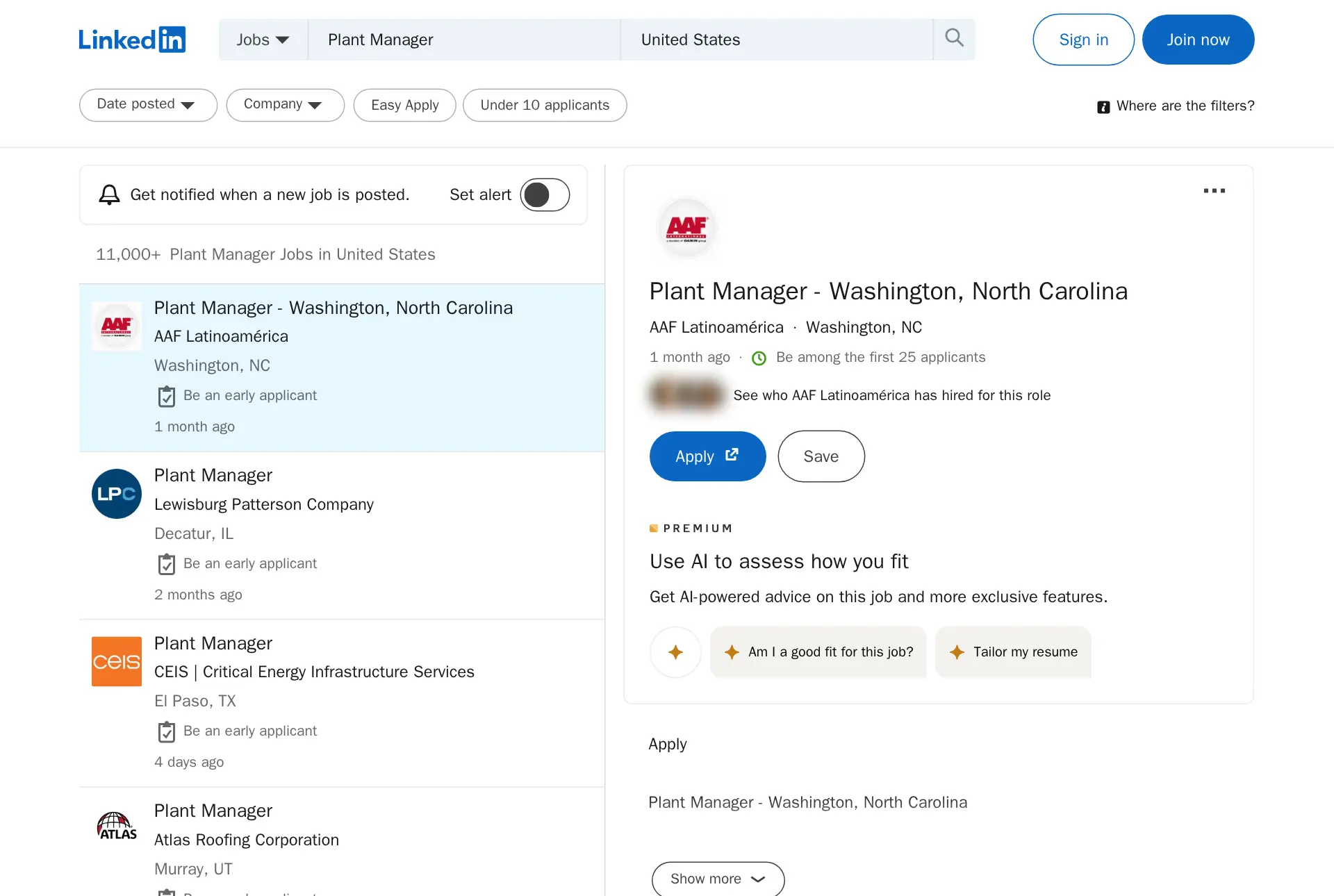
What it is used for
- Source openings by keyword
- Search LinkedIn's public job listings by keywords and place, and get each result as a complete job record, not a title and a link.
- Map demand for a skill
- Run the same search for several places and count the results by company, seniority and industry to see who is hiring for a skill, and where.
- Feed a recruiting pipeline
- Schedule a search and pass new records on by
external_id. Each has the company's LinkedIn address, so the company can be looked up in the next call.
What you send
Keywords, a place, and how recently the job was listed. These are its 6 inputs, as its schema has them.
keywordsstring At least one of the three- Words to search for, such as a job title.
locationstring At least one of the three- A place as text, such as Texas or United States.
geo_idstring At least one of the three- LinkedIn's numeric id for the place, which is more exact than text.
posted_within_hoursinteger Optional- Only postings listed in the last this many hours.
max_resultsinteger Optional- How many postings are returned, at most. 25 unless you say otherwise; LinkedIn serves 1,000 a search.Default
25 company_domainsboolean Optional- Also fill
company_domainandcompany_website: the employer's website, read from its LinkedIn company page (one more request per employer not read in the past week, so the run takes longer). Billed as without it.Defaultfalse
A request, ready to send
It starts a run with the input shown at the top of this page, waits up to 60 seconds for it, and reads its records. Put your key in the variable it reads.
# Start a run and wait up to 60 seconds for it to finish
curl -X POST "https://api.enrichednow.com/v1/scrapers/linkedin.jobs_search/runs?wait=60" \
  -H "Authorization: Bearer $ENRICHEDNOW_API_KEY" \
  -H "Content-Type: application/json" \
  -d '{"input":{"keywords":"Plant Manager","location":"United States","max_results":10}}'

# Read its records, with the id the first call answered
curl "https://api.enrichednow.com/v1/runs/$RUN_ID/records?limit=100" \
  -H "Authorization: Bearer $ENRICHEDNOW_API_KEY"
from enrichednow import EnrichedNow
client = EnrichedNow() # reads ENRICHEDNOW_API_KEY
# Start a run, wait for it to end, and get its records
result = client.scrape("linkedin.jobs_search", {
"keywords": "Plant Manager",
"location": "United States",
"max_results": 10,
})
print(result.run.id, result.run.status, result.run.record_count)
# Read its records: pages are fetched as you go
for record in result.records:
print(record)Install it with pip install enrichednow, then save as run.py and run python3 run.py
import EnrichedNow from "enrichednow";

const client = new EnrichedNow(); // reads ENRICHEDNOW_API_KEY

// Start a run, wait for it to end, and get its records
const { run, records } = await client.scrape("linkedin.jobs_search", {
  keywords: "Plant Manager",
  location: "United States",
  max_results: 10,
});
console.log(run.id, run.status, run.record_count);

// Read its records: pages are fetched as you go
for await (const record of records) console.log(record);
Install it with npm install enrichednow, then save as run.mjs and run node run.mjs
package main

import (
	"context"
	"fmt"
	"log"
	"time"

	enrichednow "github.com/enrichednow/enrichednow-go"
)

func main() {
	client, err := enrichednow.NewClient() // reads ENRICHEDNOW_API_KEY
	if err != nil {
		log.Fatal(err)
	}
	ctx, cancel := context.WithTimeout(context.Background(), 10*time.Minute)
	defer cancel()

	// Start a run, wait for it to end, and get its records
	run, records, err := client.Scrape(ctx, "linkedin.jobs_search", map[string]any{"keywords": "Plant Manager", "location": "United States", "max_results": 10})
	if err != nil {
		log.Fatal(err)
	}
	fmt.Println(run.ID, run.Status, run.RecordCount)

	// Read its records: pages are fetched as you go
	for records.Next() {
		fmt.Println(string(records.Current()))
	}
	if err := records.Err(); err != nil {
		log.Fatal(err)
	}
}
Install it with go get github.com/enrichednow/enrichednow-go@latest, then save as run.go and run go run run.go
import com.enrichednow.EnrichedNowClient;
import com.enrichednow.ScrapeResult;
import java.util.Map;

public class Run {
    public static void main(String[] args) {
        EnrichedNowClient client = EnrichedNowClient.fromEnv(); // reads ENRICHEDNOW_API_KEY

        // Start a run, wait for it to end, and get its records
        ScrapeResult result = client.scrape("linkedin.jobs_search", Map.of("keywords", "Plant Manager", "location", "United States", "max_results", 10));
        System.out.println(result.run().id() + " " + result.run().status() + " " + result.run().recordCount());

        // Read its records: pages are fetched as you go
        for (Map<String, Object> record : result.records()) {
            System.out.println(record);
        }
    }
}
Add com.enrichednow:enrichednow-java:0.4.0 to your Maven or Gradle build, then save as Run.java
enrichednow run linkedin.jobs_search --input 'keywords=Plant Manager' --input 'location=United States' --input max_results=10Install it with curl -fsSL https://raw.githubusercontent.com/enrichednow/enrichednow-cli/main/install.sh | sh
What comes back
The postings LinkedIn's public job search lists for them. A record has 24 fields. One we could not read is null, never an empty string or a zero.
{
  "title": "Plant Manager II",
  "company_name": "MANE",
  "company_domain": null,
  "location": {
    "raw": "Greater Milwaukee",
    "city": null,
    "region": null,
    "country": null,
    "remote": null
  },
  "employment_type": null,
  "posted_at": "2026-11-10",
  "valid_through": null,
  "salary": null,
  "description": null,
  "apply_url": null,
  "page_url": "https://www.linkedin.com/jobs/view/plant-manager-ii-at-mane-4466572563",
  "ats": null,
  "external_id": "4466572563",
  "fetched_at": "2026-11-19T18:07:40.916124Z",
  "company_linkedin_url": "https://www.linkedin.com/company/mane",
  "company_linkedin_id": null,
  "posted_ago": "5 hours ago",
  "seniority_level": null,
  "job_function": null,
  "industries": null,
  "applicants": null,
  "accepting_applications": null,
  "description_html": null
}
The scraper returned this record for the input above, reading a saved copy of the page, not the live site.
The fields of a record
titlestring- The job title, as the posting states it.
company_namestring or null- The employer's name; null when it is not known.
company_domainstring or null- The domain of the employer's website, without
www., e.g. acme.com: from the employer's LinkedIn company page, when the run asked forcompany_domains. Null otherwise, and when that page gives no website or one on a social network. locationobject or null- The place as LinkedIn words it, e.g. "Austin, TX": only
rawis filled, the other parts are null. employment_typestring or null- The "Employment type" on the posting's page, in LinkedIn's words, e.g. "Full-time". Null in a search result: the card does not show it.
posted_atdate or null- The date the search card carries for the posting (a date, without a time). Null from linkedin.job: a posting's own page gives only its age, returned as
posted_ago. valid_throughdate or null- Always null: LinkedIn states no expiry date.
salaryobject or null- The pay LinkedIn shows on the posting's page, in
rawonly and as written there, e.g. "$155,000.00/yr - $200,000.00/yr". Null when the page shows none, and in a search result. descriptionstring or null- The posting's text from its page, without markup, one line per paragraph or list item; at most 60,000 characters. Null in a search result.
apply_urlstring or null- Always null: LinkedIn shows the apply link only to signed-in members.
page_urlstring- The posting's address on LinkedIn, without tracking parameters.
atsstring or null- Always null: the posting is read from LinkedIn, not from an applicant-tracking system.
external_idstring or null- LinkedIn's numeric id of the posting.
fetched_atdatetime- When the posting was read, in UTC.
company_linkedin_urlstring or null- The employer's LinkedIn page, as https://www.linkedin.com/company/<slug>; null when the posting links none.
company_websitestring or null- The employer's website as its LinkedIn company page gives it, e.g. https://www.acme.com, when the run asked for
company_domains; null otherwise and when the page gives none. company_linkedin_idstring or null- LinkedIn's numeric id of the employer's organisation. Read from the posting's page: null in a search result.
posted_agostring or null- The posting's age in LinkedIn's words at the time of reading, e.g. "2 hours ago". It is not turned into a date.
seniority_levelstring or null- The "Seniority level" on the posting's page, in LinkedIn's words, e.g. "Director". Null when the page lists none, and in a search result.
job_functionstring or null- The "Job function" on the posting's page, in LinkedIn's words. Null when the page lists none, and in a search result.
industriesstring or null- The "Industries" on the posting's page, as one text in LinkedIn's words, e.g. "Wholesale Building Materials". Null when the page lists none, and in a search result.
applicantsstring or null- LinkedIn's own line about how many people applied, as text and not as a number, e.g. "Be among the first 25 applicants". Null when the page shows none, and in a search result.
accepting_applicationsboolean or null- False when the posting's page says "No longer accepting applications", true when it does not. Null in a search result: the card does not say.
description_htmlstring or null- The description as the HTML LinkedIn's page carries, at most 60,000 characters. Null in a search result.
Units and limits
- Counted per record
- Billed per record: a run that returns data costs 1 unit for each record it returns.
- A miss costs nothing
- A run that fails, that meets something not supported yet, or that you cancel costs nothing. You pay for runs that return data.
- What bounds a run
- A run may take up to 5 minutes. Its records are read in pages of up to 1,000 and are kept for 7 days.
What it does not do
- A record holds what a search result shows: title, company, location, the date it was listed and the posting's address. The description and the other details come from the LinkedIn job posting scraper.
- LinkedIn's job-type, workplace and experience filters are not offered: its logged-out search ignores them.
- LinkedIn serves at most 1,000 results for one search.
- If LinkedIn refuses a page part-way through, the run ends as partial with the postings read before it.
The bounds its schema sets
posted_within_hours- 1 to 720
max_results- 1 to 1,000; 25 unless you say otherwise
Questions
What does LinkedIn job search return?
The postings LinkedIn's public job search lists for them. A record has 24 fields, among them title, company_name, company_domain, location, employment_type and posted_at. A value that could not be read is null, never an empty string or a zero.
What do I send?
Keywords, a place, and how recently the job was listed. Of keywords, location and geo_id, send at least one of the three. Optional: posted_within_hours, max_results and company_domains.
How is it counted?
Billed per record: a run that returns data costs 1 unit for each record it returns. A run that fails, that meets something not supported yet, or that you cancel costs nothing. The first 1,000 units each month are free.
How much does one run return?
Its schema sets these bounds: posted_within_hours 1 to 720; max_results 1 to 1,000 (25 unless you say otherwise). A run may take up to 5 minutes.
What does it not do?
A record holds what a search result shows: title, company, location, the date it was listed and the posting's address. The description and the other details come from the LinkedIn job posting scraper. LinkedIn's job-type, workplace and experience filters are not offered: its logged-out search ignores them. LinkedIn serves at most 1,000 results for one search. If LinkedIn refuses a page part-way through, the run ends as partial with the postings read before it.
How long are the records kept, and in what format do they come?
Records are kept for 7 days after the run ended, and read in pages of up to 1,000. They come as JSON, as NDJSON with one record a line, or as CSV with a column for each field.
Can an AI assistant call it?
Yes. Through the EnrichedNow MCP server an assistant calls the tool run_scraper with the scraper_id linkedin.jobs_search and the same input. It costs what the same API call costs.
Used in these playbooks
A playbook runs LinkedIn job search as one of its steps and hands back the finished list. Its runs of this scraper cost what they cost here, and the playbook adds nothing.
Recruiting
Agency Ad Mining
Jobs competing agencies advertise, what they say about the client, and the employers posting the same job directly.
Recruiting
Candidate Reverse Marketing
Companies hiring for what your best candidate does, with the skills they ask for, who decides, and an opening line.
Sales
Hiring-Signal Outbound
Companies whose job posts reveal a need for what you sell, with the decision-maker and a true line to open with.
Recruiting
Job Order Hunter
Companies newly hiring for your roles and places, qualified by size and industry, with the person to contact.
Recruiting
Job Seeker Targets
Employers hiring now for the job you want, with the person who decides, their address and a first line to send.
Recruiting
Long-Open Roles
Jobs open for a month or more at companies that are struggling to fill them, with who decides on the hire.
Recruiting
Salary Benchmark
The pay employers advertise for a job in each place, as yearly ranges per place, with every posting behind them.
LinkedIn's public pages, as a visitor who is not signed in sees them. Nothing behind a sign-in is read.
LinkedIn job posting
linkedin.jobA LinkedIn job posting's address, or its id. The posting's public details: description, seniority, employment type, job function and industries.
LinkedIn company page
linkedin.companyA LinkedIn company page's address, or its slug. The company's public profile: website, industry, size, headquarters, founding year and followers.
- Industry
- Jobs and hiring
- Where
- Worldwide
- For
- Recruiters
Run it on an input of your own.
Create an account, make a key, and send the request above with your own input. The first 1,000 units each month are free.
Used with other scrapers for:Job-market data