Scraper API
Levels.fyi
levels.salariesAvailable
Levels.fyi salaries
Rows of pay at that company: for every role its median total compensation and the average total of each level; for one role the average total, base, stock and bonus of each level and the role's pay distribution.
Give it a company, as its name in its Levels.fyi address or the address of its salaries page, and if you like a role.
1 unit a run, for runs that return data. Runs that fail cost nothing. How units work
- Counted
- 1 unit a run
- Inputs
- 2, 1 required
- Record
- 23 fields
- A run takes
- up to 5 minutes
- Records kept
- 7 days
- Measured
- its success, on the status page
POST/v1/scrapers/levels.salaries/runs
sent, and answered
a record of the run23 fields
ok1 unit a run
A record this scraper returned for this input. The first 9 of its 23 fields are set down here; the whole record is below.
What it is used for
- Map levels between companies
- Line up
level_titlesandaverage_totalfor one role at several companies, to see which level at one matches which at another before an offer. - Follow pay over time
- Read a company's role each quarter and keep
median_totalandtotal_percentiles, to see how what it pays moves from one quarter to the next. - Set your own pay bands
- Load the base, stock and bonus distributions, with the number of submissions behind them, into your compensation model so thin data is weighed as such.
What you send
A company, as its name in its Levels.fyi address or the address of its salaries page, and if you like a role. These are its 2 inputs, as its schema has them.
companystring Required- The company's name as in its Levels.fyi address, such as stripe or tata-consultancy-services, or the address of its salaries page.
rolestring Optional- A role as in its Levels.fyi address, such as software-engineer or product-manager. Leave it out for every role of the company.
A request, ready to send
It starts a run with the input shown at the top of this page, waits up to 60 seconds for it, and reads its records. Put your key in the variable it reads.
# Start a run and wait up to 60 seconds for it to finish
curl -X POST "https://api.enrichednow.com/v1/scrapers/levels.salaries/runs?wait=60" \
  -H "Authorization: Bearer $ENRICHEDNOW_API_KEY" \
  -H "Content-Type: application/json" \
  -d '{"input":{"company":"stripe","role":"product-manager"}}'

# Read its records, with the id the first call answered
curl "https://api.enrichednow.com/v1/runs/$RUN_ID/records?limit=100" \
  -H "Authorization: Bearer $ENRICHEDNOW_API_KEY"
from enrichednow import EnrichedNow
client = EnrichedNow() # reads ENRICHEDNOW_API_KEY
# Start a run, wait for it to end, and get its records
result = client.scrape("levels.salaries", {
"company": "stripe",
"role": "product-manager",
})
print(result.run.id, result.run.status, result.run.record_count)
# Read its records: pages are fetched as you go
for record in result.records:
print(record)Install it with pip install enrichednow, then save as run.py and run python3 run.py
import EnrichedNow from "enrichednow";

const client = new EnrichedNow(); // reads ENRICHEDNOW_API_KEY

// Start a run, wait for it to end, and get its records
const { run, records } = await client.scrape("levels.salaries", {
  company: "stripe",
  role: "product-manager",
});
console.log(run.id, run.status, run.record_count);

// Read its records: pages are fetched as you go
for await (const record of records) console.log(record);
Install it with npm install enrichednow, then save as run.mjs and run node run.mjs
package main

import (
	"context"
	"fmt"
	"log"
	"time"

	enrichednow "github.com/enrichednow/enrichednow-go"
)

func main() {
	client, err := enrichednow.NewClient() // reads ENRICHEDNOW_API_KEY
	if err != nil {
		log.Fatal(err)
	}
	ctx, cancel := context.WithTimeout(context.Background(), 10*time.Minute)
	defer cancel()

	// Start a run, wait for it to end, and get its records
	run, records, err := client.Scrape(ctx, "levels.salaries", map[string]any{"company": "stripe", "role": "product-manager"})
	if err != nil {
		log.Fatal(err)
	}
	fmt.Println(run.ID, run.Status, run.RecordCount)

	// Read its records: pages are fetched as you go
	for records.Next() {
		fmt.Println(string(records.Current()))
	}
	if err := records.Err(); err != nil {
		log.Fatal(err)
	}
}
Install it with go get github.com/enrichednow/enrichednow-go@latest, then save as run.go and run go run run.go
import com.enrichednow.EnrichedNowClient;
import com.enrichednow.ScrapeResult;
import java.util.Map;

public class Run {
    public static void main(String[] args) {
        EnrichedNowClient client = EnrichedNowClient.fromEnv(); // reads ENRICHEDNOW_API_KEY

        // Start a run, wait for it to end, and get its records
        ScrapeResult result = client.scrape("levels.salaries", Map.of("company", "stripe", "role", "product-manager"));
        System.out.println(result.run().id() + " " + result.run().status() + " " + result.run().recordCount());

        // Read its records: pages are fetched as you go
        for (Map<String, Object> record : result.records()) {
            System.out.println(record);
        }
    }
}
Add com.enrichednow:enrichednow-java:0.4.0 to your Maven or Gradle build, then save as Run.java
enrichednow run levels.salaries --input company=stripe --input role=product-managerInstall it with curl -fsSL https://raw.githubusercontent.com/enrichednow/enrichednow-cli/main/install.sh | sh
What comes back
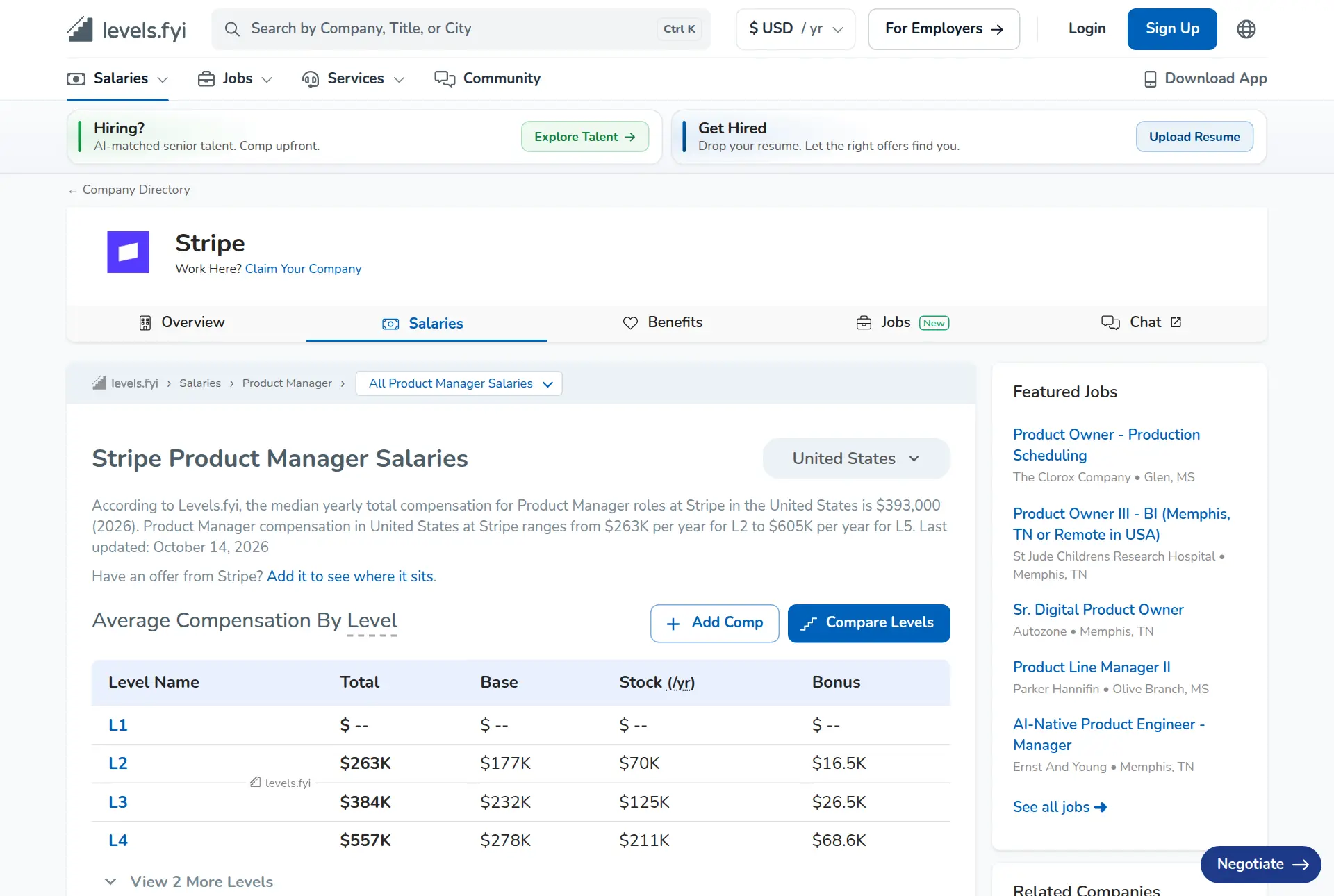
Rows of pay at that company: for every role its median total compensation and the average total of each level; for one role the average total, base, stock and bonus of each level and the role's pay distribution. A record has 23 fields. One we could not read is null, never an empty string or a zero.
{
  "company": "Stripe",
  "company_slug": "stripe",
  "role": "Product Manager",
  "role_slug": "product-manager",
  "level": "L2",
  "level_slug": "l2",
  "level_titles": [
    "L2"
  ],
  "country": "United States",
  "currency": "USD",
  "front_loaded_vesting": false,
  "submissions": 11,
  "average_total": 263112,
  "average_base": 176636,
  "average_stock": 70000,
  "average_bonus": 16475,
  "median_total": null,
  "total_percentiles": null,
  "base_percentiles": null,
  "stock_percentiles": null,
  "bonus_percentiles": null,
  "median_years_of_experience": 5,
  "url": "https://www.levels.fyi/companies/stripe/salaries/product-manager/levels/l2",
  "fetched_at": "2026-11-19T18:07:40.900839Z"
}
The scraper returned this record for the input above, reading a saved copy of the page, not the live site.
The fields of a record
companystring- The company's name, e.g.
Stripe. company_slugstring- The company's name in its Levels.fyi address, e.g.
stripe. rolestring- The role (Levels.fyi calls it a job family), e.g.
Software Engineer. role_slugstring- The role's name in its Levels.fyi address, e.g.
software-engineer. levelstring or null- The level this row is about, as the company names it, e.g.
L4. Null on the row for the role as a whole. level_slugstring or null- The level's name in its Levels.fyi address, e.g.
l4. Null on the row for the role as a whole. level_titleslist of strings- Every name the page gives the level, e.g.
L4,SWE III. Empty on the row for the role as a whole. countrystring or null- The country the figures are for, e.g.
United States: the one the page shows for the company by default. currencystring- The currency of every amount in this row, as a three-letter code: the one the page shows them in. A role's page shows the currency of the company's own country, e.g.
INR; a company's page of every role showsUSD. front_loaded_vestingboolean or null- True when the company's stock grants vest more in the first years than later. Levels.fyi then shows pay for the first year:
average_stockis the first year's stock andaverage_bonusincludes the sign-on bonus. False where it shows stock and bonus a year; null where the page's data does not say. submissionsinteger or null- The number of pay submissions the row's figures were computed from, where the page's data states it.
average_totalinteger or null- The average yearly total compensation: base, stock and bonus together. On a level's row, the level's average; on the row for a role as a whole, the role's average where the page gives one.
average_baseinteger or null- The average yearly base salary. Given when a role was asked for.
average_stockinteger or null- The average stock grant a year; the first year's where
front_loaded_vestingis true. Given when a role was asked for. average_bonusinteger or null- The average yearly bonus; with the sign-on bonus in it where
front_loaded_vestingis true. Given when a role was asked for. median_totalinteger or null- The median yearly total compensation. On the row for the role as a whole.
total_percentilesobject or null- The distribution of yearly total compensation for the role. On the row for the role as a whole, when a role was asked for.Holds
p10,p25,p50,p75,p90. base_percentilesobject or null- The distribution of yearly base salary for the role. On the same row.Holds
p10,p25,p50,p75,p90. stock_percentilesobject or null- The distribution of yearly stock grants for the role. On the same row.Holds
p10,p25,p50,p75,p90. bonus_percentilesobject or null- The distribution of yearly bonuses for the role. On the same row.Holds
p10,p25,p50,p75,p90. median_years_of_experiencenumber or null- The median years of experience of the people at this level, where the page's data states it.
urlstring- The Levels.fyi page the row can be seen on.
fetched_atdatetime- When the page was read, in UTC.
Units and limits
- Counted per request
- Billed per request: a run that returns data costs 1 unit, however many records it returns.
- A miss costs nothing
- A run that fails, that meets something not supported yet, or that you cancel costs nothing. You pay for runs that return data.
- What bounds a run
- A run may take up to 5 minutes. Its records are read in pages of up to 1,000 and are kept for 7 days.
What it does not do
- Every row is a figure Levels.fyi publishes for a company, a role or a level. The individual submissions the page lists are not read or returned.
- The figures are for the country the page shows for the company by default. For one role the amounts are in that country's currency; for every role of a company they are in US dollars. Each row names its currency.
- A company or a role Levels.fyi has no page for ends as failed, with the reason not_found, and costs nothing.
Questions
What does Levels.fyi salaries return?
Rows of pay at that company: for every role its median total compensation and the average total of each level; for one role the average total, base, stock and bonus of each level and the role's pay distribution. A record has 23 fields, among them company, company_slug, role, role_slug, level and level_slug. A value that could not be read is null, never an empty string or a zero.
What do I send?
A company, as its name in its Levels.fyi address or the address of its salaries page, and if you like a role. The input company is required. Optional: role.
How is it counted?
Billed per request: a run that returns data costs 1 unit, however many records it returns. A run that fails, that meets something not supported yet, or that you cancel costs nothing. The first 1,000 units each month are free.
What does it not do?
Every row is a figure Levels.fyi publishes for a company, a role or a level. The individual submissions the page lists are not read or returned. The figures are for the country the page shows for the company by default. For one role the amounts are in that country's currency; for every role of a company they are in US dollars. Each row names its currency. A company or a role Levels.fyi has no page for ends as failed, with the reason not_found, and costs nothing.
How long are the records kept, and in what format do they come?
Records are kept for 7 days after the run ended, and read in pages of up to 1,000. They come as JSON, as NDJSON with one record a line, or as CSV with a column for each field.
Can an AI assistant call it?
Yes. Through the EnrichedNow MCP server an assistant calls the tool run_scraper with the scraper_id levels.salaries and the same input. It costs what the same API call costs.
Used in this playbook
A playbook runs Levels.fyi salaries as one of its steps and hands back the finished list. Its runs of this scraper cost what they cost here, and the playbook adds nothing.
Recruiting
Salary Benchmark
The pay employers advertise for a job in each place, as yearly ranges per place, with every posting behind them.
Levels.fyi
What a company pays, by role and level, as Levels.fyi publishes it: averages and medians, never one person's entry.
- Industry
- Jobs and hiring
- Where
- Worldwide
- For
- Recruiters
Run it on an input of your own.
Create an account, make a key, and send the request above with your own input. The first 1,000 units each month are free.