Scraper API
Grants.gov
grantsgov.opportunityAvailable
US grant opportunity
The opportunity in full: description, department and agency, dates, award ceiling and floor, total funding, funding instruments and categories, and who may apply.
Give it Grants.gov's id of an opportunity, or its address.
1 unit a run, for runs that return data. Runs that fail cost nothing. How units work
- Counted
- 1 unit a run
- Inputs
- 1, 1 required
- Record
- 24 fields
- A run takes
- up to 5 minutes
- Records kept
- 7 days
- Measured
- its success, on the status page
POST/v1/scrapers/grantsgov.opportunity/runs
sent, and answered
a record of the run24 fields
ok1 unit a run
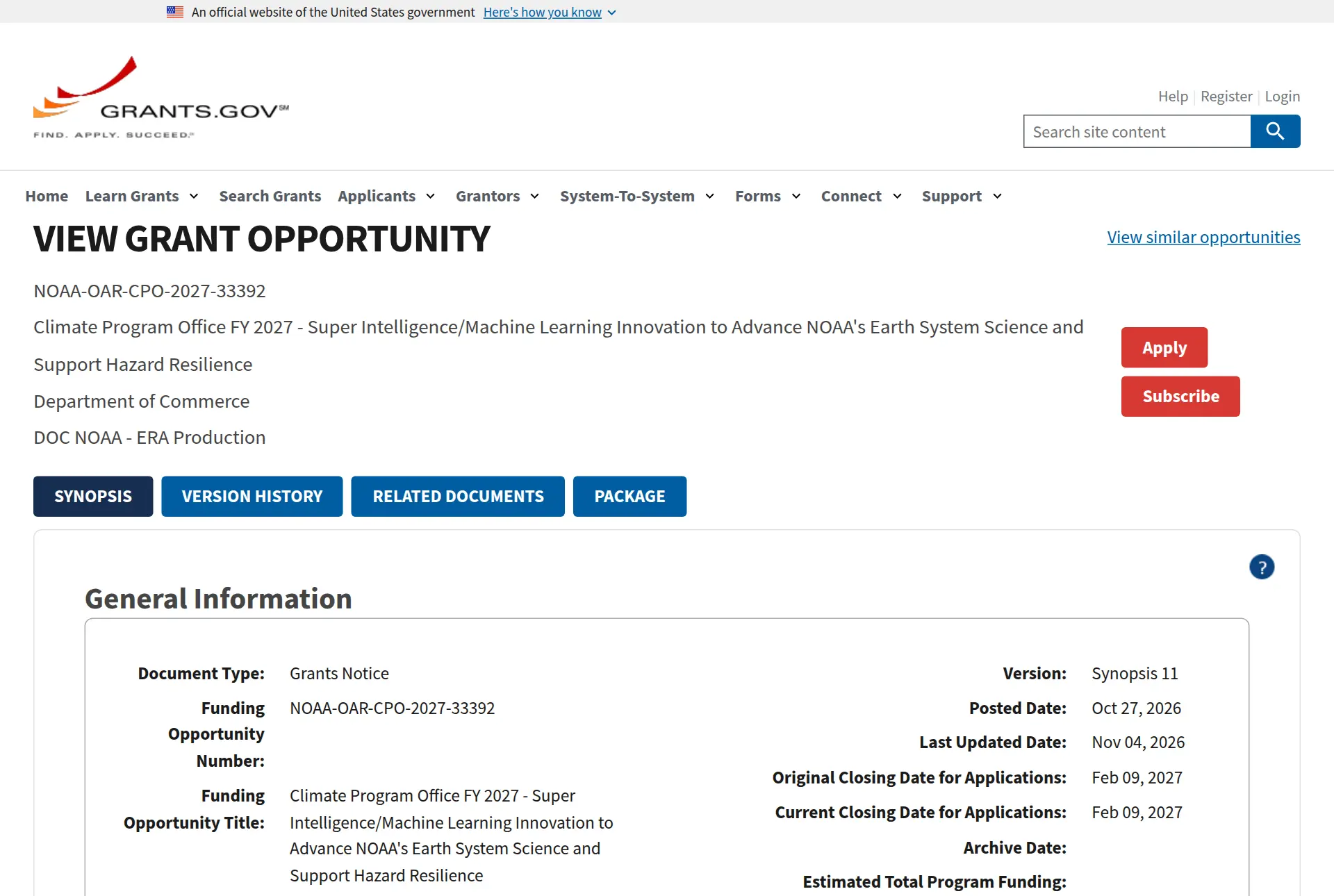
A record this scraper returned for this input. The first 9 of its 24 fields are set down here; the whole record is below.
What it is used for
- Qualify a grant
- Read
eligible_applicants,cost_sharingandeligibility_notesbefore you write a proposal. - Size the money
- Compare
award_ceiling,award_floorandestimated_fundingacross programmes. - Summarise for a team
- Feed the
descriptionandclose_dateinto a brief for whoever decides to apply.
What you send
Grants.gov's id of an opportunity, or its address. It is the one input.
opportunitystring Required- Grants.gov's id of the opportunity, as a search gives it, or its address on grants.gov.
A request, ready to send
It starts a run with the input shown at the top of this page, waits up to 60 seconds for it, and reads its records. Put your key in the variable it reads.
# Start a run and wait up to 60 seconds for it to finish
curl -X POST "https://api.enrichednow.com/v1/scrapers/grantsgov.opportunity/runs?wait=60" \
  -H "Authorization: Bearer $ENRICHEDNOW_API_KEY" \
  -H "Content-Type: application/json" \
  -d '{"input":{"opportunity":"364160"}}'

# Read its records, with the id the first call answered
curl "https://api.enrichednow.com/v1/runs/$RUN_ID/records?limit=100" \
  -H "Authorization: Bearer $ENRICHEDNOW_API_KEY"
from enrichednow import EnrichedNow
client = EnrichedNow() # reads ENRICHEDNOW_API_KEY
# Start a run, wait for it to end, and get its records
result = client.scrape("grantsgov.opportunity", {"opportunity": "364160"})
print(result.run.id, result.run.status, result.run.record_count)
# Read its records: pages are fetched as you go
for record in result.records:
print(record)Install it with pip install enrichednow, then save as run.py and run python3 run.py
import EnrichedNow from "enrichednow";

const client = new EnrichedNow(); // reads ENRICHEDNOW_API_KEY

// Start a run, wait for it to end, and get its records
const { run, records } = await client.scrape("grantsgov.opportunity", { opportunity: "364160" });
console.log(run.id, run.status, run.record_count);

// Read its records: pages are fetched as you go
for await (const record of records) console.log(record);
Install it with npm install enrichednow, then save as run.mjs and run node run.mjs
package main

import (
	"context"
	"fmt"
	"log"
	"time"

	enrichednow "github.com/enrichednow/enrichednow-go"
)

func main() {
	client, err := enrichednow.NewClient() // reads ENRICHEDNOW_API_KEY
	if err != nil {
		log.Fatal(err)
	}
	ctx, cancel := context.WithTimeout(context.Background(), 10*time.Minute)
	defer cancel()

	// Start a run, wait for it to end, and get its records
	run, records, err := client.Scrape(ctx, "grantsgov.opportunity", map[string]any{"opportunity": "364160"})
	if err != nil {
		log.Fatal(err)
	}
	fmt.Println(run.ID, run.Status, run.RecordCount)

	// Read its records: pages are fetched as you go
	for records.Next() {
		fmt.Println(string(records.Current()))
	}
	if err := records.Err(); err != nil {
		log.Fatal(err)
	}
}
Install it with go get github.com/enrichednow/enrichednow-go@latest, then save as run.go and run go run run.go
import com.enrichednow.EnrichedNowClient;
import com.enrichednow.ScrapeResult;
import java.util.Map;

public class Run {
    public static void main(String[] args) {
        EnrichedNowClient client = EnrichedNowClient.fromEnv(); // reads ENRICHEDNOW_API_KEY

        // Start a run, wait for it to end, and get its records
        ScrapeResult result = client.scrape("grantsgov.opportunity", Map.of("opportunity", "364160"));
        System.out.println(result.run().id() + " " + result.run().status() + " " + result.run().recordCount());

        // Read its records: pages are fetched as you go
        for (Map<String, Object> record : result.records()) {
            System.out.println(record);
        }
    }
}
Add com.enrichednow:enrichednow-java:0.4.0 to your Maven or Gradle build, then save as Run.java
enrichednow run grantsgov.opportunity --input-json '{"opportunity":"364160"}'Install it with curl -fsSL https://raw.githubusercontent.com/enrichednow/enrichednow-cli/main/install.sh | sh
What comes back
The opportunity in full: description, department and agency, dates, award ceiling and floor, total funding, funding instruments and categories, and who may apply. A record has 24 fields. One we could not read is null, never an empty string or a zero.
{
  "opportunity_id": "364160",
  "number": "NOAA-OAR-CPO-2027-33392",
  "url": "https://www.grants.gov/search-results-detail/364160",
  "title": "Climate Program Office FY 2027 - Super Intelligence/Machine Learning Innovation to Advance NOAA's Earth System Science and Support Hazard Resilience",
  "department": "Department of Commerce",
  "agency": "DOC NOAA - ERA Production",
  "agency_code": "DOC-DOCNOAAERA",
  "status": "posted",
  "category": "Discretionary",
  "description": "Through this Notice of Federal Funding Opportunity, the NOAA Climate Program Office ( https://cpo.noaa.gov/funding-opportunities/ ) is soliciting proposals for a FY 2027 grants competition focused on Super Intelligence/Machine Learning … [truncated]",
  "posted_date": "2026-10-27",
  "close_date": "2027-02-09",
  "updated_date": "2026-11-05",
  "award_ceiling": 750000,
  "award_floor": 1,
  "estimated_funding": null,
  "expected_awards": null,
  "cost_sharing": null,
  "funding_instruments": [
    "Grant"
  ],
  "funding_categories": [
    "Natural Resources",
    "Science and Technology and other Research and Development"
  ],
  "eligible_applicants": [
    "Others (see text field entitled \"Additional Information on Eligibility\" for clarification)"
  ],
  "eligibility_notes": "Eligible applicants are: Institutions of higher education; Other nonprofits; Commercial organizations; Local and federally recognized Tribal governments; Federal agencies that possess the statutory authority to receive transfers of funds. … [truncated]",
  "assistance_listings": [
    "11.431"
  ],
  "fetched_at": "2026-11-23T23:15:34.525920Z"
}
The scraper returned this record for the input above, reading a saved copy of the page, not the live site.
Values shortened for this page: description: 2,294 characters, the first 235 shown; eligibility_notes: 977 characters, the first 238 shown.
The fields of a record
opportunity_idstring- Grants.gov's id.
numberstring or null- The funding opportunity number.
urlstring- The opportunity's page on grants.gov.
titlestring or null- The opportunity's title.
departmentstring or null- The department.
agencystring or null- The agency within it.
agency_codestring or null- The agency's code.
statusstring or nullforecasted,posted,closedorarchived.categorystring or null- The opportunity's category, e.g.
Discretionary. descriptionstring or null- The description, as text, without contact details.
posted_datestring or null- The day it was posted,
YYYY-MM-DD. close_datestring or null- The day applications close,
YYYY-MM-DD. updated_datestring or null- The day it last changed,
YYYY-MM-DD. award_ceilingnumber or null- The largest award, in US dollars.
award_floornumber or null- The smallest award, in US dollars.
estimated_fundingnumber or null- The total the programme expects to award, in US dollars.
expected_awardsinteger or null- How many awards it expects to make.
cost_sharingboolean or null- Whether applicants must share the cost.
funding_instrumentslist of strings- How it pays, e.g.
Grant,Cooperative Agreement. funding_categorieslist of strings- The activities it funds.
eligible_applicantslist of strings- Who may apply.
eligibility_notesstring or null- More on who may apply, as text, without contact details.
assistance_listingslist of strings- Its assistance listing numbers (CFDA).
fetched_atdatetime- When Grants.gov was asked, in UTC.
Units and limits
- Counted per request
- Billed per request: a run that returns data costs 1 unit, however many records it returns.
- A miss costs nothing
- A run that fails, that meets something not supported yet, or that you cancel costs nothing. You pay for runs that return data.
- What bounds a run
- A run may take up to 5 minutes. Its records are read in pages of up to 1,000 and are kept for 7 days.
What it does not do
- Contact people are not returned, and an e-mail address or telephone number in the description is cut.
- An id Grants.gov does not have ends as failed with the reason not_found, and costs nothing.
Questions
What does US grant opportunity return?
The opportunity in full: description, department and agency, dates, award ceiling and floor, total funding, funding instruments and categories, and who may apply. A record has 24 fields, among them opportunity_id, number, url, title, department and agency. A value that could not be read is null, never an empty string or a zero.
What do I send?
Grants.gov's id of an opportunity, or its address. The input opportunity is required.
How is it counted?
Billed per request: a run that returns data costs 1 unit, however many records it returns. A run that fails, that meets something not supported yet, or that you cancel costs nothing. The first 1,000 units each month are free.
What does it not do?
Contact people are not returned, and an e-mail address or telephone number in the description is cut. An id Grants.gov does not have ends as failed with the reason not_found, and costs nothing.
How long are the records kept, and in what format do they come?
Records are kept for 7 days after the run ended, and read in pages of up to 1,000. They come as JSON, as NDJSON with one record a line, or as CSV with a column for each field.
Can an AI assistant call it?
Yes. Through the EnrichedNow MCP server an assistant calls the tool run_scraper with the scraper_id grantsgov.opportunity and the same input. It costs what the same API call costs.
Used in these playbooks
A playbook runs US grant opportunity as one of its steps and hands back the finished list. Its runs of this scraper cost what they cost here, and the playbook adds nothing.
Public sector
Tender Alerts
New public tenders that match your words and codes, from the EU, UK and US, with buyer, deadline, value and link.
Public sector
Tender Change Watch
The tenders, grants and awards you watch, read again each run, with a row only when a deadline, status or value changed.
Grants.gov
US federal grant opportunities from Grants.gov: searches by words, status and agency, and one opportunity with its funding and who may apply.
US grant opportunities
grantsgov.searchWords, statuses or an agency. Funding opportunities: number, title, agency, status, open and close dates and assistance listings.
- Industry
- Government and public records
- Where
- United States
Run it on an input of your own.
Create an account, make a key, and send the request above with your own input. The first 1,000 units each month are free.