Scraper API
GLEIF
gleif.leiAvailable
LEI record
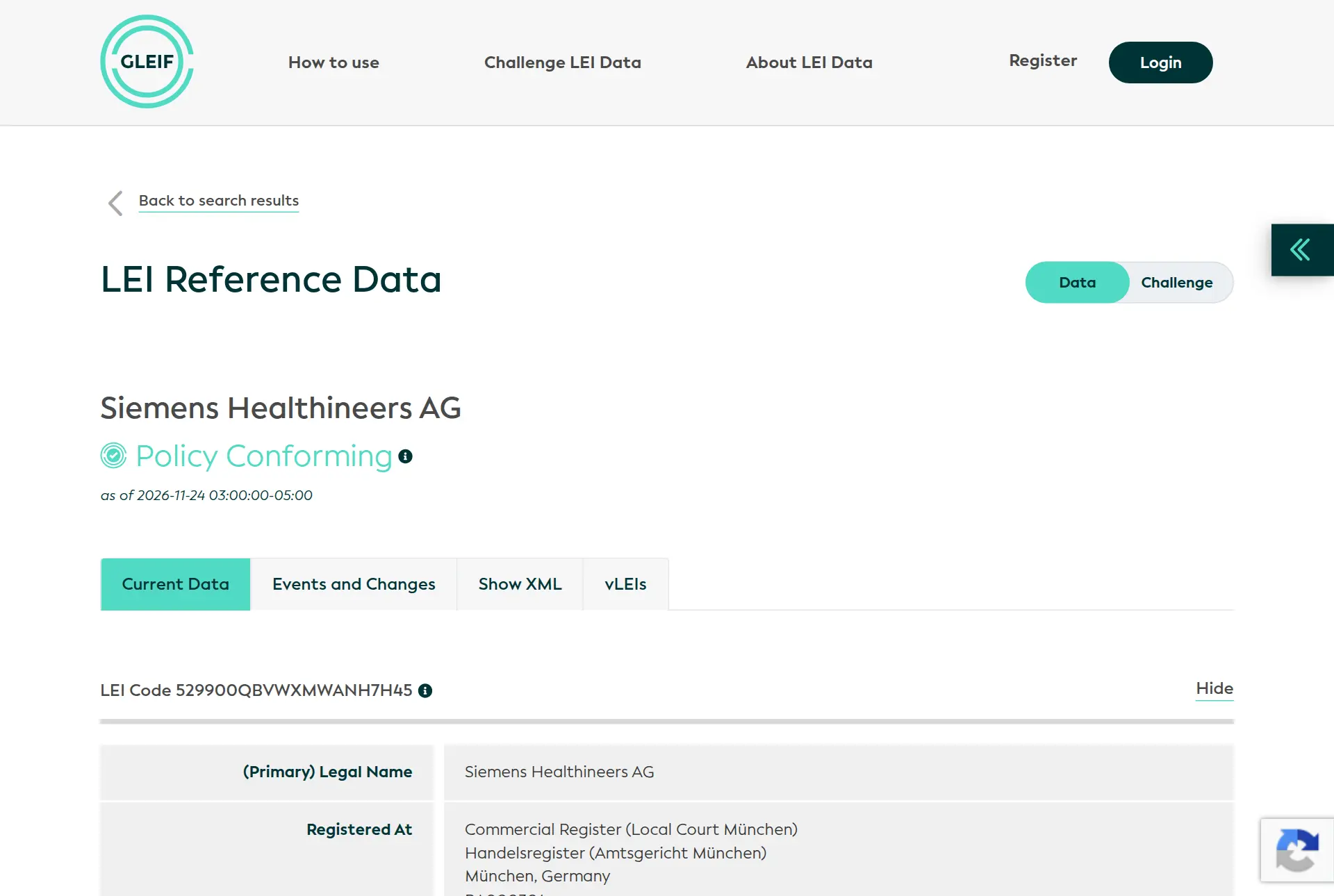
The entity: legal name and other names, legal form, legal and headquarters addresses, the register it is filed in with its number there, the state of the LEI and its renewal date, BICs, its OpenCorporates id, and its parent and ultimate parent.
Give it a Legal Entity Identifier (LEI), or the address of its record on GLEIF's search.
1 unit a run, for runs that return data. Runs that fail cost nothing. How units work
- Counted
- 1 unit a run
- Inputs
- 2, 1 required
- Record
- 30 fields
- A run takes
- up to 5 minutes
- Records kept
- 7 days
- Measured
- its success, on the status page
POST/v1/scrapers/gleif.lei/runs
sent, and answered
a record of the run30 fields
ok1 unit a run
A record this scraper returned for this input. The first 9 of its 30 fields are set down here; the whole record is below.
What it is used for
- Join a company across registers
- Read
registration_authority_idandregistry_numberbeside the LEI. They tie the entity to its record in its national register, andopencorporates_idto OpenCorporates. - Map a corporate family
- Follow
parent_leiandultimate_parent_leiup to the group. Each parent is an LEI you can read the same way. - Keep counterparty data current
- Watch
registration_statusandnext_renewal_datefor the LEIs you trade with. A lapsed LEI is a reporting problem you can see coming.
What you send
A Legal Entity Identifier (LEI), or the address of its record on GLEIF's search. These are its 2 inputs, as its schema has them.
leistring Required- The entity's LEI, 20 letters and digits, checked by its check digits. gleif.search finds it by name, register number, ISIN or BIC.
parentsboolean Optional- true, the default, reads its parent and its ultimate parent too; false reads the entity alone.Default
true
A request, ready to send
It starts a run with the input shown at the top of this page, waits up to 60 seconds for it, and reads its records. Put your key in the variable it reads.
# Start a run and wait up to 60 seconds for it to finish
curl -X POST "https://api.enrichednow.com/v1/scrapers/gleif.lei/runs?wait=60" \
  -H "Authorization: Bearer $ENRICHEDNOW_API_KEY" \
  -H "Content-Type: application/json" \
  -d '{"input":{"lei":"529900QBVWXMWANH7H45"}}'

# Read its records, with the id the first call answered
curl "https://api.enrichednow.com/v1/runs/$RUN_ID/records?limit=100" \
  -H "Authorization: Bearer $ENRICHEDNOW_API_KEY"
from enrichednow import EnrichedNow
client = EnrichedNow() # reads ENRICHEDNOW_API_KEY
# Start a run, wait for it to end, and get its records
result = client.scrape("gleif.lei", {"lei": "529900QBVWXMWANH7H45"})
print(result.run.id, result.run.status, result.run.record_count)
# Read its records: pages are fetched as you go
for record in result.records:
print(record)Install it with pip install enrichednow, then save as run.py and run python3 run.py
import EnrichedNow from "enrichednow";

const client = new EnrichedNow(); // reads ENRICHEDNOW_API_KEY

// Start a run, wait for it to end, and get its records
const { run, records } = await client.scrape("gleif.lei", { lei: "529900QBVWXMWANH7H45" });
console.log(run.id, run.status, run.record_count);

// Read its records: pages are fetched as you go
for await (const record of records) console.log(record);
Install it with npm install enrichednow, then save as run.mjs and run node run.mjs
package main

import (
	"context"
	"fmt"
	"log"
	"time"

	enrichednow "github.com/enrichednow/enrichednow-go"
)

func main() {
	client, err := enrichednow.NewClient() // reads ENRICHEDNOW_API_KEY
	if err != nil {
		log.Fatal(err)
	}
	ctx, cancel := context.WithTimeout(context.Background(), 10*time.Minute)
	defer cancel()

	// Start a run, wait for it to end, and get its records
	run, records, err := client.Scrape(ctx, "gleif.lei", map[string]any{"lei": "529900QBVWXMWANH7H45"})
	if err != nil {
		log.Fatal(err)
	}
	fmt.Println(run.ID, run.Status, run.RecordCount)

	// Read its records: pages are fetched as you go
	for records.Next() {
		fmt.Println(string(records.Current()))
	}
	if err := records.Err(); err != nil {
		log.Fatal(err)
	}
}
Install it with go get github.com/enrichednow/enrichednow-go@latest, then save as run.go and run go run run.go
import com.enrichednow.EnrichedNowClient;
import com.enrichednow.ScrapeResult;
import java.util.Map;

public class Run {
    public static void main(String[] args) {
        EnrichedNowClient client = EnrichedNowClient.fromEnv(); // reads ENRICHEDNOW_API_KEY

        // Start a run, wait for it to end, and get its records
        ScrapeResult result = client.scrape("gleif.lei", Map.of("lei", "529900QBVWXMWANH7H45"));
        System.out.println(result.run().id() + " " + result.run().status() + " " + result.run().recordCount());

        // Read its records: pages are fetched as you go
        for (Map<String, Object> record : result.records()) {
            System.out.println(record);
        }
    }
}
Add com.enrichednow:enrichednow-java:0.4.0 to your Maven or Gradle build, then save as Run.java
enrichednow run gleif.lei --input lei=529900QBVWXMWANH7H45Install it with curl -fsSL https://raw.githubusercontent.com/enrichednow/enrichednow-cli/main/install.sh | sh
What comes back
The entity: legal name and other names, legal form, legal and headquarters addresses, the register it is filed in with its number there, the state of the LEI and its renewal date, BICs, its OpenCorporates id, and its parent and ultimate parent. A record has 30 fields. One we could not read is null, never an empty string or a zero.
{
  "lei": "529900QBVWXMWANH7H45",
  "url": "https://search.gleif.org/#/record/529900QBVWXMWANH7H45",
  "legal_name": "Siemens Healthineers AG",
  "other_names": [],
  "legal_form_code": "6QQB",
  "category": "GENERAL",
  "status": "ACTIVE",
  "jurisdiction": "DE",
  "legal_address": {
    "lines": [],
    "city": "München",
    "region": "DE-BY",
    "postal_code": "80331",
    "country": "DE"
  },
  "headquarters_address": {
    "lines": [
      "Siemensstr. 3"
    ],
    "city": "Forchheim",
    "region": "DE-BY",
    "postal_code": "91301",
    "country": "DE"
  },
  "registration_authority_id": "RA000304",
  "registry_number": "HRB 237558",
  "registration_status": "ISSUED",
  "corroboration_level": "FULLY_CORROBORATED",
  "created_date": "2017-12-11",
  "initial_registration_date": "2018-02-13",
  "last_update_date": "2026-01-16",
  "next_renewal_date": "2027-03-05",
  "managing_lou": "5299000J2N45DDNE4Y28",
  "successor_lei": null,
  "bics": [
    "SIHCDE8EXXX"
  ],
  "opencorporates_id": null,
  "fetched_at": "2026-11-24T22:35:23.592444Z",
  "legal_form": "Aktiengesellschaft",
  "registration_authority": "Commercial Register (Local Court München)",
  "registration_authority_website": "www.handelsregister.de",
  "parent_lei": "W38RGI023J3WT1HWRP32",
  "parent_name": "Siemens Aktiengesellschaft",
  "ultimate_parent_lei": "W38RGI023J3WT1HWRP32",
  "ultimate_parent_name": "Siemens Aktiengesellschaft"
}
The scraper returned this record for the input above, reading a saved copy of the page, not the live site.
The fields of a record
leistring- The entity's Legal Entity Identifier, 20 characters, e.g.
529900QBVWXMWANH7H45. urlstring- The entity's record on GLEIF's search.
legal_namestring- The entity's legal name, as filed.
other_nameslist of strings- Its other names: trading, previous and transliterated names.
legal_form_codestring or null- Its legal form, as an ISO 20275 code (ELF), e.g.
6QQB; or the form in words where it has no code. categorystring or null- GLEIF's category of the entity, e.g.
GENERAL,BRANCH,FUND. statusstring or null- Whether the entity exists:
ACTIVEorINACTIVE. jurisdictionstring or null- The jurisdiction it is formed under, e.g.
DEorUS-DE. legal_addressobject or null- Its legal address.Holds
lines,city,region,postal_code,country. headquarters_addressobject or null- The address of its headquarters.Holds
lines,city,region,postal_code,country. registration_authority_idstring or null- The register it is filed in, as GLEIF's code of registration authorities, e.g.
RA000304. registry_numberstring or null- Its number in that register, e.g.
HRB 237558. registration_statusstring or null- The state of the LEI itself, e.g.
ISSUED,LAPSED,RETIRED. corroboration_levelstring or null- How far the issuer checked the data, e.g.
FULLY_CORROBORATED. created_datestring or null- The day the entity was formed,
YYYY-MM-DD, where filed. initial_registration_datestring or null- The day the LEI was issued,
YYYY-MM-DD. last_update_datestring or null- The day the record last changed,
YYYY-MM-DD. next_renewal_datestring or null- The day the LEI is due for renewal,
YYYY-MM-DD. managing_loustring or null- The LEI of the issuer that manages the record.
successor_leistring or null- The LEI of the entity that succeeded it, for one that merged or was absorbed.
bicslist of strings- The SWIFT BICs mapped to the entity.
opencorporates_idstring or null- The entity's id on OpenCorporates, as GLEIF maps it, e.g.
us_de/4348344. fetched_atdatetime- When GLEIF was asked, in UTC.
legal_formstring or null- The name of its legal form, e.g.
Aktiengesellschaft. registration_authoritystring or null- The name of the register, and of the body that keeps it, e.g.
Commercial Register (Local Court München). registration_authority_websitestring or null- The register's website, as GLEIF lists it.
parent_leistring or null- The LEI of its parent, the entity that consolidates it first, where one is reported.
parent_namestring or null- That parent's legal name.
ultimate_parent_leistring or null- The LEI of its ultimate parent, where one is reported.
ultimate_parent_namestring or null- That parent's legal name.
Units and limits
- Counted per request
- Billed per request: a run that returns data costs 1 unit, however many records it returns.
- A miss costs nothing
- A run that fails, that meets something not supported yet, or that you cancel costs nothing. You pay for runs that return data.
- What bounds a run
- A run may take up to 5 minutes. Its records are read in pages of up to 1,000 and are kept for 7 days.
What it does not do
- A parent that is not reported, or that is a sole proprietor or a French group of people without legal personality, is null.
- A sole proprietor's LEI, filed by GLEIF as one or with a sole proprietorship's legal form, is a person's, and ends as failed with the reason sole_trader; so does a French group of people without legal personality (an indivision, a de facto company, an undisclosed partnership). An address line in someone's care is left out.
- The data are what each LEI's issuer filed and checked; corroboration_level says how far.
Questions
What does LEI record return?
The entity: legal name and other names, legal form, legal and headquarters addresses, the register it is filed in with its number there, the state of the LEI and its renewal date, BICs, its OpenCorporates id, and its parent and ultimate parent. A record has 30 fields, among them lei, url, legal_name, other_names, legal_form_code and category. A value that could not be read is null, never an empty string or a zero.
What do I send?
A Legal Entity Identifier (LEI), or the address of its record on GLEIF's search. The input lei is required. Optional: parents.
How is it counted?
Billed per request: a run that returns data costs 1 unit, however many records it returns. A run that fails, that meets something not supported yet, or that you cancel costs nothing. The first 1,000 units each month are free.
What does it not do?
A parent that is not reported, or that is a sole proprietor or a French group of people without legal personality, is null. A sole proprietor's LEI, filed by GLEIF as one or with a sole proprietorship's legal form, is a person's, and ends as failed with the reason sole_trader; so does a French group of people without legal personality (an indivision, a de facto company, an undisclosed partnership). An address line in someone's care is left out. The data are what each LEI's issuer filed and checked; corroboration_level says how far.
How long are the records kept, and in what format do they come?
Records are kept for 7 days after the run ended, and read in pages of up to 1,000. They come as JSON, as NDJSON with one record a line, or as CSV with a column for each field.
Can an AI assistant call it?
Yes. Through the EnrichedNow MCP server an assistant calls the tool run_scraper with the scraper_id gleif.lei and the same input. It costs what the same API call costs.
GLEIF
Legal entities from the Global LEI Index: the LEI, the register a company is filed in and its number there, BICs and parents, by name, register number, ISIN or BIC.
LEI search
gleif.searchWords of a name, a company's national register number, an ISIN or a BIC, and optionally a country. Legal entities with an LEI: legal name, legal form code, addresses, the register they are filed in and their number there, status, BICs and the state of the LEI.
- Industry
- Companies and B2B
- Where
- Worldwide
Run it on an input of your own.
Create an account, make a key, and send the request above with your own input. The first 1,000 units each month are free.